Hindenburg Research short report sends Icahn Enterprises spiraling down 19% again Wednesday
- Carl Icahn is being accused of running his company like a Ponzi scheme.
- Hindenburg Research released a short report on IEP late Tuesday.
- Icahn Enterprises lost about 20% on Tuesday.
- IEP stock is off 19% in the first hour of Wednesday trading.

Icahn Enterprises (IEP) stock is off 19% on Wednesday following short-seller shop Hindenburg Research's report released late Tuesday calling the company a ponzi-like structure. Hindenburg, which has made its bones loudly shorting India's Adani family of companies, Nikola (NKLA) and DraftKings (DKNG) in the past few years, is now taking it to one of Wall Street's most famous corporate raiders. Carl Icahn, for whom the holding company is named, is famously an activist investor in his own right, and so the short report is pretty much the most entertaining thing to happen on Wall Street since Icahn himself bashed Bill Ackman publically in a televised argument on CNBC back in 2013.
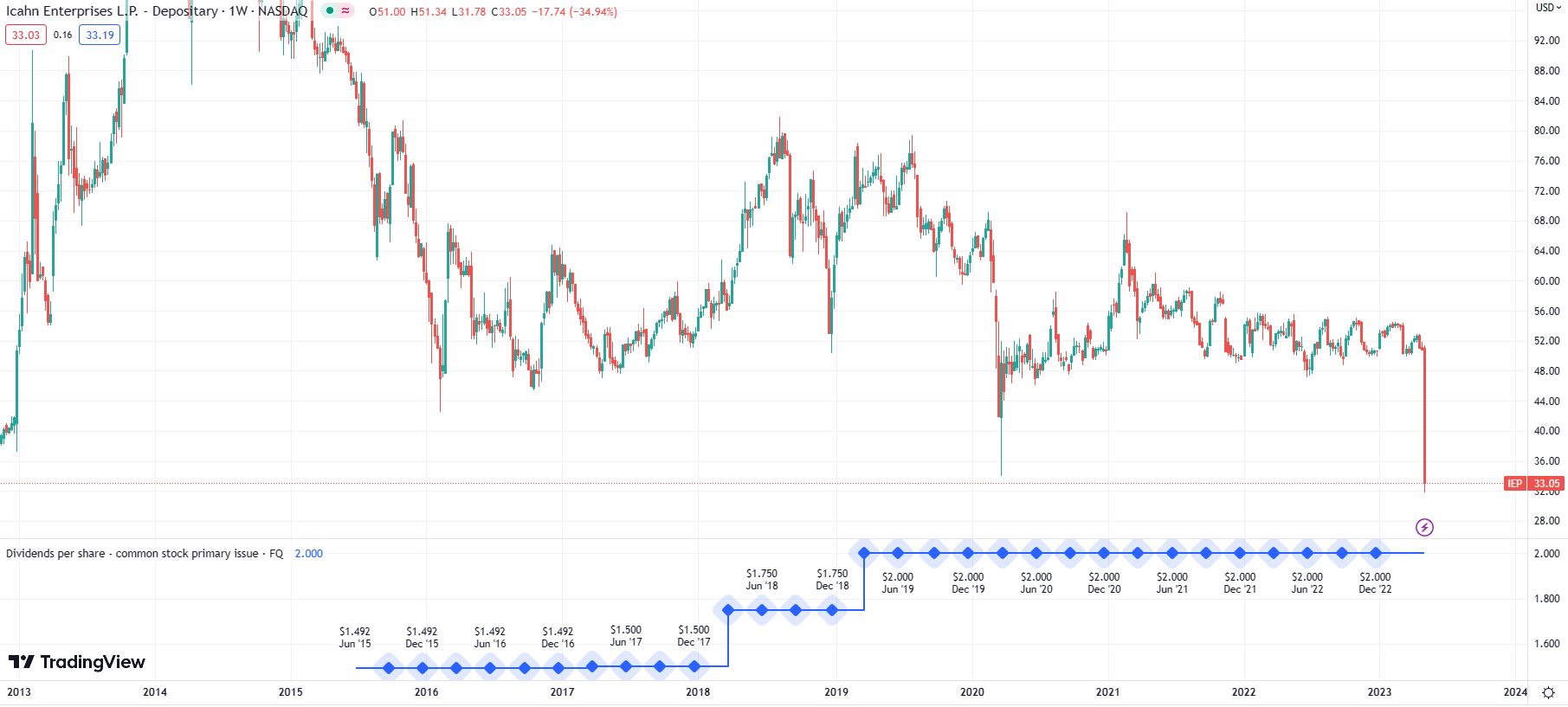
IEP stock is now trading at $32.71 a half hour or so into the Wednesday session. It closed down about 20% on Tuesday following the report's release late in the session. The stock closed at $50.41 on Monday.
Icahn Enterprises stock news: Hindenburg guns for famed corporate raider
Hindenburg's newest takedown is titled: "Icahn Enterprises: The Corporate Raider Throwing Stones From His Own Glass House". The report begins with an underhanded acknowledgement of Icahn's and Ackman's relationship, which goes back at least 20 years. Nathan Anderson's short shop writes that while IEP trades at a 218% premium to its net asset value, a closed-end holding company run by Bill Ackman trades at a 35% discount to NAV.
More significantly, Hindenburg alleges that Icahn Enterprises has been selling shares to new investors in normal at-the-market offerings to pay its steep dividend to long-time investors. IEP pays a wildly high, almost 16% dividend. Despite its porfolio dropping in value by 53% since 2014, Hindenburg writes, IEP has raised its dividend three times since then to its current annual outlay of $8 per share. Because Icahn Enterprises is cash-flow negative, Carl Icahn and his son Brett, who own about 85% of the stock, take their dividend in new shares rather than cash. Essentially, Hindenburg says this setup is "Ponzi-like" and cannot last.
Icahn Enterprises has raised $1.7 billion in new offerings like this since 2019, according to Hindenburg. It does this through investment bank Jefferies, which Hindenburg says furnishes Icahn Enterprises with positive client notes that give the impression that the dividend is sustainable.
"Adding to evidence of IEP’s unsustainability, we estimate that IEP’s last reported indicative year-end NAV of $5.6 billion is inflated by at least 22%, due to a combination of overly aggressive marks on IEP’s less liquid/private investments and continued year to date underperformance," writes Hindenburg. The report shows evidence of IEP marking up the valuations on companies well above their public market values. The company has also listed high valuations on subsidiaries or private corporate assets that later went bankrupt.
IEP stock forecast
The weekly chart below shows IEP stock's price action over the past decade or so. IEP stock is now below its lowest price during the great market sell-off of March 2020 that preceded the Covid-19 pandemic. It would be surprising if IEP can come back from this short report since it appears awfully believable. If IEP stock were to trade at 2022's reported NAV of $5.6 billion, which Hindenburg still believes is inflated, shares would go for $15.84 apiece.
Author

Clay Webster
FXStreet
Clay Webster grew up in the US outside Buffalo, New York and Lancaster, Pennsylvania. He began investing after college following the 2008 financial crisis.