Gold unable to break above key resistance level at $3,245 despite surging uncertainties
- Gold price rallies over 1% higher on Monday after Moody’s downgraded the US's sovereign debt credit rating on Friday, sending yields higher.
- Fed's Bostic comments saying ripple effects into US economy could be felt for this credit downgrade.
- Gold trades in a tight range, holding above $3,230 to start the week.

Gold (XAU/USD) edges higher, trading over 1% on Monday and hits $3,240 at the time of writing, while traders mull three main elements this Monday. Tensions are brewing in the Middle East with Israel embarking on another massive ground offensive. The military action comes just days after United States (US) President Donald Trump visited the Middle East, though he didn’t visit Israel.
The second main driver is the bond market, where several pension funds and Fixed Income (Bonds) investors will need to reshuffle their holdings after rating agency Moody’s downgraded the US's sovereign debt credit rating after the market closed on Friday. In lowering the US rating from 'AAA' to 'Aa1', Moody's noted that successive US administrations had failed to reverse ballooning deficits and interest costs, BBC reports. This could have repercussions for the Federal Reserve(Fed) and US yields, where non-US parties will ask for higher rates in search of more guarantees before considering buying US debt.
The very last driver this Monday is rather a headwind for the precious metal. US President Trump last week torpedoed peace talks in Istanbul by saying at Air Force One that no deal was possible without himself and Russian President Vladimir Putin involved. Both presidents will have a phone call on Monday to discuss the matter, and could provide headwinds for Gold if a breakthrough is materializing.
Daily digest market movers: Another three to six months of pricing in
- Federal Reserve Bank of Atlanta President Raphael Bostic has issues warnings on Monday that ripple effects could feed into the US economy on the back of this US downgrade. He suggested to wait another 3 to 6 months before uncertainty settle with tariff transition taking longer might hit consumer behavior, Bloomberg reports.
- A reclusive Chinese billionaire whose prescient Gold trades turned into an eye-catching windfall has now become the country’s biggest Copper bull, amassing a bet worth nearly $1 billion in a market jolted by escalating competition between the US and China, Bloomberg reports.
- Gold is sliding lower as traders respond to fresh uncertainty surrounding the US outlook after Moody’s lowered the nation’s sovereign credit rating. The increase in general angst levels may also be reviving concerns about the potential for lower US and global economic growth, given the drop in crude oil contracts, Bloomberg reports.
- “While we recognize the US’ significant economic and financial strengths, we believe these no longer fully counterbalance the decline in fiscal metrics,” Moody’s added in its statement, Reuters reports.
- The US 30-year yield rose to 5% on Monday after Moody’s rate cut, back to April’s levels.
Gold Price Technical Analysis: Additional buying needed for a break
Did Moody’s just put a band-aid on the wound for the US? Rather, Moody’s calling out is what several traders and analysts were predicting: the US is more quickly racking up debt than it is seeing income. At one point that needs to be addressed, and President Trump might be mad at Moody’s, there is a far greater concern: the domestic activity and economy with elevated rates and the Fed having its hands tied.
On the upside, the pivotal technical level at $3,245 (April 1 high) is acting as resistance and could be difficult to reclaim. Once through there, the R1 resistance at $3,252 and the R2 resistance at $3,301 are the following levels to watch, though a major catalyst would be needed to get it there.
On the other side, the daily Pivot Point stands at $3,203, in line with the $3,200 big figure. In case that level does not hold, expect a move lower to test the support area around $3,150, with the April 3 high at $3,167 and the intraday S1 support at $3,155, before the 55-day Simple Moving Average (SMA) at $3,151.
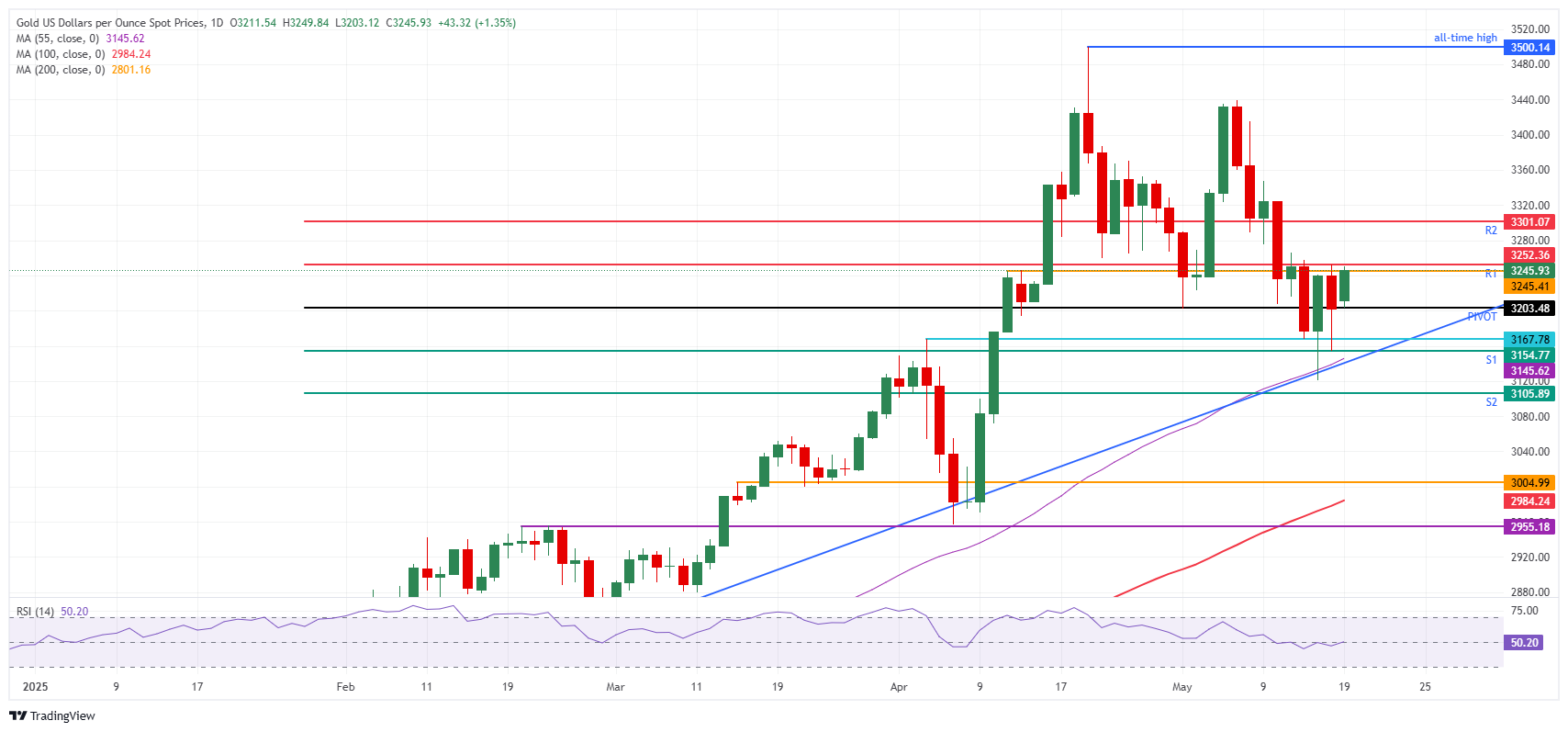
XAU/USD: Daily Chart
Banking crisis FAQs
The Banking Crisis of March 2023 occurred when three US-based banks with heavy exposure to the tech-sector and crypto suffered a spike in withdrawals that revealed severe weaknesses in their balance sheets, resulting in their insolvency. The most high profile of the banks was California-based Silicon Valley Bank (SVB) which experienced a surge in withdrawal requests due to a combination of customers fearing fallout from the FTX debacle, and substantially higher returns being offered elsewhere.
In order to fulfill the redemptions, Silicon Valley Bank had to sell its holdings of predominantly US Treasury bonds. Due to the rise in interest rates caused by the Federal Reserve’s rapid tightening measures, however, Treasury bonds had substantially fallen in value. The news that SVB had taken a $1.8B loss from the sale of its bonds triggered a panic and precipitated a full scale run on the bank that ended with the Federal Deposit Insurance Corporation (FDIC) having to take it over.The crisis spread to San-Francisco-based First Republic which ended up being rescued by a coordinated effort from a group of large US banks. On March 19, Credit Suisse in Switzerland fell foul after several years of poor performance and had to be taken over by UBS.
The Banking Crisis was negative for the US Dollar (USD) because it changed expectations about the future course of interest rates. Prior to the crisis investors had expected the Federal Reserve (Fed) to continue raising interest rates to combat persistently high inflation, however, once it became clear how much stress this was placing on the banking sector by devaluing bank holdings of US Treasury bonds, the expectation was the Fed would pause or even reverse its policy trajectory. Since higher interest rates are positive for the US Dollar, it fell as it discounted the possibility of a policy pivot.
The Banking Crisis was a bullish event for Gold. Firstly it benefited from demand due to its status as a safe-haven asset. Secondly, it led to investors expecting the Federal Reserve (Fed) to pause its aggressive rate-hiking policy, out of fear of the impact on the financial stability of the banking system – lower interest rate expectations reduced the opportunity cost of holding Gold. Thirdly, Gold, which is priced in US Dollars (XAU/USD), rose in value because the US Dollar weakened.
Author

Filip Lagaart
FXStreet
Filip Lagaart is a former sales/trader with over 15 years of financial markets expertise under its belt.