Gold tests $4,200 amid weak Dollar and yields ahead of US shutdown vote
- Gold surges above $4,200 as the US Dollar and Treasury yields retreat, extending recovery from October lows.
- Optimism grows as House prepares to vote on ending 43-day US government shutdown.
- Weak ADP and Challenger data signal labor market strain, reinforcing Fed rate cut expectations.

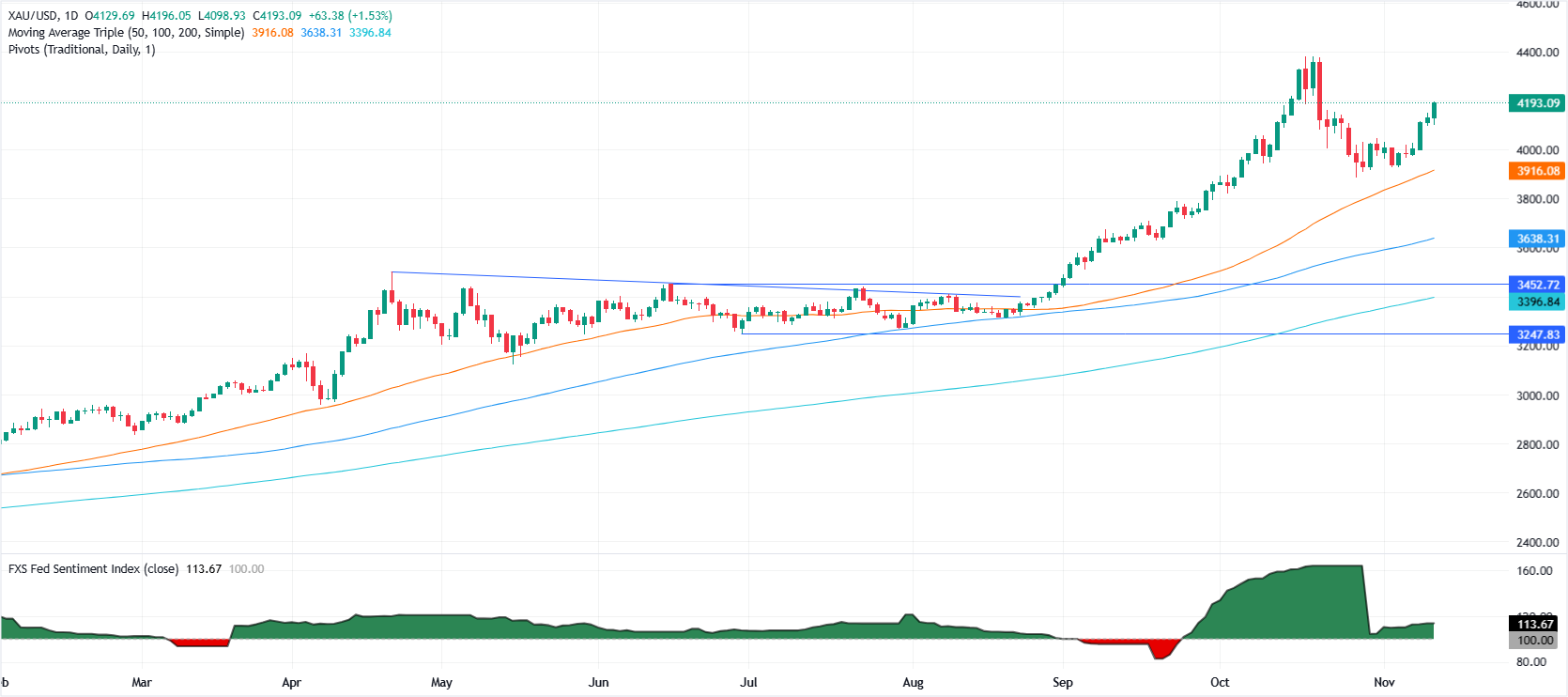
Gold (XAU/USD) rallies sharply past the $4,200 milestone on Wednesday, as US Treasury yields slip and the US Dollar gives back earlier gains. An improvement in risk appetite has not kept the yellow metal from recovering after falling to $3,886 late October, following a record high near $4,400. At the time of writing, XAU/USD gains close to 2%.
Bullion surges nearly 2% despite risk-on mood, fueled by weak US data and expectations of a government reopening
The yellow metal seems poised to extend its gains, even though US equity markets are rallying, contrary to what usually happens with Bullion prices. The high probability of a US government reopening after being shut for 43 days seems likely.
The US House of Representatives will vote at around 7:00 PM ET, revealed Steve Scalise, leader of the Republicans, to CNBC.
At the time of writing, the White House announced that once the government reopens, the October inflation report and Nonfarm Payrolls data might be skipped, according to Press Secretary Karoline Leavitt.
Hence, traders would remain leaning on the latest job reports, such as the ADP weekly employment change and the Challenger report. Both prints missed estimates in recent days, indicating that the labor market is deteriorating sharply.
Daily market movers: Falling US yields boost Gold prices
- The US Dollar Index (DXY), which tracks the performance of the American currency against other six, holds firm at around 99.49 up by a modest 0.04%.
- US Treasury yields are sliding, a tailwind for Gold prices. The 10-year US Treasury note is at 4.12% plummets five basis points. US real yields — which correlate inversely to Gold prices — plunge six bps to 1.768%.
- ADP revealed on Tuesday that private companies slashed an average of 11,250 jobs a week in the four weeks ending October 25.
- The firm Challenger, Gray & Christmas announced last week that US employers slashed 153,074 jobs in October, up from the 55,597 cuts announced in October 2024, the highest level for that month in two decades.
- Fed Governor Stephen Miran says that monetary policy is too restrictive. Atlanta’s Fed President Raphael Bostic was hawkish, saying that moving policy lower risks feeding the "inflation beast" and added that he does not see a “severe labor market downturn.” Worth noting that Bostic announced that he would retire from his position in February 2026.
- A Reuters survey revealed that 80% of 109 economists expect the Fed to cut rates by 25 basis points at the December meeting.
- Money markets now see a 63% probability of a quarter of a percentage cut at the Fed's meeting in December, according to CME Group's FedWatch tool.
Technical outlook: Gold rallies close to 2%, looms around $4,200
Gold’s uptrend remains intact, but due to the strong gain of nearly 3% on Monday, it suggests that XAU/USD might consolidate in the near term. A daily close above $4,200 could sponsor a leg up towards $4,250 ahead of $4,300.
Momentum as depicted by the Relative Strength Index (RSI) confirms that further upside lies ahead with the index aiming higher above its 50-neutral level.
Conversely, the first support is seen at the October 22 high at $4,161, followed by $4,100. A breach of the latter exposes the 20-day Simple Moving Average (SMA) at $4,080 ahead of testing the October 28 low near $3,886.
Gold FAQs
Gold has played a key role in human’s history as it has been widely used as a store of value and medium of exchange. Currently, apart from its shine and usage for jewelry, the precious metal is widely seen as a safe-haven asset, meaning that it is considered a good investment during turbulent times. Gold is also widely seen as a hedge against inflation and against depreciating currencies as it doesn’t rely on any specific issuer or government.
Central banks are the biggest Gold holders. In their aim to support their currencies in turbulent times, central banks tend to diversify their reserves and buy Gold to improve the perceived strength of the economy and the currency. High Gold reserves can be a source of trust for a country’s solvency. Central banks added 1,136 tonnes of Gold worth around $70 billion to their reserves in 2022, according to data from the World Gold Council. This is the highest yearly purchase since records began. Central banks from emerging economies such as China, India and Turkey are quickly increasing their Gold reserves.
Gold has an inverse correlation with the US Dollar and US Treasuries, which are both major reserve and safe-haven assets. When the Dollar depreciates, Gold tends to rise, enabling investors and central banks to diversify their assets in turbulent times. Gold is also inversely correlated with risk assets. A rally in the stock market tends to weaken Gold price, while sell-offs in riskier markets tend to favor the precious metal.
The price can move due to a wide range of factors. Geopolitical instability or fears of a deep recession can quickly make Gold price escalate due to its safe-haven status. As a yield-less asset, Gold tends to rise with lower interest rates, while higher cost of money usually weighs down on the yellow metal. Still, most moves depend on how the US Dollar (USD) behaves as the asset is priced in dollars (XAU/USD). A strong Dollar tends to keep the price of Gold controlled, whereas a weaker Dollar is likely to push Gold prices up.
Author

Christian Borjon Valencia
FXStreet
Markets analyst, news editor, and trading instructor with over 14 years of experience across FX, commodities, US equity indices, and global macro markets.