Gold tanks to $4,061 as blowout NFP and hawkish Fed spark mass exit from havens
- Gold falls 0.38% as strong NFP lift the US Dollar, reversing the earlier rally toward key resistance.
- Mixed jobs report shows 119K gains and higher unemployment, while Fed officials warn inflation remains elevated.
- Rate-cut odds edge up to 36%, but Fed minutes show many policymakers oppose easing in December.

Gold (XAU/USD) retreats on Thursday during the North American session following the release of the September US jobs report, which fared better than expected, crushing forecasts. At the time of writing, XAU/USD trades at $4,061, down 0.38%.
Bullion trims gains on upbeat US data, hawkish Fed commentary denting rate cut chances
The US Bureau of Labor Statistics (BLS) revealed Nonfarm Payrolls (NFP) for September and the Unemployment Rate. The data was mixed as the NFP figures doubled estimates of 50,000, but the latter rose from 4.3% to 4.4%, still within the Federal Reserve’s (Fed) projections.
On the data, Gold prices rallied to the daily high of $4,110, before making a U-turn on hawkish comments by Cleveland Fed President Beth Hammack and Fed Governor Michael Barr, who surprised by saying that he is worried that inflation is still at 3%.
Money markets show odds of a 25 basis points (bps) rate cut by the Fed at the December meeting lie at 39% up from 30% a day ago, according to CME FedWatch Tool data.
Expectations for a rate cut tumbled on Wednesday as October’s minutes of the last Federal Open Market Committee (FOMC) meeting revealed that “many participants” were leaning against reducing the fed funds rate at the December meeting.
Daily market movers: Gold retreats amid falling US Treasury yields
- September Nonfarm Payrolls rose by 119K, exceeding estimates of 50K, and up from August's -4K. The Unemployment Rate edged up from 4.3% to 4.4%, though it remained below the Federal Reserve’s projection of 4.5% for 2025.
- The Department of Labor also revealed Jobless Claims for the week ending November 15 came at 220K, its lowest level since September, an indication that the labor market, despite softening, remains stable.
- Regarding the future NFP report, the BLS canceled the release of October’s data and combined it with November’s print. The report will be featured on December 16, after the last Fed meeting of December 9-10.
- Cleveland Fed Beth Hammack said that easing monetary policy now could encourage financial risk-taking. “Cutting rates risks prolonging high inflation,” she stated, and added that “financial conditions are ‘quite accommodative’ right now.”
- Recently, Fed Governor Michael Barr said that he is concerned about inflation still at 3%, leaning hawkish.
- Fed’s October meeting minutes showed that policymakers lowered interest rates despite warning that the move could heighten the risk of inflation and undermine public confidence in the central bank.
- Morgan Stanley no longer expects a cut in December, following the jobs data.
- The US Dollar is virtually unchanged as depicted by the US Dollar Index (DXY). The DXY, which tracks the buck’s performance versus six currencies, remains steady at 100.15. Contrarily, US Treasury yields are diving, with the 10-year US Treasury note yield down 5 bps to 4.08%. US real yields, which correlate inversely to Gold prices, are also plummeting to 1.81% down five bps.
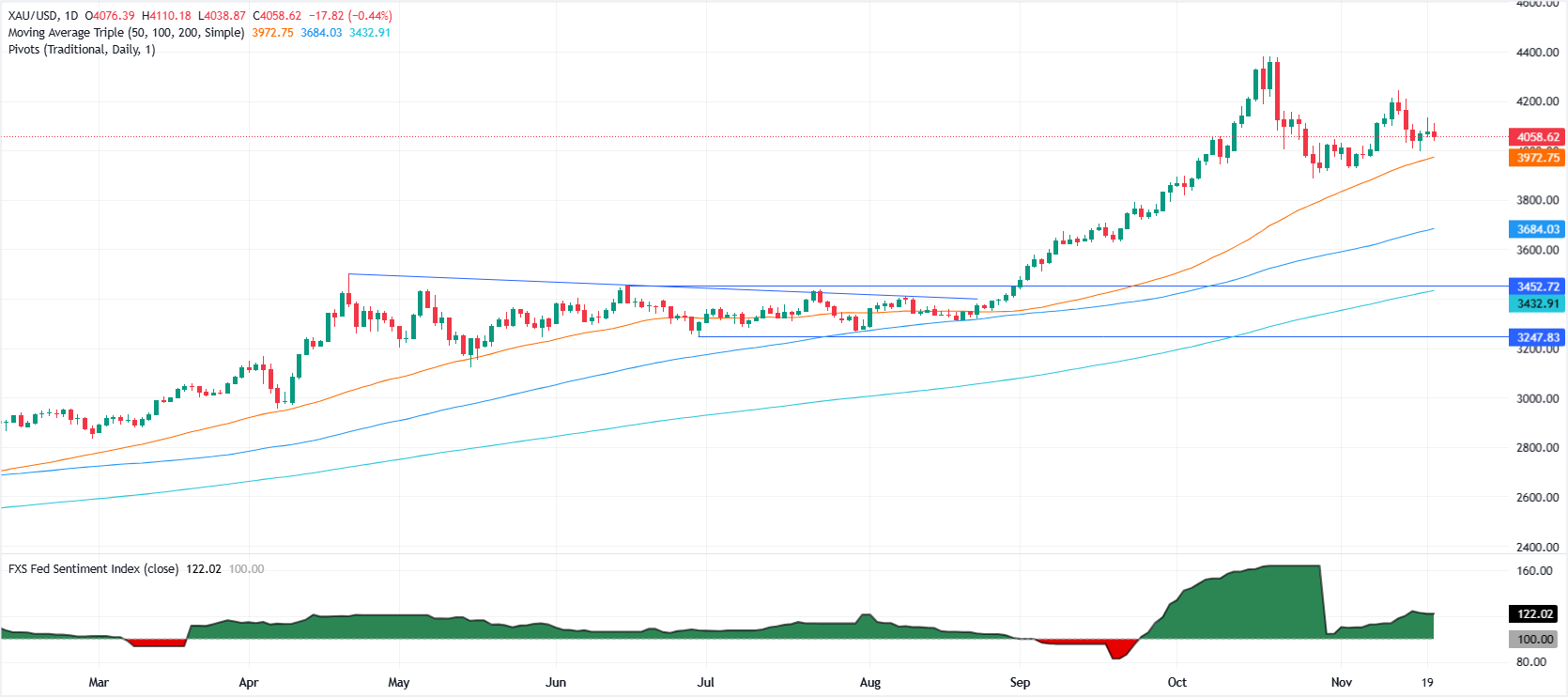
Technical analysis: Despite retreating, Gold is bullish above $4,000
Gold’s uptrend remains intact even though Fed officials turned hawkish, and the chances for a cut are slim. However, price action suggests that sellers could be in control once XAU/USD drops below the November 18 swing low of $3,998, ahead of testing the 50-day Simple Moving Average (SMA) at $3,954.
Still, the path of least resistance indicates that once Bullion crosses above $4,100, buying pressure could drive Gold towards $4,150 before testing the last cycle high of $4,245, November’s 13 peak.
Gold FAQs
Gold has played a key role in human’s history as it has been widely used as a store of value and medium of exchange. Currently, apart from its shine and usage for jewelry, the precious metal is widely seen as a safe-haven asset, meaning that it is considered a good investment during turbulent times. Gold is also widely seen as a hedge against inflation and against depreciating currencies as it doesn’t rely on any specific issuer or government.
Central banks are the biggest Gold holders. In their aim to support their currencies in turbulent times, central banks tend to diversify their reserves and buy Gold to improve the perceived strength of the economy and the currency. High Gold reserves can be a source of trust for a country’s solvency. Central banks added 1,136 tonnes of Gold worth around $70 billion to their reserves in 2022, according to data from the World Gold Council. This is the highest yearly purchase since records began. Central banks from emerging economies such as China, India and Turkey are quickly increasing their Gold reserves.
Gold has an inverse correlation with the US Dollar and US Treasuries, which are both major reserve and safe-haven assets. When the Dollar depreciates, Gold tends to rise, enabling investors and central banks to diversify their assets in turbulent times. Gold is also inversely correlated with risk assets. A rally in the stock market tends to weaken Gold price, while sell-offs in riskier markets tend to favor the precious metal.
The price can move due to a wide range of factors. Geopolitical instability or fears of a deep recession can quickly make Gold price escalate due to its safe-haven status. As a yield-less asset, Gold tends to rise with lower interest rates, while higher cost of money usually weighs down on the yellow metal. Still, most moves depend on how the US Dollar (USD) behaves as the asset is priced in dollars (XAU/USD). A strong Dollar tends to keep the price of Gold controlled, whereas a weaker Dollar is likely to push Gold prices up.
Author

Christian Borjon Valencia
FXStreet
Markets analyst, news editor, and trading instructor with over 14 years of experience across FX, commodities, US equity indices, and global macro markets.