Gold drifts lower as USD rebounds from two-week low ahead of US PPI
- Gold price attracts some intraday sellers amid a positive risk tone and a modest USD recovery.
- Rising Fed rate cut bets should keep a lid on the USD and support the non-yielding commodity.
- Traders now look forward to the release of the US PPI report to grab short-term opportunities.


Gold (XAU/USD) attracts some intraday selling near the $3,375 area and drops to a fresh daily low during the first half of the European session, snapping a two-day winning streak. The risk sentiment remains well supported by the recent optimism over an extension of the US-China trade truce for another three months and the US-Russia summit on Friday aimed at ending the war in Ukraine. This, in turn, acted as a headwind for the safe-haven precious metal.
Apart from this, a goodish US Dollar (USD) recovery from the lowest level in over two weeks exerted downward pressure on the Gold price and contributed to the latest leg down witnessed over the past hour or so. Any meaningful USD appreciation, however, seems elusive in the wake of firming expectations for the resumption of the Federal Reserve's (Fed) rate-cutting cycle in September. This, in turn, could limit the downside for the non-yielding precious metal.
Daily Digest Market Movers: Gold price is pressured by modest USD recovery, positive risk tone
- Asian stock markets, except Japan's Nikkei225, prolonged the recent bullish run, tracking the overnight record-setting rise in the US benchmark S&P 500 and the tech-heavy Nasdaq Composite Index for the second straight session.
- The US Dollar stages a modest recovery from a two-week low touched earlier this Thursday, though the upside potential seems limited amid rising bets for more interest rate cuts by the Federal Reserve than previously expected.
- According to the CME Group's FedWatch Tool, the US central bank is all but certain to lower borrowing costs by 25 basis points at the September policy meeting and is expected to deliver at least two rate cuts by the end of this year.
- The expectations were reaffirmed by Tuesday's mostly in-line US consumer inflation figures. Moreover, the July US Nonfarm Payrolls report pointed to signs of weakness in the labor market and backs the case for more easing.
- Meanwhile, US President Donald Trump escalated his pressure on Fed Chair Jerome Powell to cut interest rates. Furthermore, US Treasury Secretary Scott Bessent said that the Fed should think about a 50-bps rate cut next month.
- Chicago Fed President Austan Goolsbee said that he’s more concerned about last month’s rise in underlying inflation than an unusually weak jobs report, and he may not be inclined to support an interest rate cut in September.
- Separately, Atlanta Fed President Raphael Bostic acknowledged a general weakening in the latest round of labor data and noted that tariffs may cause structural changes, though he refrained from commenting on rate cuts.
- The US Treasury bond yields remain depressed as investors assess the likely impact of higher tariffs on the US economy and ahead of the US Producer Price Index, due for release later during the North American session.
Gold bullish technical setup backs the case for the emergence of dip-buying at lower levels
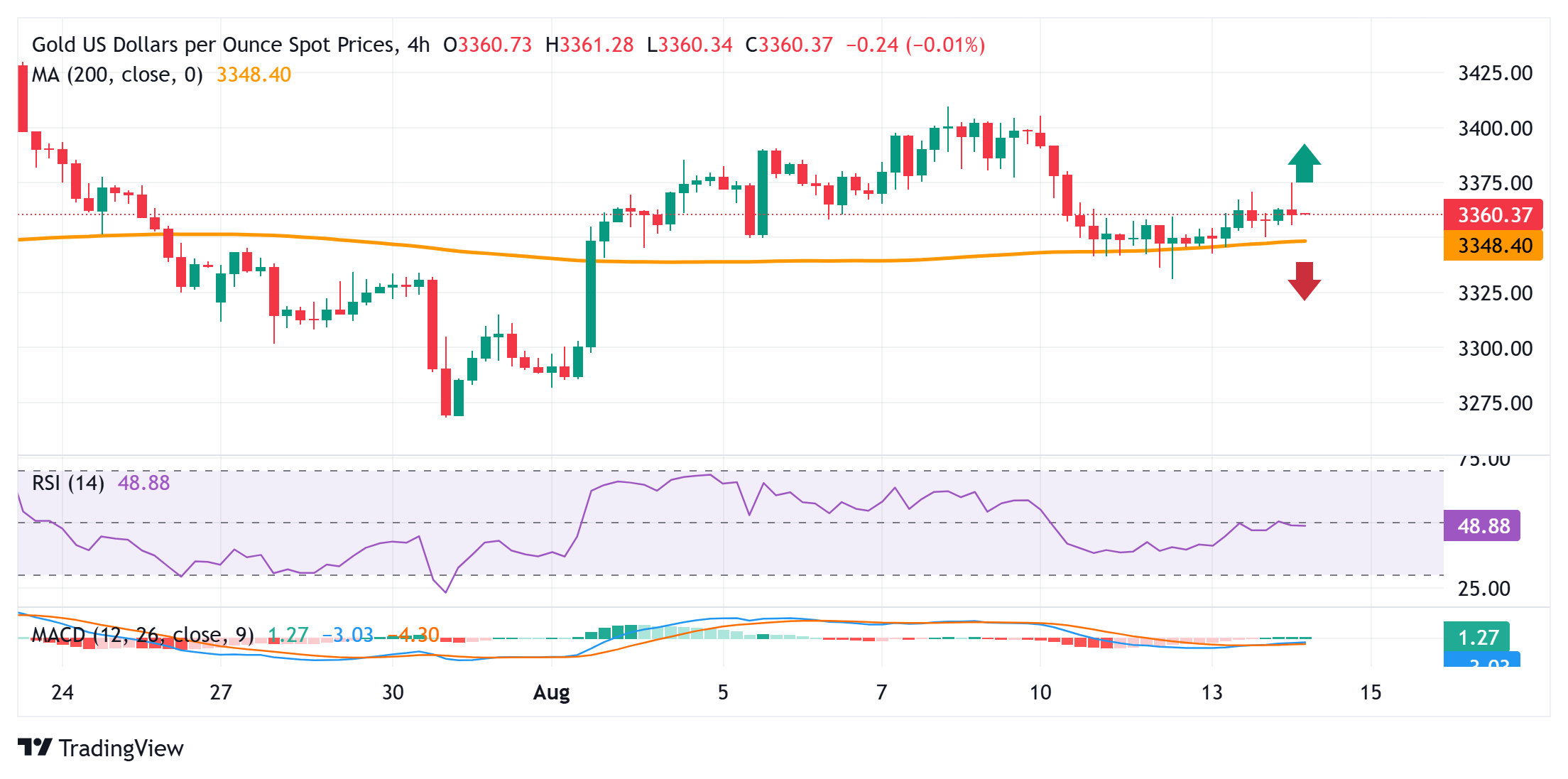
The overnight breakout through the $3,358-3,360 barrier comes on top of the resilience below the 200-period Simple Moving Average (SMA) on the 4-hour chart earlier this week and favors the XAU/USD bulls. That said, oscillators on hourly/daily charts have been struggling to gain positive traction, making it prudent to wait for some follow-through buying before positioning for further gains.
In the meantime, the Asian session peak, around the $3,375 area, could act as an immediate resistance, above which the Gold price could aim towards reclaiming the $3,400 round figure. This is closely followed by last week's swing high, around the $3,409-3,410 area, which, if cleared, should pave the way for a move towards the $3,422-3,423 intermediate resistance. The momentum could eventually lift the commodity beyond the $3,434-3,435 region, towards challenging the all-time peak, around the $3,500 psychological mark touched in April.
On the flip side, the weekly low, weakness below the $3,243-3,242 region (200-period SMA on H4) could find some support near the $3,331 area, or the weekly low. Some follow-through selling could make the Gold price vulnerable to accelerate the slide to the $3,300 round figure. A convincing break below the latter would shift the near-term bias in favor of bearish traders and set the stage for a further depreciating move.
US Dollar PRICE Today
The table below shows the percentage change of US Dollar (USD) against listed major currencies today. US Dollar was the strongest against the New Zealand Dollar.
| USD | EUR | GBP | JPY | CAD | AUD | NZD | CHF | |
|---|---|---|---|---|---|---|---|---|
| USD | 0.24% | 0.04% | -0.57% | 0.14% | 0.16% | 0.39% | 0.16% | |
| EUR | -0.24% | -0.17% | -0.79% | -0.11% | -0.08% | 0.14% | -0.09% | |
| GBP | -0.04% | 0.17% | -0.64% | 0.16% | 0.15% | 0.41% | 0.18% | |
| JPY | 0.57% | 0.79% | 0.64% | 0.72% | 0.72% | 0.85% | 0.68% | |
| CAD | -0.14% | 0.11% | -0.16% | -0.72% | 0.05% | 0.25% | 0.02% | |
| AUD | -0.16% | 0.08% | -0.15% | -0.72% | -0.05% | 0.26% | -0.07% | |
| NZD | -0.39% | -0.14% | -0.41% | -0.85% | -0.25% | -0.26% | -0.27% | |
| CHF | -0.16% | 0.09% | -0.18% | -0.68% | -0.02% | 0.07% | 0.27% |
The heat map shows percentage changes of major currencies against each other. The base currency is picked from the left column, while the quote currency is picked from the top row. For example, if you pick the US Dollar from the left column and move along the horizontal line to the Japanese Yen, the percentage change displayed in the box will represent USD (base)/JPY (quote).
Author
Haresh Menghani
FXStreet
Haresh Menghani is a detail-oriented professional with 10+ years of extensive experience in analysing the global financial markets.