Gold surges past $4,440 as Venezuela strikes fuel geopolitical bid
- Gold jumps over 2.6% as geopolitical risks overpower hawkish central banks.
- Geopolitical tensions after US strikes on Venezuela drive safe-haven flows into Gold despite firm yields.
- Rising Japanese yields and potential BoJ hikes raise carry-trade unwind risks, pressuring Gold’s medium-term outlook.

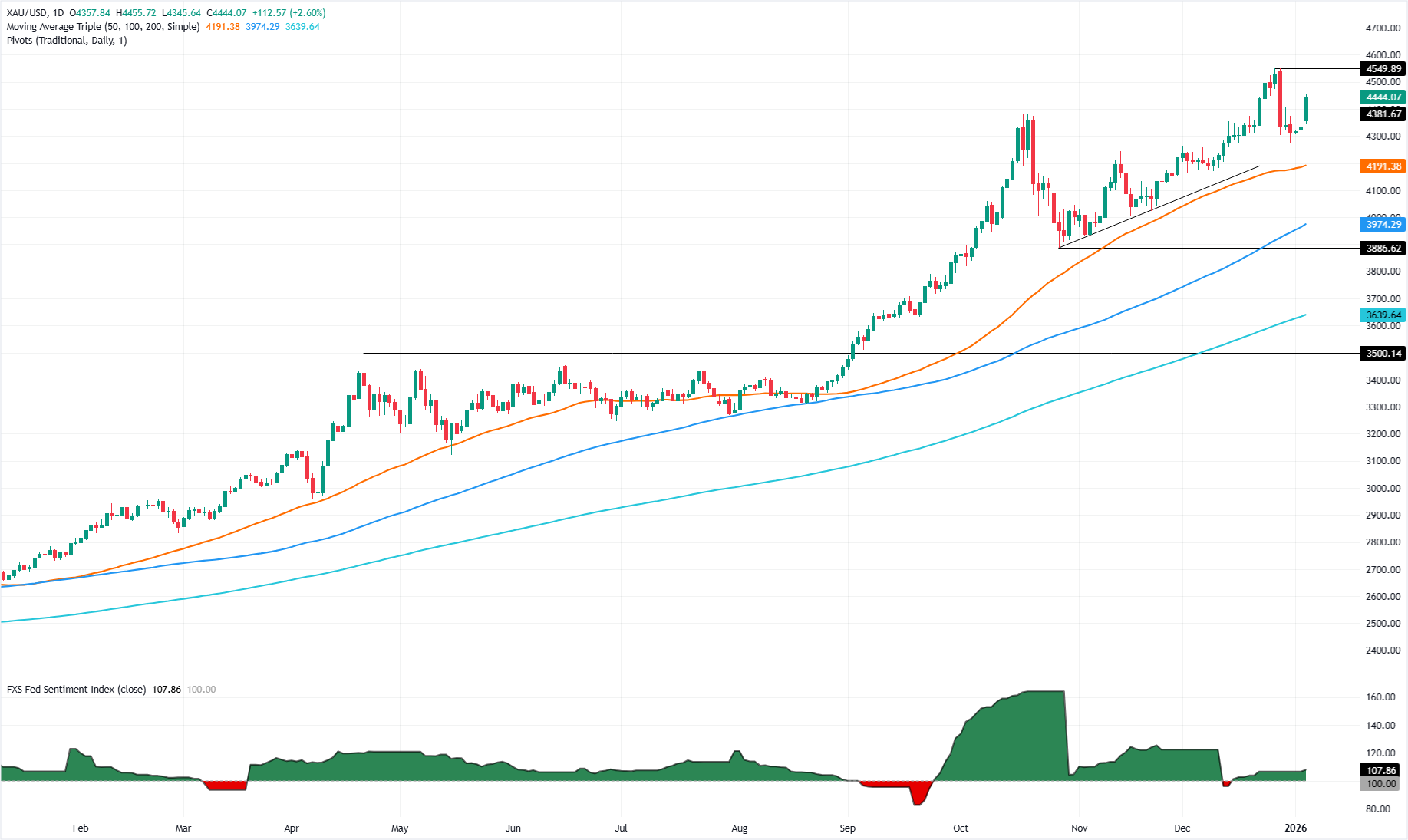
Gold (XAU/USD) rallies sharply on Monday, gaining over 2.60% as investors assess the risk of last week's US strikes on Venezuela and its geopolitical implications worldwide. At the time of writing, XAU/USD trades at $4,442 after bouncing off daily lows of $4,345.
Bullion prices rise also on weak US ISM Manufacturing PMI
The yellow metal in 2026 doesn’t look appealing as most major central banks signaled an end to their easing cycle, except for the Federal Reserve (Fed) and the Bank of England (BoE), which are expected to cut rates by 60 and 44.8 basis points, respectively, towards the year-end.
On the hawkish front sits the Bank of Japan (BoJ), led by Governor Kazuo Ueda, who said that “Interest rate hikes likely to persist if economic and inflation trends align with our projections.”
If the BoJ indeed raises rates, it would increase the risks of the carry trade unwinding. So far, Japanese Government Bond (JGB) yields have been rising sharply, as the 10-year JGB rose from around 1.64% in mid-October 2025 to 2.11% as of writing. This implies that market participants are expecting at least 50 bps of hikes from the BoJ. This means that if Gold traders borrowed in Yen to purchase the yellow metal, they would be looking to exit to trim foreign exchange losses.
Given the backdrop, Gold prices could be subject to a pullback. However, in the short term, geopolitical risks could push the non-yielding metal higher, to challenge the current record high of $4,549.
Earlier, the US economic docket revealed that manufacturing businesses continue to paint a grim outlook, while Minneapolis Fed President Neel Kashkari remained hawkish.
Ahead in the week, the US economic schedule will feature the release of the ISM Services PMI, Initial Jobless Claims for the week ending January 3 and December’s Nonfarm Payrolls.
Daily digest market movers: Falling US yields, boosts Gold
- Last weekend, US military forces captured the Venezuelan President Nicolas Maduro and his wife Cilia Flores. Maduro faces accusations of drug trafficking and partnering with drug cartels, like the Mexican Sinaloa Cartel and Tren de Aragua, which were designated as foreign terrorist organizations by the White House.
- US President Donald Trump said that the US will temporarily “run” Venezuela.
- The US ISM Manufacturing PMI for December 2025 fell to 47.9, missing forecasts of 48.3 and signaling a further deterioration in manufacturing activity. The reading marked the tenth consecutive month of contraction, down from 48.2 in November, underscoring persistent weakness in the sector. Despite slipping to its lowest level since October 2024, the index remains well above 42.3—a threshold that the ISM has historically associated with overall economic expansion.
- Minneapolis Fed President Neel Kashkari said that inflation remains too high, adding that monetary policy is now closer to a neutral stance. He also described the labor market as operating in a “low-hiring, low-firing” environment, suggesting limited churn rather than outright deterioration.
- Gold prices benefit from falling US Treasury yields. The US 10-year note yield tumbles three basis points to 4.163%, from 4.195%. US real yields, which correlate inversely with Gold prices, are also down nearly three and a half basis points to 1.91%.
- The US Dollar Index (DXY), which tracks the Greenback’s value against six currencies, edges down 0.17% at 98.27, a tailwind for precious metals prices.
Technical analysis: Gold price recovers, eyes $4,500
Gold price uptrend remains intact, but it seems that buyers are losing strength. The Relative Strength Index (RSI), although aiming higher, suggests that bullish momentum is fading due to the overextended rally that began late in October, when XAU/USD fell back below $4,000.
Since then, Gold reached a record high of $4,549 and stabilized within the $4,250-$4,450 mark during the last four trading days. If Gold clears $4,450, the next resistance would be $4,500, followed by the all-time high of $4,549. Otherwise, if XAU/USD drops below $4,400, the next support would be $4,350, followed by $4,300.
Gold FAQs
Gold has played a key role in human’s history as it has been widely used as a store of value and medium of exchange. Currently, apart from its shine and usage for jewelry, the precious metal is widely seen as a safe-haven asset, meaning that it is considered a good investment during turbulent times. Gold is also widely seen as a hedge against inflation and against depreciating currencies as it doesn’t rely on any specific issuer or government.
Central banks are the biggest Gold holders. In their aim to support their currencies in turbulent times, central banks tend to diversify their reserves and buy Gold to improve the perceived strength of the economy and the currency. High Gold reserves can be a source of trust for a country’s solvency. Central banks added 1,136 tonnes of Gold worth around $70 billion to their reserves in 2022, according to data from the World Gold Council. This is the highest yearly purchase since records began. Central banks from emerging economies such as China, India and Turkey are quickly increasing their Gold reserves.
Gold has an inverse correlation with the US Dollar and US Treasuries, which are both major reserve and safe-haven assets. When the Dollar depreciates, Gold tends to rise, enabling investors and central banks to diversify their assets in turbulent times. Gold is also inversely correlated with risk assets. A rally in the stock market tends to weaken Gold price, while sell-offs in riskier markets tend to favor the precious metal.
The price can move due to a wide range of factors. Geopolitical instability or fears of a deep recession can quickly make Gold price escalate due to its safe-haven status. As a yield-less asset, Gold tends to rise with lower interest rates, while higher cost of money usually weighs down on the yellow metal. Still, most moves depend on how the US Dollar (USD) behaves as the asset is priced in dollars (XAU/USD). A strong Dollar tends to keep the price of Gold controlled, whereas a weaker Dollar is likely to push Gold prices up.
Author

Christian Borjon Valencia
FXStreet
Markets analyst, news editor, and trading instructor with over 14 years of experience across FX, commodities, US equity indices, and global macro markets.