Gold surges above $3,300 as US jobs data disappoints, Trump tariffs blocked
- XAU/USD jumps 0.94% after weak labor report despite court ruling against Trump tariffs.
- Initial Jobless Claims rise above estimates, increasing pressure on Fed to consider rate cuts.
- US GDP confirms Q1 contraction; US Dollar tumbles, fueling safe-haven demand for Bullion.
- Court ruling nullifies Trump tariffs, boosting risk appetite and weighing on Greenback.

Gold price bounced off weekly lows of $3,245 and rose past $3,300 on Thursday, helped by a softer jobs report in the United States (US), while markets cheered a US court decision to block US President Donald Trump’s tariffs. At the time of writing, XAU/USD trades at $3,318 and gains 0.94%.
The US Department of Labor revealed that the number of Americans filing for unemployment claims, exceeded estimates and the prior week’s report.
The report adds pressure on the Federal Reserve (Fed) to ease policy as the risk of high unemployment has increased. This, along with the confirmation of a contraction in the US Gross Domestic Product (GDP) in Q1 2025, sent the US Dollar into a tailspin, which boosted the prospects of the golden metal.
Late on Wednesday, Bloomberg revealed that the US Court of International Trade, composed of a three-judge panel, declared that the Trump administration “had wrongly invoked a 1977 law in imposing his Liberation Day tariffs on dozens of countries and they were therefore illegal.”
The US court decision freed Mexico, Canada and China from previously imposed tariffs, imposed over the security of the US border and fentanyl trafficking. However, tariffs on aluminum, autos and steel remain unaffected. The Trump administration is appealing the ruling, and Goldman Sachs expects broad tariff policy to remain on the books via other legal means.
The Trump blockage headline prompted a rally on global equities. Gold tumbled to a weekly low, while the US Dollar Index (DXY), a measure of the Greenback’s value, reached a weekly high of 100.54.
The DXY, which tracks the US Dollar’s value against a basket of six currencies, tumbles 0.50% to 99.32.
This week, Bullion traders are eyeing the release of the Fed’s favorite inflation gauge, the Core Personal Consumption Expenditures (PCE) Price Index.
Gold’s daily market movers: Plunging US yields, soft US Dollar boosts XAU/USD
- US Treasury bond yields are plummeting following the release of US data. The 10-year Treasury note yield dives by four and a half basis points (bps) to 4.30%. Meanwhile, US real yields followed suit, also down four bps at 2.11%.
- US Initial Jobless Claims for the week ending May 24 rose by 240K, up from 226K a week before and exceeding forecasts of 230K.
- US GDP's second estimate for the first quarter of 2021 came at -0.2% QoQ contraction, up from the preliminary estimate of -0.3%.
- Federal Reserve minutes cited uncertainty about the potential impact of tariffs on the economy, with officials adopting a patient stance due to high risks of elevated inflation and unemployment.
- Policymakers acknowledged some stagflation risks as they noted the “Committee might face difficult tradeoffs if inflation proves to be more persistent while the outlooks for growth and employment weaken.” They added that they are waiting for the “net economic effects of the array of changes to government policies to become clearer.”
- Data revealed that Gold imports to Switzerland from the US rose to its highest level since at least 2012 in April.
- Money markets suggest that traders are pricing in 49 basis points of easing toward the end of the year, following the soft US Initial Jobless Claims report, according to Prime Market Terminal data.
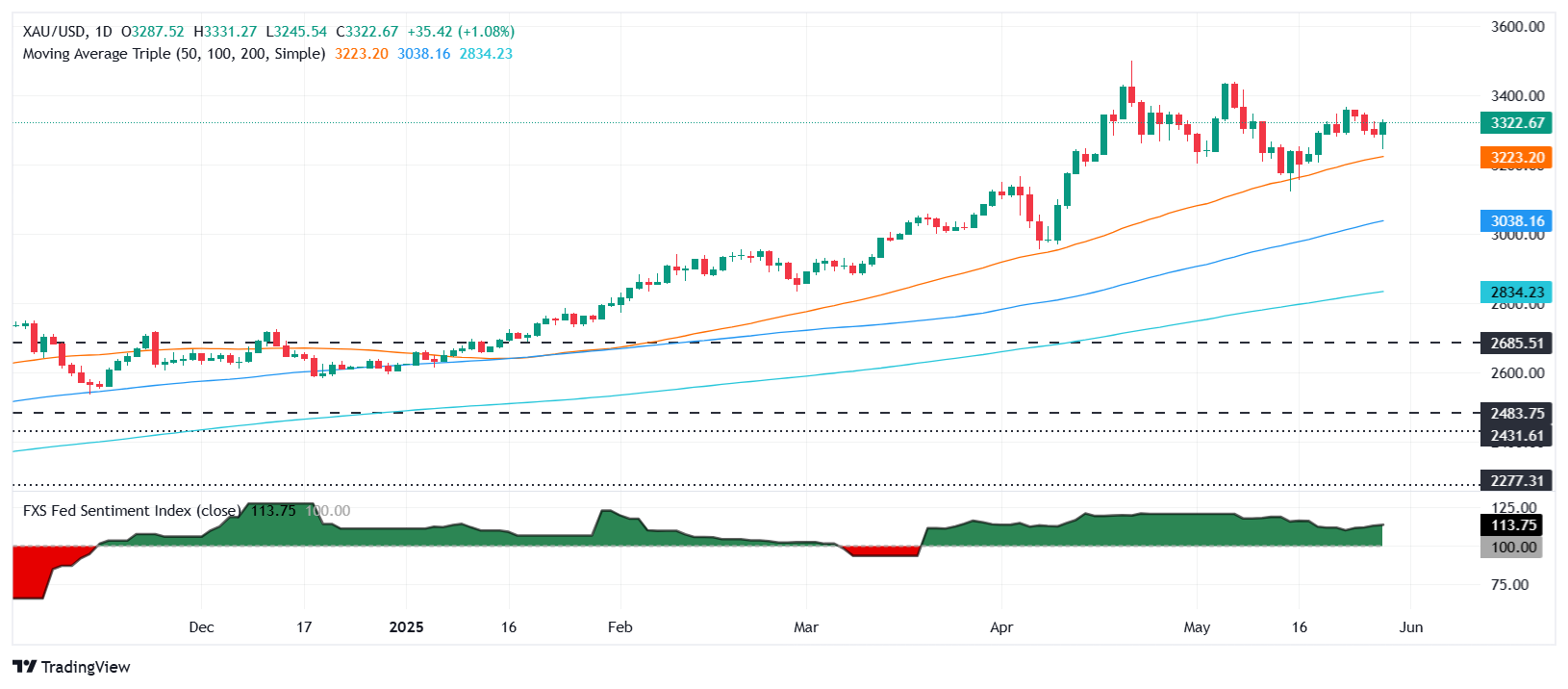
XAU/USD technical outlook: Gold price regains $3,300, poised to test $3,350
Gold price resumed its uptrend, and as of writing, spot prices are near the May 28 daily high of $3,325. A daily close above the latter is needed, so XAU/USD could be poised to challenge $3,350. If surpassed, the next key resistance levels are $3,400 and the May 7 swing high of $3,438. If achieved, Gold’s next goal would be $3,500.
On the downside, Gold tumbling below $3,300 opens the path to challenge $3,250. Once cleared, a move toward the 50-day Simple Moving Average (SMA) at $3,217 is on the cards.
Gold FAQs
Gold has played a key role in human’s history as it has been widely used as a store of value and medium of exchange. Currently, apart from its shine and usage for jewelry, the precious metal is widely seen as a safe-haven asset, meaning that it is considered a good investment during turbulent times. Gold is also widely seen as a hedge against inflation and against depreciating currencies as it doesn’t rely on any specific issuer or government.
Central banks are the biggest Gold holders. In their aim to support their currencies in turbulent times, central banks tend to diversify their reserves and buy Gold to improve the perceived strength of the economy and the currency. High Gold reserves can be a source of trust for a country’s solvency. Central banks added 1,136 tonnes of Gold worth around $70 billion to their reserves in 2022, according to data from the World Gold Council. This is the highest yearly purchase since records began. Central banks from emerging economies such as China, India and Turkey are quickly increasing their Gold reserves.
Gold has an inverse correlation with the US Dollar and US Treasuries, which are both major reserve and safe-haven assets. When the Dollar depreciates, Gold tends to rise, enabling investors and central banks to diversify their assets in turbulent times. Gold is also inversely correlated with risk assets. A rally in the stock market tends to weaken Gold price, while sell-offs in riskier markets tend to favor the precious metal.
The price can move due to a wide range of factors. Geopolitical instability or fears of a deep recession can quickly make Gold price escalate due to its safe-haven status. As a yield-less asset, Gold tends to rise with lower interest rates, while higher cost of money usually weighs down on the yellow metal. Still, most moves depend on how the US Dollar (USD) behaves as the asset is priced in dollars (XAU/USD). A strong Dollar tends to keep the price of Gold controlled, whereas a weaker Dollar is likely to push Gold prices up.
Author

Christian Borjon Valencia
FXStreet
Markets analyst, news editor, and trading instructor with over 14 years of experience across FX, commodities, US equity indices, and global macro markets.