Gold refreshes all-time highs as tariff war boosts safe-haven demand
- Gold price refreshes ATH above $3,300 as US President Trump plans to reduce dependency on China for critical minerals.
- Investors doubt the credibility of the US Dollar due to Trump’s abrupt decision on international policies.
- Fed Powell is expected to provide fresh guidance on the monetary policy outlook.


Gold price (XAU/USD) posts a fresh all-time high (ATH) near $3,319 in Wednesday's North American session.. The precious metal remains an attractive investment amid heightening global trade tensions. The intensifying trade war between the United States (US) and China has forced financial market participants to stay on the safe-haven fleet, assuming that the tussle for dominance between them is painful for the global economy
The tariff war between the world’s largest powerhouses has escalated further, with US President Donald Trump ordering his team on late Tuesday to probe into potential new tariffs on all imports of critical minerals, in an effort to reduce their dependency on China. US dependency on minerals imports "raises the potential for risks to national security, defense readiness, price stability, and economic prosperity and resilience," Trump said in the order, Reuters reported.
Donald Trump has taken a step to reassess levies on vital minerals after Beijing announced a non-tariff barrier on their exports by establishing a licensing system. Earlier this month, Beijing also imposed export restrictions on six heavy rare earth metals and rare earth magnets.
Market experts worry that the US economy could be vulnerable without these minerals, as they barely produce them, given their application in many industries, including defence and technology.
Beijing has imposed restrictive controls on exports of rare minerals to the US in retaliation for hefty reciprocal tariffs imposed by Donald Trump on them. Till now, the US has raised additional duties on Chinese imports to 145%. At the same time, China has also imposed 125% tariffs on US imports. Meanwhile, Trump has declared a 90-day pause on reciprocal tariffs for the rest of his trading partners.
Meanwhile, the possibility of trade talks between Washington and Beijing has improved slightly. During European trading hours, China showed willingness to talk with the US but cleared that Washington should show respect. "If the US really wants to resolve the issue through dialogue and negotiation, it should stop exerting extreme pressure, stop threatening and blackmailing, and talk to China on the basis of equality, respect and mutual benefit," foreign ministry spokesman Lin Jian said, according to France24.com.
Daily digest market movers: Gold price surges while US Dollar slumps
- A sharp upside in the Gold price is majorly driven by sheer weakness in the US Dollar (USD). The US Dollar Index (DXY), which tracks the Greenback’s value against six major currencies, slumps to near 99.50, holding near its lowest level in three years. Technically, weakness in the US Dollar makes the Gold price an attractive bet for investors.
- The US Dollar has been facing an intense sell-off as investors worry that the US-China trade war is more painful for the US economy than it is for the rest of the world.
- Market participants expect that substitutes of Chinese products available in the US economy are incapable of matching the price and quantity in a short span of time due to the absence of manufacturing facilities and a low-cost competitive advantage. This could lead US businesses to raise prices of their goods to offset the constant demand, which will prompt inflation and diminish the purchasing power of households. Such a scenario could stem stagflation in the US economy and is unfavorable for the US Dollar.
- Additionally, investors are losing faith in the US Dollar’s label as a safe-haven asset due to ever-changing tariff headlines from President Trump. His sudden decision to declare a 90-day pause on the execution of reciprocal tariffs and signals to exempt duty on automobiles for some time has forced investors to doubt the credibility of the US Dollar.
- Meanwhile, the recovery in the US bond yields due to escalated fears of a US economic slowdown has also failed to lighten the strength in the Gold price. 10-year US Treasury yields have rebounded to near 4.34% after correcting almost 6.6% in the last two trading days from their recent high of 4.60%.
- Historically, higher yields on interest-bearing assets diminish the appeal of non-yielding assets, such as Gold. However, Treasury yields have not created any havoc for Gold bulls despite rising 11% in over a week, as traders have raised their bets supporting the Federal Reserve (Fed) to cut interest rates by 100 basis points (bps) this year. Traders have increased Fed dovish bets amid firming US economic slowdown risks.
- For fresh cues on the interest rate outlook, investors await Fed Chair Jerome Powell’s speech at the Economic Club of Chicago at 17:30 GMT.
- On the economic front, US Retail Sales rose at a robust pace of 1.4% in March on month-on-month, beating estiamtes of 1.3% and the prior release of 0.2%.
Technical Analysis: Gold breaks above $3,300
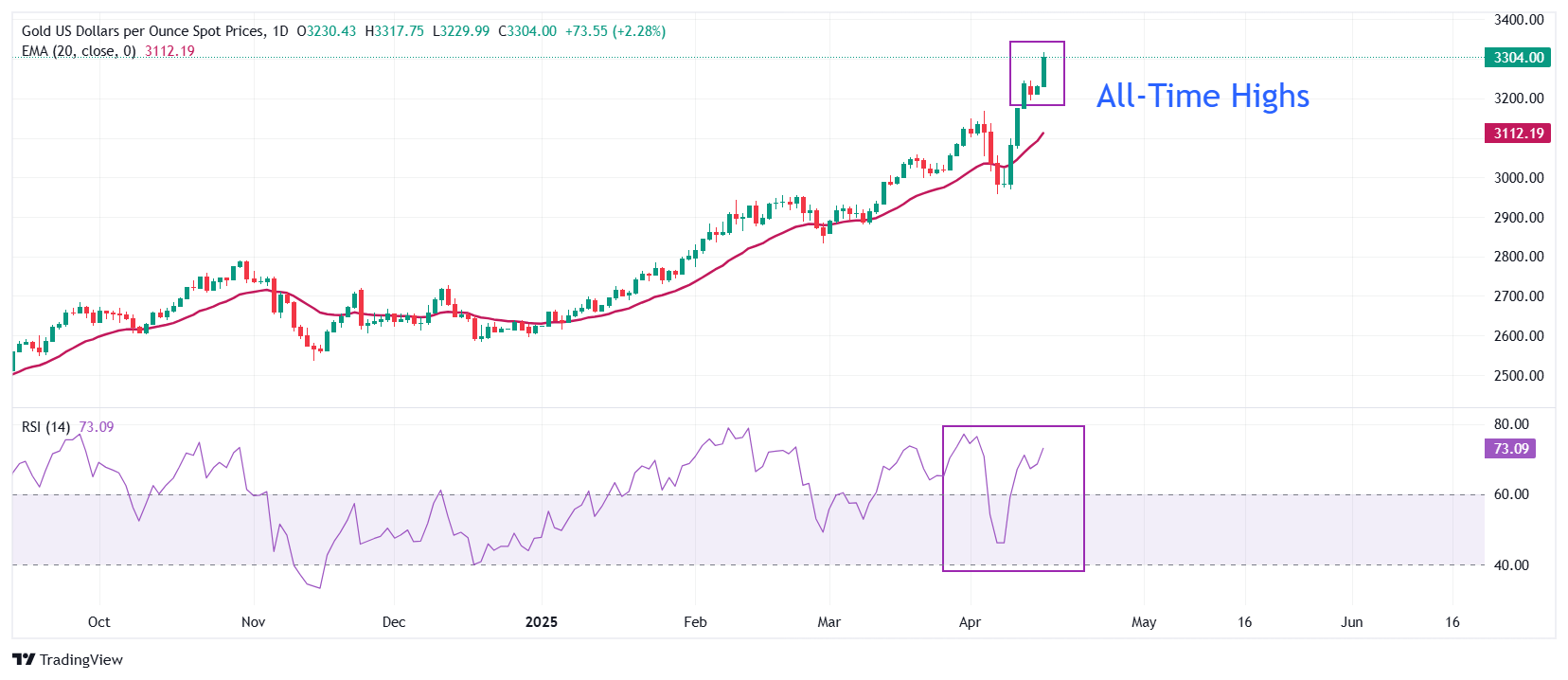
Gold price tests the region above $3,300 and posts a fresh all-time high around $3,319 on Wednesday. The outlook of the Gold price is upbeat as the 20-day Exponential Moving Average (EMA) slopes higher, trading around $3,112.
The 14-day Relative Strength Index (RSI) trades above 70.00, suggesting a strong bullish momentum.
Looking down, the 20-day EMA will act as a key support zone for the pair. On the upside, the round level of $3,400 will act as a key resistance zone.
US-China Trade War FAQs
Generally speaking, a trade war is an economic conflict between two or more countries due to extreme protectionism on one end. It implies the creation of trade barriers, such as tariffs, which result in counter-barriers, escalating import costs, and hence the cost of living.
An economic conflict between the United States (US) and China began early in 2018, when President Donald Trump set trade barriers on China, claiming unfair commercial practices and intellectual property theft from the Asian giant. China took retaliatory action, imposing tariffs on multiple US goods, such as automobiles and soybeans. Tensions escalated until the two countries signed the US-China Phase One trade deal in January 2020. The agreement required structural reforms and other changes to China’s economic and trade regime and pretended to restore stability and trust between the two nations. However, the Coronavirus pandemic took the focus out of the conflict. Yet, it is worth mentioning that President Joe Biden, who took office after Trump, kept tariffs in place and even added some additional levies.
The return of Donald Trump to the White House as the 47th US President has sparked a fresh wave of tensions between the two countries. During the 2024 election campaign, Trump pledged to impose 60% tariffs on China once he returned to office, which he did on January 20, 2025. With Trump back, the US-China trade war is meant to resume where it was left, with tit-for-tat policies affecting the global economic landscape amid disruptions in global supply chains, resulting in a reduction in spending, particularly investment, and directly feeding into the Consumer Price Index inflation.
BRANDED CONTENT
Not all brokers provide the same benefits for Gold trading, making it essential to compare key features. Knowing each broker’s strengths will help you find the ideal fit for your trading strategy. Explore our detailed guide on the best Gold brokers.
Author
Sagar Dua
FXStreet
Sagar Dua is associated with the financial markets from his college days. Along with pursuing post-graduation in Commerce in 2014, he started his markets training with chart analysis.