Gold snaps below $2,900 with concerns on US economy swelling
- Gold faces selling presure on Monday at start of the week with equities dipping lower.
- US yields are off their year-to-date low after President Trump avoids mentioning "recession" in a press conference.
- Traders are mulling the upcoming Fed meeting on March 19 as the blackout period begins.

Gold’s price (XAU/USD) is ticking below the $2,900 level at the start of the week with some selling pressure on Monday as market rout picks up towards the US trading session. Traders are mulling over comments from United States (US) President Donald Trump after an interview on Fox News over the weekend. When asked about the US economy, President Trump said that the economy is in a ‘transition’ phase, while markets have already floated the idea that the US economy is in a recession scenario.
Meanwhile, Federal Reserve (Fed) Chairman Jerome Powell issued some remarks on Friday before the Fed’s blackout period started. That blackout period precedes the actual policy rate decision on March 19, where expectations are for keeping the policy rate steady. Powell said that the central bank does not need to do anything at this point and that the price for keeping its policy rate steady comes with a very small price against the chances of a policy mistake by changing interest rates preemptively.
Daily digest market movers: Fed to hold
- US President Donald Trump said the economy faced “a period of transition” as he pressed on with his focus on tariffs and federal job cuts, Bloomberg reports.
- Fed Chair Jerome Powell acknowledged on Friday the rising economic uncertainties in the US but said the central bank does not need to rush to adjust policy. Among recent data points, the Atlanta Fed’s Gross Domestic Product (GDP) gauge signaled the US economy may shrink this quarter. Lower borrowing costs tend to be beneficial for Gold, Reuters reports.
- The CME Fedwatch Tool sees a 97.0% chance for no rate changes in the upcoming Fed policy meeting on March 19. The odds for an interest rate cut by the June 18 meeting have grown now to 81.8% on Monday.
Technical Analysis: What is transition takes longer?
It is time for markets to settle down and see a pullback after stretched positions and moves on the charts. The same goes for Bullion, where the precious metal would benefit from a pullback. Should President Trump remain relatively quiet on any additional tariffs, the nervousness would start to settle and would see Gold dipping towards the S2 support of the daily Pivot Point near $2,878 or even lower, ideal for bulls to get back in before reciprocal tariffs are set to hit by next month.
While Gold trades near $2,905 at the time of writing on Monday, the daily Pivot Point at $2,912 and the daily R1 resistance at $2,927 are the key levels to watch for. In case Gold sees more inflows, the daily R2 resistance at $2,945 will possibly be the final cap ahead of the all-time high of $2,956 reached on February 24.
On the downside, the $2,900 psychological big figure and the S1 support at $2,893 acts as a double support barrier. If Bullion bulls want to avoid another leg lower, that zone must hold. Further down, the daily S2 support at $2,878 should be able to catch any additional downside pressure.
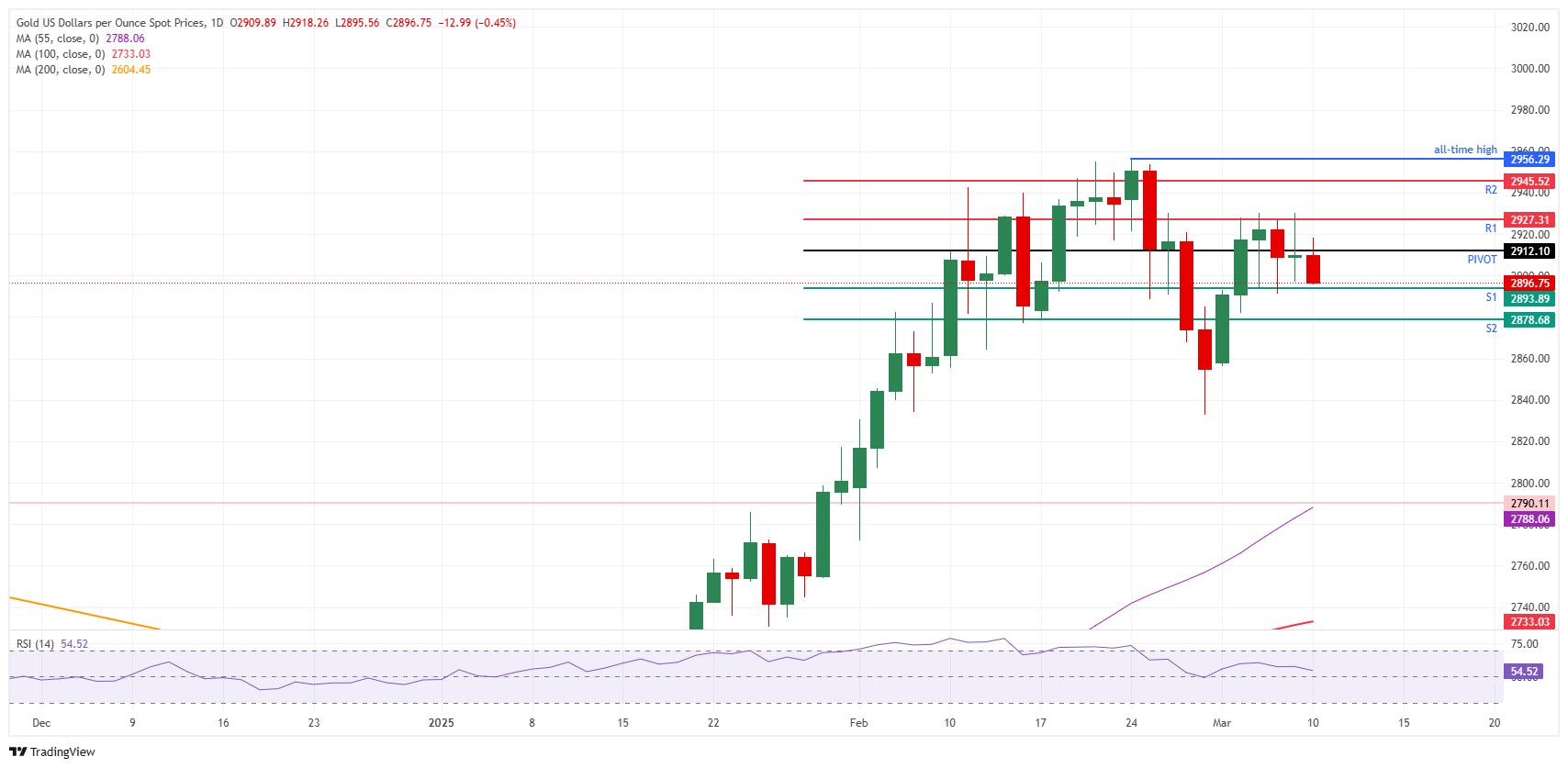
XAU/USD: Daily Chart
Gold FAQs
Gold has played a key role in human’s history as it has been widely used as a store of value and medium of exchange. Currently, apart from its shine and usage for jewelry, the precious metal is widely seen as a safe-haven asset, meaning that it is considered a good investment during turbulent times. Gold is also widely seen as a hedge against inflation and against depreciating currencies as it doesn’t rely on any specific issuer or government.
Central banks are the biggest Gold holders. In their aim to support their currencies in turbulent times, central banks tend to diversify their reserves and buy Gold to improve the perceived strength of the economy and the currency. High Gold reserves can be a source of trust for a country’s solvency. Central banks added 1,136 tonnes of Gold worth around $70 billion to their reserves in 2022, according to data from the World Gold Council. This is the highest yearly purchase since records began. Central banks from emerging economies such as China, India and Turkey are quickly increasing their Gold reserves.
Gold has an inverse correlation with the US Dollar and US Treasuries, which are both major reserve and safe-haven assets. When the Dollar depreciates, Gold tends to rise, enabling investors and central banks to diversify their assets in turbulent times. Gold is also inversely correlated with risk assets. A rally in the stock market tends to weaken Gold price, while sell-offs in riskier markets tend to favor the precious metal.
The price can move due to a wide range of factors. Geopolitical instability or fears of a deep recession can quickly make Gold price escalate due to its safe-haven status. As a yield-less asset, Gold tends to rise with lower interest rates, while higher cost of money usually weighs down on the yellow metal. Still, most moves depend on how the US Dollar (USD) behaves as the asset is priced in dollars (XAU/USD). A strong Dollar tends to keep the price of Gold controlled, whereas a weaker Dollar is likely to push Gold prices up.
Author

Filip Lagaart
FXStreet
Filip Lagaart is a former sales/trader with over 15 years of financial markets expertise under its belt.