Gold steadies ahead of Trump–Putin summit as US Dollar slips
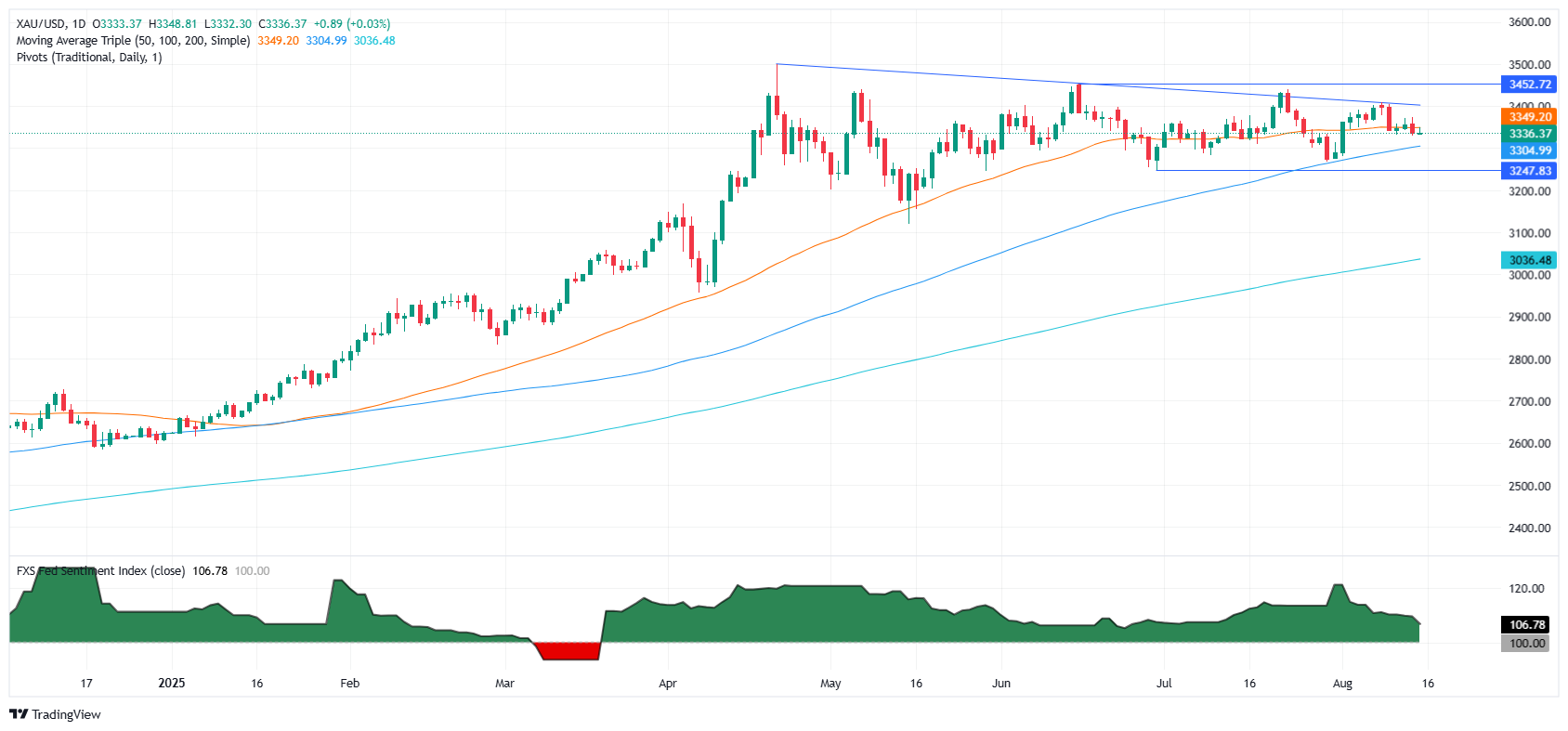
- XAU/USD rises 0.17% to $3,340, trapped between $3,330 and $3,350 since late Thursday’s session.
- US Dollar fails to rally after in-line July Retail Sales and upward June revision; sentiment weakens, inflation expectations rise.
- US Dollar Index drops 0.37% to 97.83, while high Treasury yields cap Gold’s upside momentum.

Gold price (XAU/USD) holds firm during the North American session as market participants await the outcome of the meeting between US President Donald Trump and his counterpart, Russian President Vladimir Putin. Traders shrugged off in-line US Retail Sales figures, which failed to propel the US Dollar. The XAU/USD trades at $3,340, up 0.17%.
The golden metal seems trapped within the $3,330-$3,350 range since late on Thursday and throughout Friday’s session. Expectations of a positive result of the Trump-Putin summit in Alaska are not as high as expected. However, the White House expressed that something’s going to come off and that the war needs to stop before talking about business.
The US Dollar failed to gain traction after a solid Retail Sales report in July, which also witnessed the upward revision of June’s print. Further data showed that Consumer Sentiment has deteriorated as inflation expectations have risen, while Industrial Production in the US declined in July.
Bullion prices extended their gains as the US Dollar Index (DXY), which tracks the buck’s performance against six currencies, tumbled 0.37% at 97.83. Nonetheless, XAU/USD has failed to clear $3,350, capped by high US Treasury yields.
Next week, the US economic docket will feature Flash PMI readings, the release of the minutes of the latest meeting of the Federal Open Market Committee (FOMC), and Federal Reserve (Fed) Chair Jerome Powell's speech at Jackson Hole.
Daily digest market movers: Gold gains capped by high US Treasury yields
- US Treasury yields rebounded across the curve on Thursday, with the benchmark 10-year rising three basis points (bps) near 4.322%. US real yields, which inversely correlate with Gold prices, are also up more than three and a half bps, climbing to 1.936%.
- US Retail Sales rose 0.5% MoM in July, aligned with forecasts, but shy of June’s upwardly revised figures of 0.9%. In the 12 months to July, the rate dipped from June’s 4.4% to 3.9% YoY.
- Industrial Production in the United States (US) shrank by 0.1% MoM in July, as published on Friday. The print reading followed the 0.4% increase recorded in June and came in worse than the market expectation for no change.
- The UoM Consumer Sentiment Index, on its preliminary reading for August, rose by 58.6, down from July's 61.7, missing forecasts of 62.0. Inflation is the main reason for American households turning pessimistic, with inflation expectations for one year jumping from 4.5% to 4.9%, and for five years the rate rose from 3.4% to 3.9%.
- Following the latest US data releases, the Atlanta Fed's GDPnow Q3 projection remained unchanged at 2.5%.
- Fed Interest Rate Probabilities show that traders had priced in a 95% chance of a 25 bps rate cut at the September meeting, according to Prime Market Terminal data.
Technical outlook: Gold price dips but remains bullish above $3,300
Gold price uptrend remains in place from a price action standpoint, but in the short term has turned sideways, unable to clear the 50-day Simple Moving Average (SMA) resistance at the confluence of the 20-day and 50-day SMAs near $3,349-$3,357. As mentioned above, Bullion is trapped within $3,330-$3,350 and seems poised to stay directionless as depicted by the Relative Strength Index (RSI).
If Gold clears 3,357, the next resistance would be $3,380, followed by $3,400. Key resistance levels lie overhead like the June 16 high at $3,452, followed by the record high of $3,500. Conversely, a drop below $3,330 and a move toward $3,300 is on the cards. The next support would be the 100-day SMA at $3,295.
Gold FAQs
Gold has played a key role in human’s history as it has been widely used as a store of value and medium of exchange. Currently, apart from its shine and usage for jewelry, the precious metal is widely seen as a safe-haven asset, meaning that it is considered a good investment during turbulent times. Gold is also widely seen as a hedge against inflation and against depreciating currencies as it doesn’t rely on any specific issuer or government.
Central banks are the biggest Gold holders. In their aim to support their currencies in turbulent times, central banks tend to diversify their reserves and buy Gold to improve the perceived strength of the economy and the currency. High Gold reserves can be a source of trust for a country’s solvency. Central banks added 1,136 tonnes of Gold worth around $70 billion to their reserves in 2022, according to data from the World Gold Council. This is the highest yearly purchase since records began. Central banks from emerging economies such as China, India and Turkey are quickly increasing their Gold reserves.
Gold has an inverse correlation with the US Dollar and US Treasuries, which are both major reserve and safe-haven assets. When the Dollar depreciates, Gold tends to rise, enabling investors and central banks to diversify their assets in turbulent times. Gold is also inversely correlated with risk assets. A rally in the stock market tends to weaken Gold price, while sell-offs in riskier markets tend to favor the precious metal.
The price can move due to a wide range of factors. Geopolitical instability or fears of a deep recession can quickly make Gold price escalate due to its safe-haven status. As a yield-less asset, Gold tends to rise with lower interest rates, while higher cost of money usually weighs down on the yellow metal. Still, most moves depend on how the US Dollar (USD) behaves as the asset is priced in dollars (XAU/USD). A strong Dollar tends to keep the price of Gold controlled, whereas a weaker Dollar is likely to push Gold prices up.
Author

Christian Borjon Valencia
FXStreet
Markets analyst, news editor, and trading instructor with over 14 years of experience across FX, commodities, US equity indices, and global macro markets.















