Gold looks clueless on Monday after US officials ease on reciprocal tariff
- Gold is trading rather steady around $3,020 after Friday’s decline.
- US President Trump is said to ease off on tariffs by April 2, according to US officials.
- Gold is still supported in the $3,000 region, though pressure is building for more downside.

Gold’s price (XAU/USD) is looking for direction while orbiting around $3,020 at the time of writing, on the back of fresh tariff headlines over the weekend. News emerging that the Trump administration will ease off on the broad scope of tariffs being imposed on April 2 brings sighs of relief in markets. Instead, United States (US) President Donald Trump is said to be looking for more specifically targeted tariffs on specific sectors per country or region.
This helps ease the fear of broad reciprocal tariffs. The idea behind these tariffs is to get companies to reshore back to the US. However, a 25% tariff is not high enough to make the supply chains of corporations untenable, and the Trump administration would actually need to impose import taxes of perhaps 100% to 200%, as well as offer big government subsidies, to get companies to reshore their manufacturing, Marketwatch reports.
Daily digest market movers: Unclear on the impact
- Johannesburg-based firm Gold Fields said Monday it put forward a non-binding proposal to buy the Perth-based company Gold Road Resources for 3.05 Australian Dollars (AUD) a share in cash on March 7, valuing its equity at 3.3 billion AUD and implying a total enterprise value of 2.4 billion AUD. Gold Road’s board rejected the offer, Bloomberg reports.
- Chinese metals producer Zijin Mining Group Co. shares rose more than 5% after the company posted a record profit on surging Gold and Copper prices. Heightened global economic and geopolitical risks, coupled with tariffs, are increasing uncertainty, the company said in a statement after net income surged 52% last year. Rising demand for Gold Exchange Traded Funds (ETFs), as well as central bank purchases, will push bullion higher this year, Reuters reports.
- US tariffs due April 2 are poised to be more targeted than the sprawling ones, according to US officials familiar with the matter. Still, traders remain wary with officials in China and Australia warning of widespread shocks to the global economy from US trade policy, Bloomberg reports.
Technical Analysis: New all-time high still in sight
The softer comments on tariffs will mean a bit less tailwind for Bullion. Expect to see some selling pressure on Gold, though the tailwind will not fade completely. Tariffs are still to come, and even if they are targeted and per sector, it could still severely impact markets and certain countries as long the full-scale scope is not yet communicated.
Regarding technical levels, at the time of writing Gold stabilizes just above the intraday Pivot Point at $3,023. Looking up, the R1 resistance stands at $3,046. Should US President Trump push back on earlier comments from US officials on the scope of the tariffs, for example, the current all-time high at $3,057 could face a new test.
On the downside, some red flags are rising as the intraday S1 support stands at $2,998. That means the $3,000 mark is exposed and needs to act on its own as big support. There is no line of defense before it to make sure any downturn is being slowed. Further down, the S2 support comes in at $2,975.
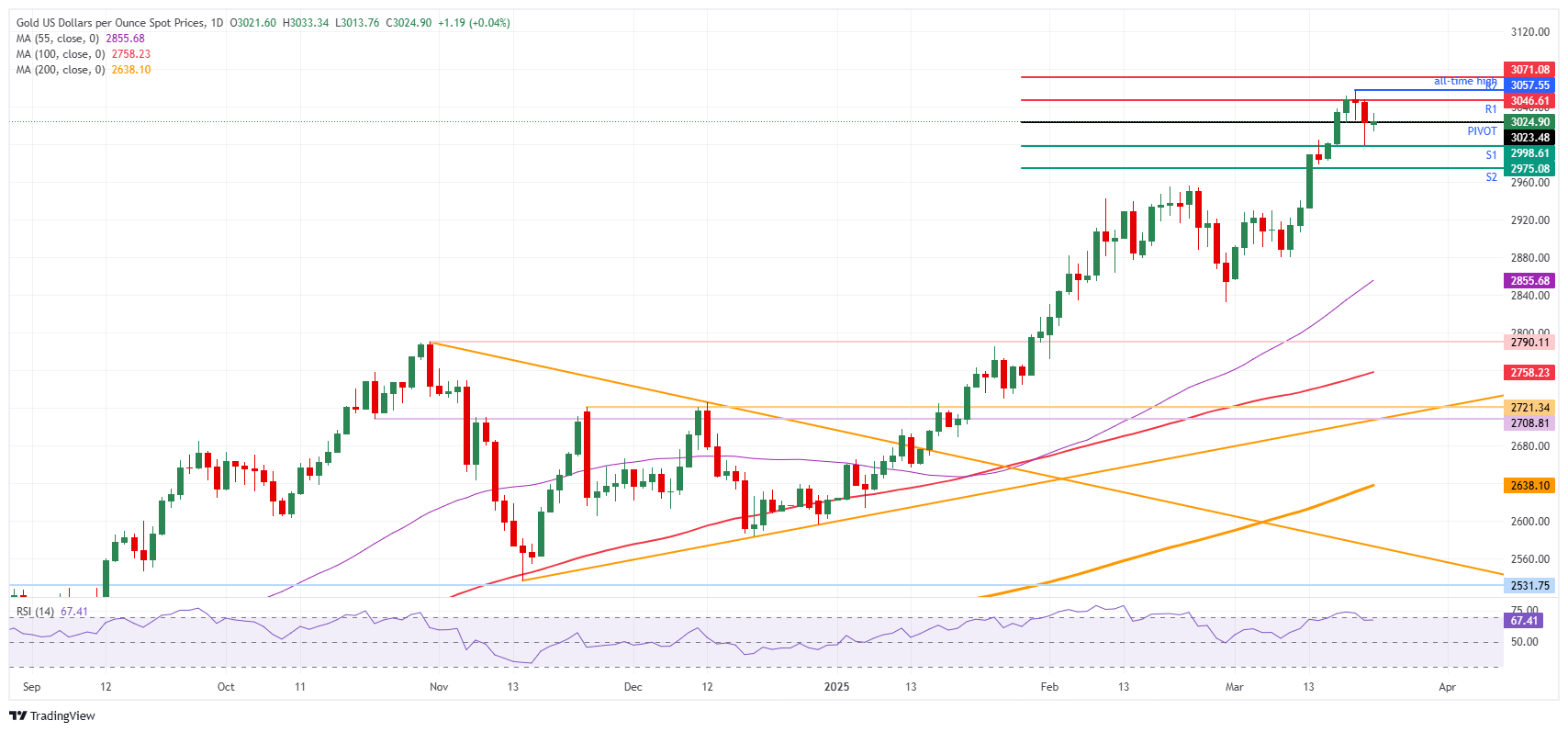
XAU/USD: Daily Chart
Interest rates FAQs
Interest rates are charged by financial institutions on loans to borrowers and are paid as interest to savers and depositors. They are influenced by base lending rates, which are set by central banks in response to changes in the economy. Central banks normally have a mandate to ensure price stability, which in most cases means targeting a core inflation rate of around 2%. If inflation falls below target the central bank may cut base lending rates, with a view to stimulating lending and boosting the economy. If inflation rises substantially above 2% it normally results in the central bank raising base lending rates in an attempt to lower inflation.
Higher interest rates generally help strengthen a country’s currency as they make it a more attractive place for global investors to park their money.
Higher interest rates overall weigh on the price of Gold because they increase the opportunity cost of holding Gold instead of investing in an interest-bearing asset or placing cash in the bank. If interest rates are high that usually pushes up the price of the US Dollar (USD), and since Gold is priced in Dollars, this has the effect of lowering the price of Gold.
The Fed funds rate is the overnight rate at which US banks lend to each other. It is the oft-quoted headline rate set by the Federal Reserve at its FOMC meetings. It is set as a range, for example 4.75%-5.00%, though the upper limit (in that case 5.00%) is the quoted figure. Market expectations for future Fed funds rate are tracked by the CME FedWatch tool, which shapes how many financial markets behave in anticipation of future Federal Reserve monetary policy decisions.
Author

Filip Lagaart
FXStreet
Filip Lagaart is a former sales/trader with over 15 years of financial markets expertise under its belt.