Gold rises as USD aversion and tariff tensions boost safe-haven demand
- Gold price gains 1.20% as investors shy away from the US Dollar.
- Trade wars and tariffs weigh on market sentiment, driving demand for precious metals.
- XAU/USD rallies toward Fibonacci resistance above $3,370 with $3,400 in focus.
Gold (XAU/USD) price surged on Friday, trading above $3,360 at the time of writing, as trade tensions and safe-haven demand have overshadowed rising US yields.
US President Donald Trump announced on Friday a sweeping 35% tariff on Canadian imports, effective from August 1, in a move that rattled global markets.
The decision is particularly significant given that the United States is Canada’s largest trading partner, accounting for 76% of Canadian exports in 2024, according to Statistics Canada.
Trump also warned of broader action, stating: “We’re just going to say all of the remaining countries are going to pay, whether it’s 20% or 15%. We’ll work that out now.”
His remarks fueled fears of a new wave of blanket tariffs, boosting demand for Gold as a tariff risk hedge.
Gold daily digest: XAU/USD benefits from safe-haven demand on broader tariff risks
- The release of the Federal Reserve’s (Fed) June meeting Minutes on Wednesday revealed growing concern among policymakers about the inflationary impact of escalating tariffs. The minutes noted that “most participants highlighted the risk that tariffs could have more persistent effects on inflation.” Officials also reiterated they are “well-positioned to wait for more clarity on the outlook for inflation and economic activity.”
- According to the CME FedWatch Tool, markets now see a 62.9% probability of a 25 basis point interest rate cut in September. So far this year, the Fed has kept interest rates unchanged within the 4.25%–4.50% range.
- Meanwhile, President Donald Trump escalated trade tensions this week by announcing a 50% tariff on Copper, effective August 1, citing national security concerns. “I am announcing a 50% TARIFF on Copper, effective August 1, 2025, after receiving a robust NATIONAL SECURITY ASSESSMENT. America will, once again, build a DOMINANT Copper Industry,” Trump declared on Truth Social on Wednesday.
- Brazil was also hit with a 50% tariff, with Trump directly linking the move to what he called the political persecution of former President Jair Bolsonaro, describing the proceedings as a “witch hunt”. He further ordered a Section 301 investigation into Brazil’s digital trade practices, signaling the potential for additional tariffs.
- At a Cabinet Meeting on Tuesday, Trump confirmed that the August 1 tariff deadline would not be extended, stating that “Everybody has to pay. And the incentive is that they have the right to deal in the United States.” Reinforcing this stance, he later wrote: “TARIFFS WILL START BEING PAID ON AUGUST 1, 2025. There has been no change to this date, and there will be no change.”
- For Gold, these developments may continue to support the metal’s safe-haven appeal.
Gold technical analysis: XAU/USD breaks triangle resistance, heads toward $3,400
Gold daily chart
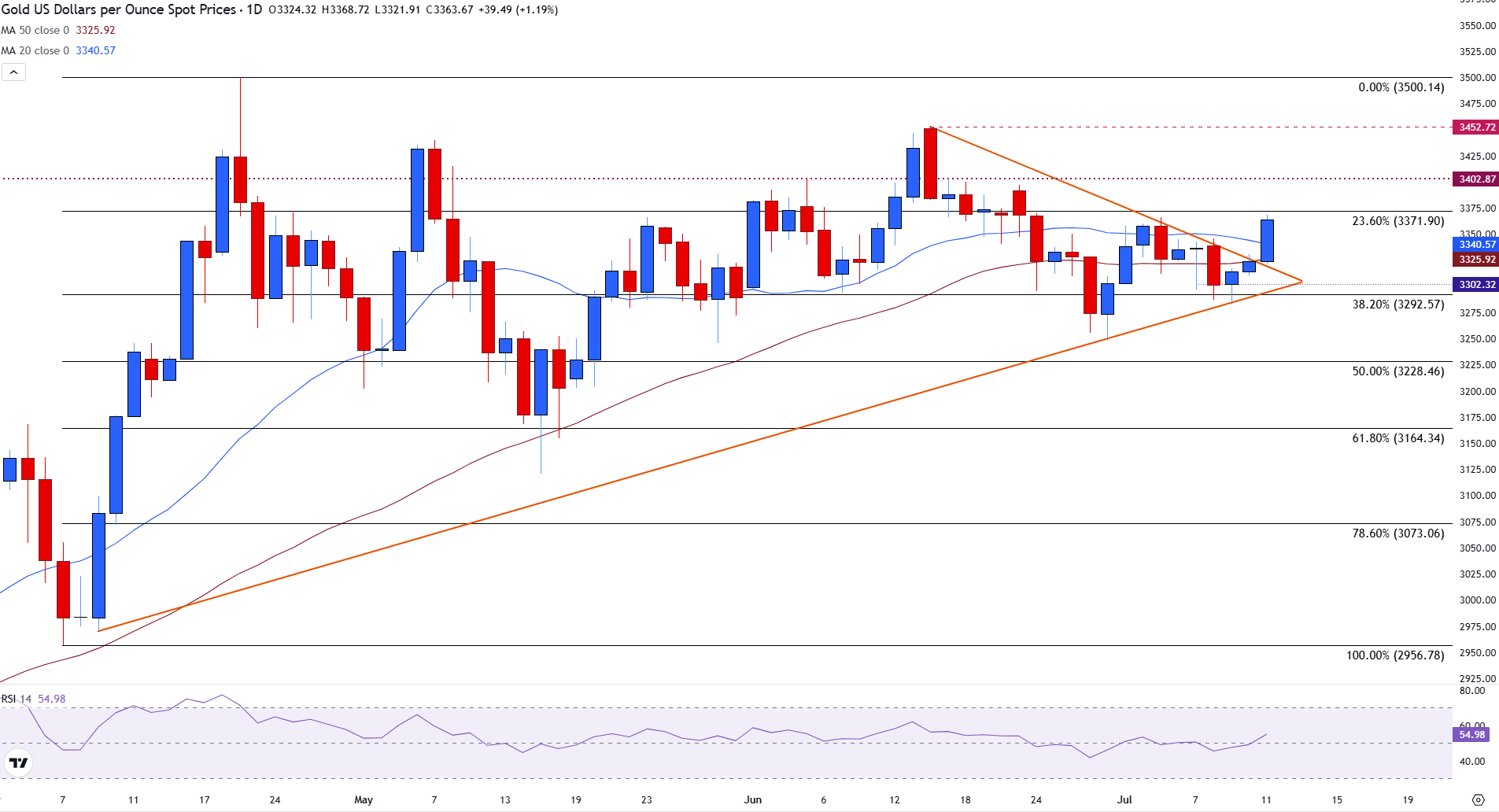
Gold has broken through the symmetrical triangle resistance, allowing XAU/USD to reclaim the 20-day Simple Moving Average (SMA) at $3,340.
The Relative Strength Index (RSI) rises, pointing upwards near 55 on the daily chart, signalling a slight bullish momentum in Gold.
But upside risks remain firm. The 23.6% Fibonacci retracement of the April uptrend stands at around $3,372, which could limit additional gains. Further up, the $3,400 psychological level and the June high near $3,452 are the next targets.
Meanwhile, if the US Dollar (USD) manages to gain traction and risk sentiment improves, then the 50-day SMA could come into focus at $3,325 as support. Below that level, focus turns to the $3,300 psychological level and the 38.2% Fibonacci retracement at $3,292.
Risk sentiment FAQs
In the world of financial jargon the two widely used terms “risk-on” and “risk off'' refer to the level of risk that investors are willing to stomach during the period referenced. In a “risk-on” market, investors are optimistic about the future and more willing to buy risky assets. In a “risk-off” market investors start to ‘play it safe’ because they are worried about the future, and therefore buy less risky assets that are more certain of bringing a return, even if it is relatively modest.
Typically, during periods of “risk-on”, stock markets will rise, most commodities – except Gold – will also gain in value, since they benefit from a positive growth outlook. The currencies of nations that are heavy commodity exporters strengthen because of increased demand, and Cryptocurrencies rise. In a “risk-off” market, Bonds go up – especially major government Bonds – Gold shines, and safe-haven currencies such as the Japanese Yen, Swiss Franc and US Dollar all benefit.
The Australian Dollar (AUD), the Canadian Dollar (CAD), the New Zealand Dollar (NZD) and minor FX like the Ruble (RUB) and the South African Rand (ZAR), all tend to rise in markets that are “risk-on”. This is because the economies of these currencies are heavily reliant on commodity exports for growth, and commodities tend to rise in price during risk-on periods. This is because investors foresee greater demand for raw materials in the future due to heightened economic activity.
The major currencies that tend to rise during periods of “risk-off” are the US Dollar (USD), the Japanese Yen (JPY) and the Swiss Franc (CHF). The US Dollar, because it is the world’s reserve currency, and because in times of crisis investors buy US government debt, which is seen as safe because the largest economy in the world is unlikely to default. The Yen, from increased demand for Japanese government bonds, because a high proportion are held by domestic investors who are unlikely to dump them – even in a crisis. The Swiss Franc, because strict Swiss banking laws offer investors enhanced capital protection.
Author

Tammy Da Costa, CFTe®
FXStreet
Tammy is an economist and market analyst with a deep passion for financial markets, particularly commodities and geopolitics.