Gold slumps over 3% from $5,600 peak as tech rout sparks profit-taking
- Gold plunges over 3% as Mag 7 stocks slide sharply, reviving fears of an AI-driven equity bubble.
- Fed’s steady-rate stance and Powell’s confidence in growth reduce urgency for defensive positioning.
- RSI cools from extreme levels, with $5,100 and $5,000 emerging as key technical supports.

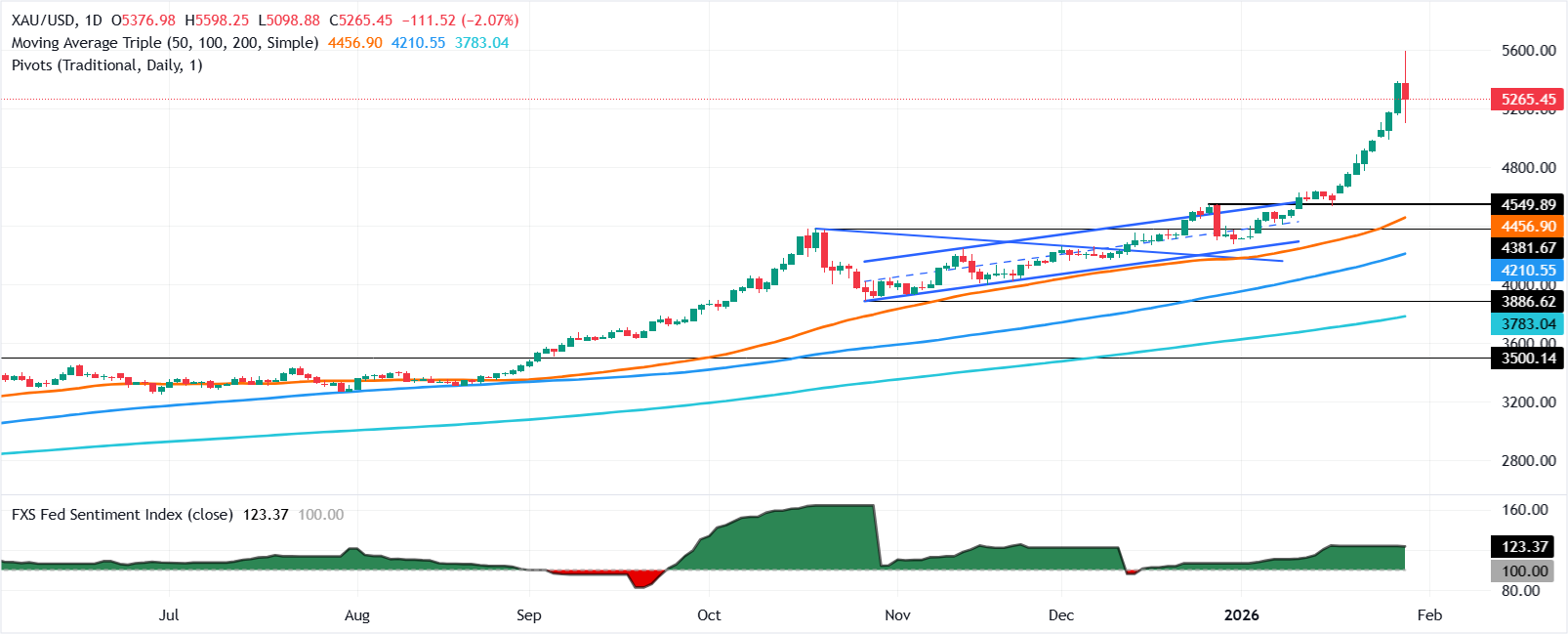
Gold (XAU/USD) plummets more than 3% on Thursday amid the lack of a catalyst that has pushed Silver’s down, copper prices retreating, and six of the Mag 7 equities getting hammered during the North American session. XAU/USD trades at $5,266 after reaching a record high near $5,600.
Bullion retreats sharply as equities sell off, commodities weaken, and traders lock in gains after record highs
As of writing, shares of Microsoft (MSFT), Tesla (TSLA), NVIDIA (NVDA), Amazon (AMZN), Apple (AAPL) and Alphabet (GOOGL) are dropping sharply. Fears of an AI bubble reignited, driven by poor earnings reports by MSFT, whose shares are plunging 12%.
On Wednesday, the Fed maintained the status quo, keeping rates unchanged after revealing an improvement in the labor market. Regarding inflation, they said that it remains elevated and sticks to its data-dependent and meeting-by-meeting approach.
Fed Chair Jerome Powell was questioned about his views on White House actions and declined to answer, saying his job is with the American people and that reporters should ask about economics. In that regard, he expects solid economic growth, and that the risks of a jump in the unemployment rate diminished, but not so high prices
Earlier, US Initial Jobless Claims rose from 210K to 209K in the week ending January 24, exceeding forecasts of 205K
Gold Price Forecast: Technical outlook
Gold retreated to a daily low below $5,100 before making a U-turn and recovered towards $5,300. The Relative Strength Index (RSI) has moved from around 89 to 79, an indication that some traders are booking profits.
If XAU/USD extends its losses below $5,100, traders should look at $5,000 as the next line of defense for buyers.
Gold FAQs
Gold has played a key role in human’s history as it has been widely used as a store of value and medium of exchange. Currently, apart from its shine and usage for jewelry, the precious metal is widely seen as a safe-haven asset, meaning that it is considered a good investment during turbulent times. Gold is also widely seen as a hedge against inflation and against depreciating currencies as it doesn’t rely on any specific issuer or government.
Central banks are the biggest Gold holders. In their aim to support their currencies in turbulent times, central banks tend to diversify their reserves and buy Gold to improve the perceived strength of the economy and the currency. High Gold reserves can be a source of trust for a country’s solvency. Central banks added 1,136 tonnes of Gold worth around $70 billion to their reserves in 2022, according to data from the World Gold Council. This is the highest yearly purchase since records began. Central banks from emerging economies such as China, India and Turkey are quickly increasing their Gold reserves.
Gold has an inverse correlation with the US Dollar and US Treasuries, which are both major reserve and safe-haven assets. When the Dollar depreciates, Gold tends to rise, enabling investors and central banks to diversify their assets in turbulent times. Gold is also inversely correlated with risk assets. A rally in the stock market tends to weaken Gold price, while sell-offs in riskier markets tend to favor the precious metal.
The price can move due to a wide range of factors. Geopolitical instability or fears of a deep recession can quickly make Gold price escalate due to its safe-haven status. As a yield-less asset, Gold tends to rise with lower interest rates, while higher cost of money usually weighs down on the yellow metal. Still, most moves depend on how the US Dollar (USD) behaves as the asset is priced in dollars (XAU/USD). A strong Dollar tends to keep the price of Gold controlled, whereas a weaker Dollar is likely to push Gold prices up.
Author

Christian Borjon Valencia
FXStreet
Markets analyst, news editor, and trading instructor with over 14 years of experience across FX, commodities, US equity indices, and global macro markets.