USD/JPY slips toward 152.70 as risk shift lifts Yen
- USD/JPY falls as US equity sell-off and risk repricing favor the defensive Japanese Yen.
- Fed holds rates steady, citing labor market stabilization and elevated inflation pressures.
- Traders digest mild uptick in jobless claims amid Powell’s data-dependent policy stance.

USD/JPY drops during the North American session on Thursday, down 0.33% after the financial markets witnessed a sell-off of US equities, precious metals and a mild appreciation of the US Dollar (USD). At the time of writing, the pair trades volatile at around 152.70-153.00.
The Yen strengthens as US equity losses and Fed caution trigger a late-session reversal in USD/JPY
The Japanese Yen (JPY) appreciated amid a shift in risk-appetite that sent the US Dollar higher, before trading against its Asian counterpart. US equity markets dropped as Microsoft shares tumbled close to 12%. Investors had become cautious regarding the timeline for realizing returns on investment (ROI) in AI initiatives.
In the meantime, traders digested the Federal Reserve’s (Fed) decision to hold rates unchanged, on an uneventful meeting, with journalists more worried about Jerome Powell’s decision to remain on the board after finishing his stint as the Fed Chair.
Fed members had grown slightly confident that the labor market had stabilized, while inflation remains elevated. This suggested that the central bank should keep rates at its current level, to better assess the impact of the three rate cuts sustained last year.
Alongside this, the Fed Chair Jerome Powell commented that they will remain data-dependent and that decisions should be made, meeting by meeting. He added that he expects solid economic growth.
Earlier, US Initial Jobless Claims for the week ending January 24 edged down to 209K from 210K, coming in above forecasts of 205K, signaling some mild softening at the margin in labor market data.
USD/JPY Price Forecast: Technical outlook
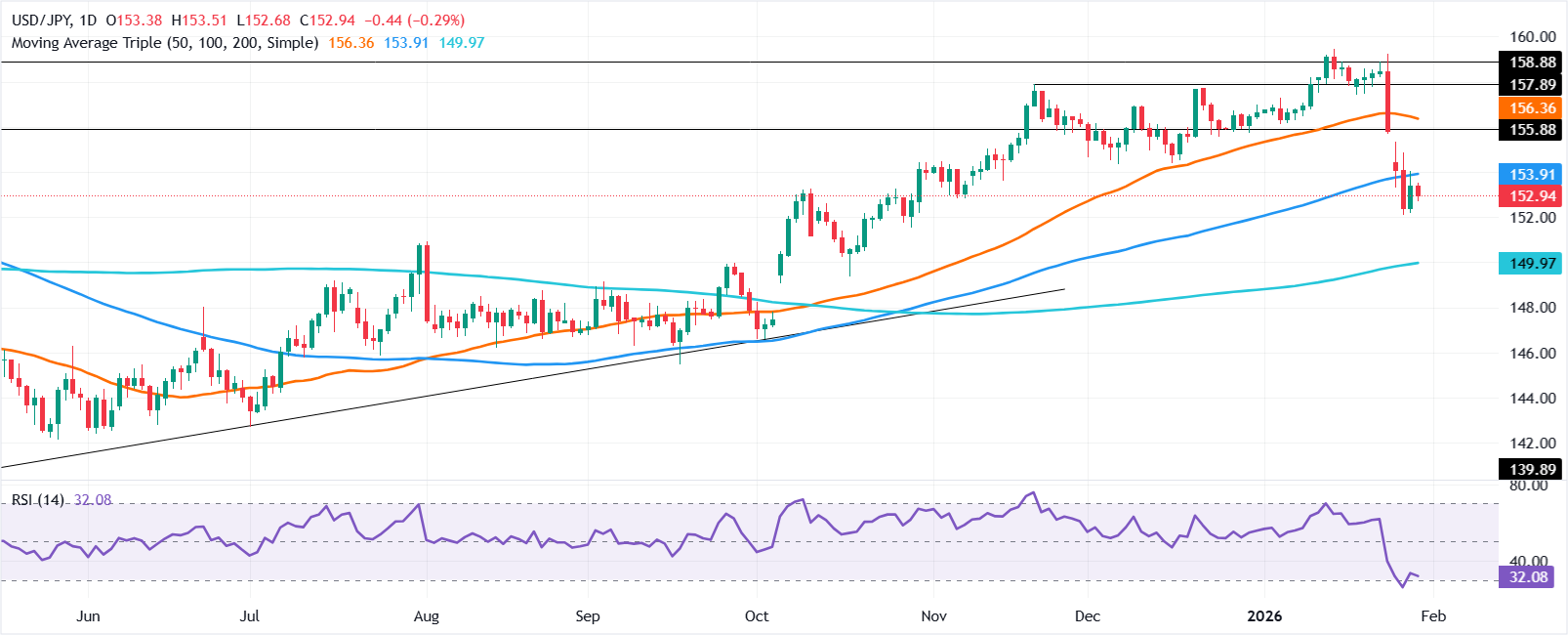
Despite seesawing during the session, USD/JPY seems poised to achieve back-to-back sessions of a ‘bullish harami’ candle pattern, which usually happens at the end of a bearish run.
If USD/JPY clears 155.00, buyers could drive the exchange rate to the last cycle high seen on January 23 at 159.22. On further strength, traders could challenge 160.00 amid intervention fears. On the flip side, if the pair slides below the January 22 daily low of 152.09, this could negate the ‘bullish harami’ and exacerbate a test of 150.00.
Japanese Yen FAQs
The Japanese Yen (JPY) is one of the world’s most traded currencies. Its value is broadly determined by the performance of the Japanese economy, but more specifically by the Bank of Japan’s policy, the differential between Japanese and US bond yields, or risk sentiment among traders, among other factors.
One of the Bank of Japan’s mandates is currency control, so its moves are key for the Yen. The BoJ has directly intervened in currency markets sometimes, generally to lower the value of the Yen, although it refrains from doing it often due to political concerns of its main trading partners. The BoJ ultra-loose monetary policy between 2013 and 2024 caused the Yen to depreciate against its main currency peers due to an increasing policy divergence between the Bank of Japan and other main central banks. More recently, the gradually unwinding of this ultra-loose policy has given some support to the Yen.
Over the last decade, the BoJ’s stance of sticking to ultra-loose monetary policy has led to a widening policy divergence with other central banks, particularly with the US Federal Reserve. This supported a widening of the differential between the 10-year US and Japanese bonds, which favored the US Dollar against the Japanese Yen. The BoJ decision in 2024 to gradually abandon the ultra-loose policy, coupled with interest-rate cuts in other major central banks, is narrowing this differential.
The Japanese Yen is often seen as a safe-haven investment. This means that in times of market stress, investors are more likely to put their money in the Japanese currency due to its supposed reliability and stability. Turbulent times are likely to strengthen the Yen’s value against other currencies seen as more risky to invest in.
Author

Christian Borjon Valencia
FXStreet
Markets analyst, news editor, and trading instructor with over 14 years of experience across FX, commodities, US equity indices, and global macro markets.


![How Wall Street rigs the game [Video]](https://editorial.fxsstatic.com/images/i/market-chaos-01.jpg)