Gold slumps on geopolitical developments, strong Dollar ahead of Powell’s speech
- Gold tumbles as Trump, Zelenskiy and European leaders discuss possible negotiations with Russia.
- Safe-haven demand eases as speculation of security guarantees for Kyiv sparks optimism over a potential end to the war.
- Trader’s eye Fed minutes and Powell’s speech for clues on policy path as Bowman reiterates outlook for three rate cuts.

Gold price tumbles on Tuesday as the Greenback extends its minimal gains for the second straight day, while geopolitical developments suggest that a positive outcome of the US President Trump meeting with Putin, Zelenskiy and European leaders could put an end to the ongoing war. XAU/USD is trading at $3,317.
Rumors of a possible de-escalation of the Ukraine–Russia conflict weighed on Bullion prices, which usually benefit from global uncertainty. Last Friday, the meeting between US President Donald Trump and his Russian counterpart, Vladimir Putin, prepared the ground for a possible resolution.
Trump reunited with Ukraine’s President Volodymyr Zelenskiy and other European leaders on Monday to set the stage for a possible ceasefire and push for a trilateral meeting to begin negotiations between Kyiv and Moscow.
US President Trump said that “Putin, Zelenskiy must be flexible” and that there would be some security guarantees for Ukraine to prevent another Russian attack. However, he said that he would not allow Ukraine to join NATO and added that European countries would supply ground troops.
Aside from this, housing data in the US was mixed. Housing Starts in July crushed estimates, rising more than 5%, while Building Permits dropped. Meanwhile, Federal Reserve (Fed) Governor Michelle Bowman reiterated the posture of three cuts by the year’s end and emphasized that the central bank should focus more on the employment mandate.
Ahead of this week, traders are eyeing the latest Fed meeting minutes and the speech of Fed Chair Jerome Powell on Friday.
Daily digest market movers: Gold price tumbles on US Dollar strength
- The US Dollar Index (DXY), which tracks the buck's performance against a basket of six currencies, is up 0.13% at 98.23.
- The US 10-year Treasury note is yielding 4.30%, down by nearly three basis points (bps).
- US Housing Starts rose 5.2% in July, climbing from 1.321 million to 1.428 million and beating expectations for a decline to 1.3 million. In contrast, Building Permits slipped during the same period, falling from 1.393 million to 1.354 million, signaling some softness ahead in residential construction activity.
- Expectations that the Fed will reduce rates in September remain high, though traders priced out a 50-bps chance that emerged following the US Consumer Price Index (CPI) report. However, July’s PPI spooked investors, who had also bet that the central bank might keep rates unchanged.
- Fed Interest Rate Probabilities show that traders had priced in an 85% chance of a quarter of a percentage rate cut at the September meeting, according to Prime Market Terminal data.
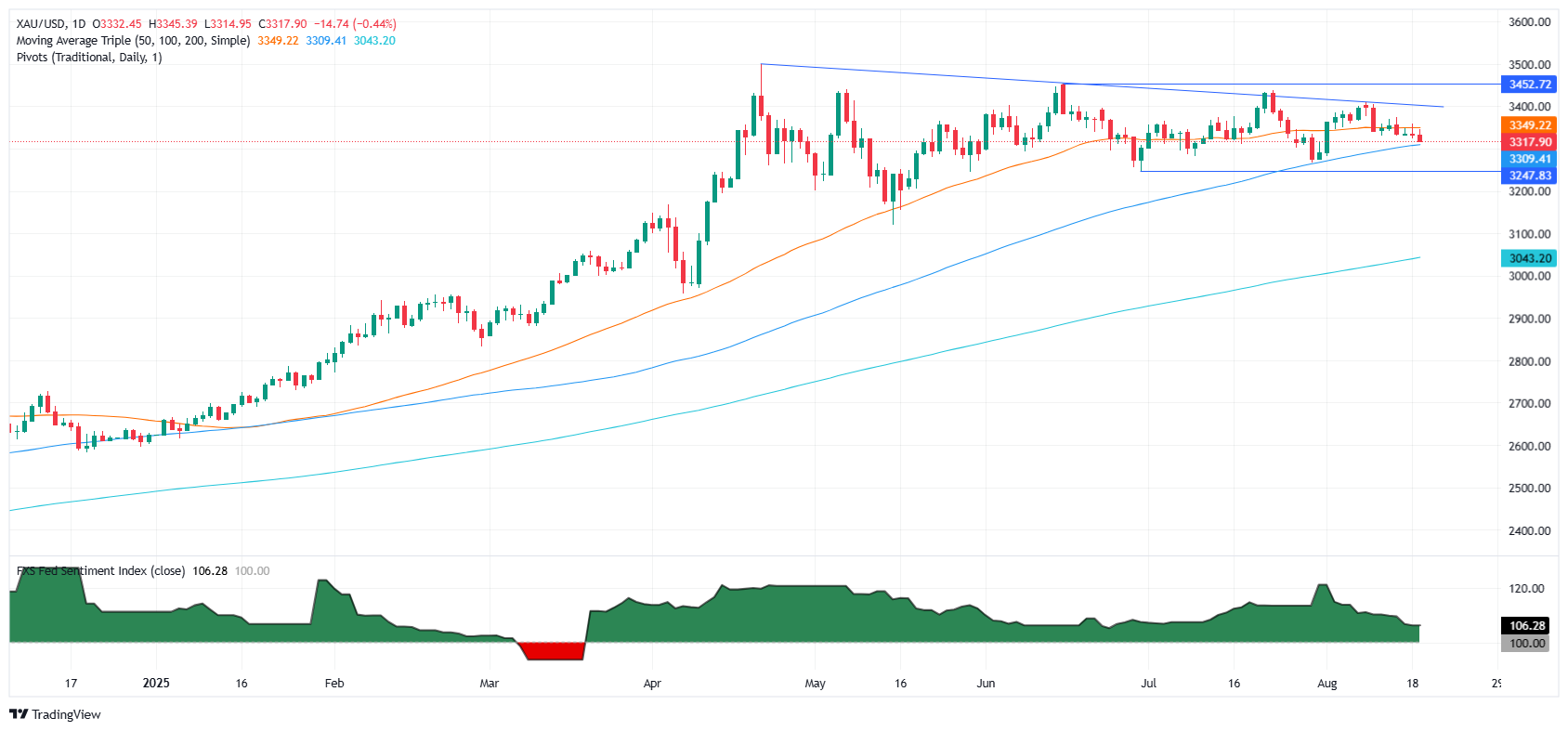
Technical outlook: Gold price slides towards $3,300 to turn neutral below $3,250
Gold price prints back-to-back bearish days, even though the overall trend in the daily chart is upwards. Nevertheless, since XAU/USD dropped below $3,320, the yellow metal seems poised to challenge the 100-day Simple Moving Average (SMA) at $3,301 in the near term.
The Relative Strength Index (RSI) turned bearish after it crossed below its 50-neutral line, but from a price action perspective, Gold needs to clear the June 30 low of $3,246 before turning neutral ahead of testing lower prices.
For a bullish resumption, traders need to reclaim the confluence of the 20- and 50-day Simple Moving Averages (SMAs) between $3,347/48. A breach of those levels clears the path to test $3,400. Overhead lie further key resistance levels, like the June 16 high at $3,452 and ultimately the all-time peak of $3,500.
Gold FAQs
Gold has played a key role in human’s history as it has been widely used as a store of value and medium of exchange. Currently, apart from its shine and usage for jewelry, the precious metal is widely seen as a safe-haven asset, meaning that it is considered a good investment during turbulent times. Gold is also widely seen as a hedge against inflation and against depreciating currencies as it doesn’t rely on any specific issuer or government.
Central banks are the biggest Gold holders. In their aim to support their currencies in turbulent times, central banks tend to diversify their reserves and buy Gold to improve the perceived strength of the economy and the currency. High Gold reserves can be a source of trust for a country’s solvency. Central banks added 1,136 tonnes of Gold worth around $70 billion to their reserves in 2022, according to data from the World Gold Council. This is the highest yearly purchase since records began. Central banks from emerging economies such as China, India and Turkey are quickly increasing their Gold reserves.
Gold has an inverse correlation with the US Dollar and US Treasuries, which are both major reserve and safe-haven assets. When the Dollar depreciates, Gold tends to rise, enabling investors and central banks to diversify their assets in turbulent times. Gold is also inversely correlated with risk assets. A rally in the stock market tends to weaken Gold price, while sell-offs in riskier markets tend to favor the precious metal.
The price can move due to a wide range of factors. Geopolitical instability or fears of a deep recession can quickly make Gold price escalate due to its safe-haven status. As a yield-less asset, Gold tends to rise with lower interest rates, while higher cost of money usually weighs down on the yellow metal. Still, most moves depend on how the US Dollar (USD) behaves as the asset is priced in dollars (XAU/USD). A strong Dollar tends to keep the price of Gold controlled, whereas a weaker Dollar is likely to push Gold prices up.
Author

Christian Borjon Valencia
FXStreet
Markets analyst, news editor, and trading instructor with over 14 years of experience across FX, commodities, US equity indices, and global macro markets.

















