Gold retreats from record highs, holds above $3,100 ahead April's tariff shock
- Gold dips 0.28% after rally on Tuesday with market cautious ahead of April 2 'Liberation Day' tariff announcement.
- Recession fears increase as Atlanta Fed cuts Q1 GDP projection to -3.7%, spiking Fed rate cut expectations to 78 bps.
- US data sends mixed signals; ISM indicates worsening conditions, S&P Global suggests expansion.

Gold prices retreated on Tuesday as traders booked profits, awaiting April 2’s Liberation Day in the US, an event in which President Donald Trump is expected to announce additional tariffs aimed at improving the trade deficit imbalance. The XAU/USD trades at $3,114, down 0.28%.
Market sentiment remains mixed as reflected by US equity markets. Investors are anticipating the release of the latest US tariffs on Wednesday with speculation that they will be universal and may reach as high as 20%, according to The Washington Post.
Bullion’s rally was halted on Tuesday despite traders remaining uncertain about the magnitude of the tariffs imposed.
The US economic schedule revealed data that presents a bleak economic outlook as evidenced by money market futures pricing in more than 78 basis points of interest rate cuts by the Federal Reserve (Fed).
Business activity in the US was mixed, according to data announced by S&P Global and the Institute for Supply Management (ISM). The former revealed expansion, while the latter hinted that business conditions are worsening as another round of tariffs looms.
Other data revealed that the labor market remains robust as the US Department of Labor reported a decrease in job openings.
In the meantime, recession fears in the US are growing. Goldman Sachs revealed that the odds of a recession in the United States (US) rose from 20% to 35%, primarily due to business and household pessimism about the outlook, as well as Washington's tolerance of a deeper economic slowdown.
The latest estimate from the Atlanta Fed's GDPNow model indicates that GDP for Q1 2025 is expected to contract by -3.7%, down from the -2.8% estimate on March 28.
Ahead this week, the US economic docket will feature the ISM Services PMI, Nonfarm Payrolls (NFP) figures, and Fed Chair Jerome Powell's speech on Friday.
Daily digest market movers: Gold price treads water amid lower US yields
- The US 10-year T-note yield tumbles four basis points to 4.169%. US real yields edge down two bps to 1.832%, according to US 10-year Treasury Inflation-Protected Securities (TIPS) yields.
- The US ISM Manufacturing PMI fell sharply in March, dropping from 50.3 to 49.3, signaling contraction in the sector. The survey’s comments highlighted tariffs as a key factor contributing to weakness across multiple sub-components.
- The JOLTS report from the US Department of Labor showed that job openings decreased to 7.568 million in February, down from 7.762 million and missing the forecast of 7.63 million. Despite the decline, vacancies remained relatively steady.
- In contrast, S&P Global's Manufacturing PMI indicated modest growth, rising from 49.8 to 50.2, suggesting a slight rebound in factory activity.
- On the commodities front, major Wall Street banks including Goldman Sachs, Société Générale, and Bank of America have raised their Gold price forecasts. They now eye $3,300 as the next upside target, according to a report by Kitco.
XAU/USD technical outlook: Gold price retreats from all-time highs near $3,150
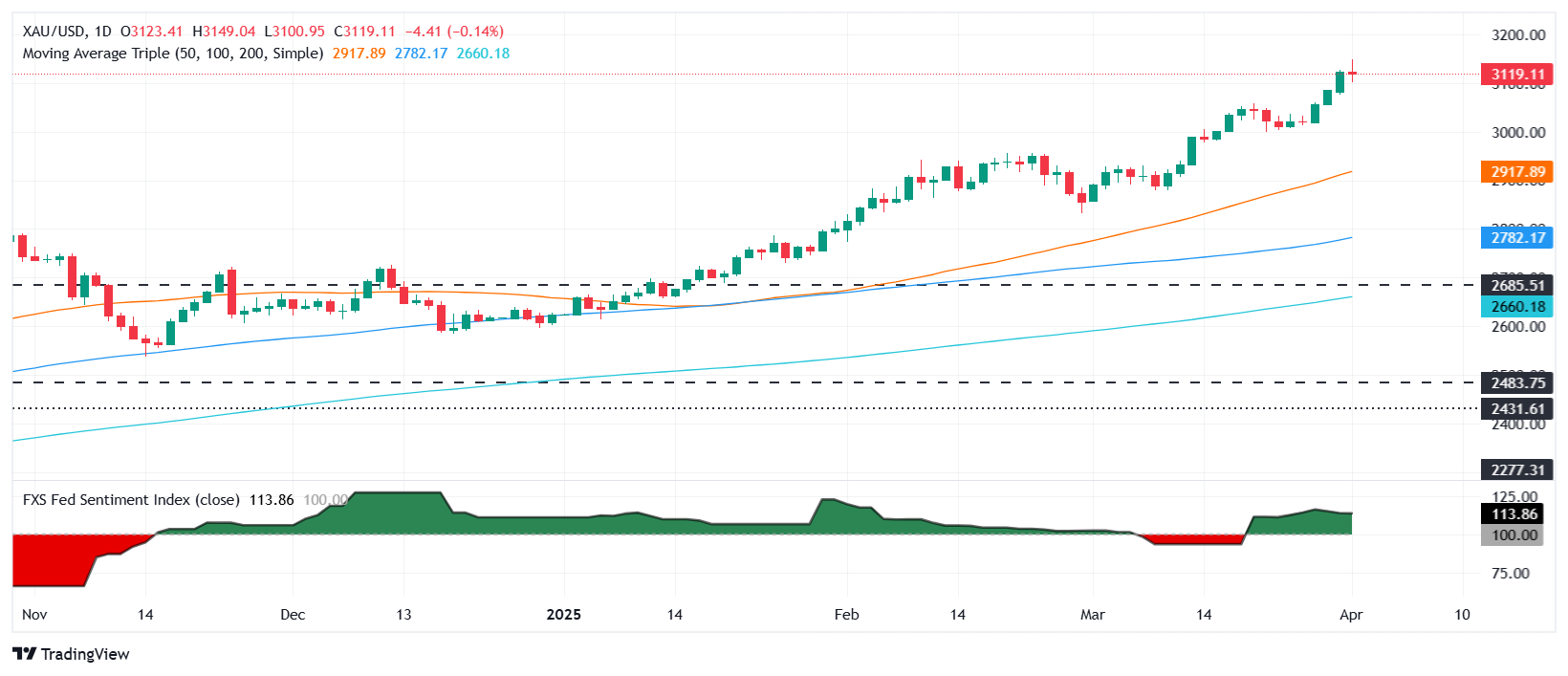
Gold price’s uptrend remains intact, yet price action on Tuesday formed a Doji candlestick, an indication that buyers and sellers lack commitment to open fresh positions ahead of Trump’s announcement. Technical indicators, such as the Relative Strength Index (RSI), suggest that the yellow metal is overbought, paving the way for a retracement.
Despite this, if XAU/USD remains above $3,100, it maintains buyers' control. A breach of this level will expose the March 20 high, which has since turned into support at $3,057, followed by the $3,000 mark. Conversely, if the rally extends, the first resistance level would be the record high at $3,149, followed by the $3,200 mark.
Risk sentiment FAQs
In the world of financial jargon the two widely used terms “risk-on” and “risk off'' refer to the level of risk that investors are willing to stomach during the period referenced. In a “risk-on” market, investors are optimistic about the future and more willing to buy risky assets. In a “risk-off” market investors start to ‘play it safe’ because they are worried about the future, and therefore buy less risky assets that are more certain of bringing a return, even if it is relatively modest.
Typically, during periods of “risk-on”, stock markets will rise, most commodities – except Gold – will also gain in value, since they benefit from a positive growth outlook. The currencies of nations that are heavy commodity exporters strengthen because of increased demand, and Cryptocurrencies rise. In a “risk-off” market, Bonds go up – especially major government Bonds – Gold shines, and safe-haven currencies such as the Japanese Yen, Swiss Franc and US Dollar all benefit.
The Australian Dollar (AUD), the Canadian Dollar (CAD), the New Zealand Dollar (NZD) and minor FX like the Ruble (RUB) and the South African Rand (ZAR), all tend to rise in markets that are “risk-on”. This is because the economies of these currencies are heavily reliant on commodity exports for growth, and commodities tend to rise in price during risk-on periods. This is because investors foresee greater demand for raw materials in the future due to heightened economic activity.
The major currencies that tend to rise during periods of “risk-off” are the US Dollar (USD), the Japanese Yen (JPY) and the Swiss Franc (CHF). The US Dollar, because it is the world’s reserve currency, and because in times of crisis investors buy US government debt, which is seen as safe because the largest economy in the world is unlikely to default. The Yen, from increased demand for Japanese government bonds, because a high proportion are held by domestic investors who are unlikely to dump them – even in a crisis. The Swiss Franc, because strict Swiss banking laws offer investors enhanced capital protection.
Author

Christian Borjon Valencia
FXStreet
Markets analyst, news editor, and trading instructor with over 14 years of experience across FX, commodities, US equity indices, and global macro markets.

















