Gold price rises on fears about Fed's independence, weak PPI
- Gold reached a three-week high before retreating to around 3,350.
- Trump fuels volatility after hinting at Powell's removal, then walks back comments.
- India’s Gold imports plunge 40% in June as high prices curb demand.

Gold price rose during the North American session by 0.78%, helped by US President Donald Trump's comments on firing Federal Reserve (Fed) Chair Jerome Powell, despite his denials of the remarks, saying it is highly unlikely to fire him unless there is fraud. At the time of writing, XAU/USD trades at 3,348 after hitting a daily peak of $3,377 on Trump’s headlines.
A Bloomberg article revealed that “Trump discussed the possible move in a meeting with GOP lawmakers at the White House to discuss cryptocurrency legislation,” with Trump saying that almost every one of them liked the idea of removing Powell.
Besides domestic political issues, data and geopolitical developments pushed bullion prices higher. The Producer Price Index (PPI) in the US dipped below estimates but remains above the Federal Reserve’s 2% goal. On the geopolitical front, Israeli strikes on Syria capped XAU/USD drop, while the latest consumer inflation report in the US capped Gold’s upside below the $3,400 mark.
Physical demand for the yellow metal impeded XAU/USD from climbing back above $3,400. India revealed that Gold imports in June fell 40% from a year ago, due to high prices sapping demand, according to two industry officials.
Ahead this week, traders will eye Fed speeches, Retail Sales, jobs data, and the University of Michigan Consumer Sentiment report.
Gold daily market movers: Hovers near $3,350 awaiting a fresh catalyst
- Gold price continued to trade sideways, capped by the $3,300-$3,380 range on Wednesday. Bullion’s spike happened on reports of Powell’s firing. Bloomberg revealed that “A White House official, speaking on the condition of anonymity earlier Wednesday, said they expected Trump to move soon against the Fed chief. That was also the impression of some lawmakers following a Tuesday evening meeting, where Trump polled them on the possibility of moving against Powell.”
- When asked on Wednesday, Trump said that while “it’s highly unlikely,” he could still see removing the Fed chair for “fraud.”
- The US Produce Price Index (PPI) in June dipped from 2.6% to 2.3% YoY, below estimates of 2.5%. Excluding volatile items, PPI cooled from 3% to 2.6%, below forecasts of 2.7%.
- Although factory inflation eased, the latest consumer inflation report in the US showed that prices jumped in June and are closing in on the 3% threshold, far from the Fed’s 2% goal.
- US Treasury yields dipped on Wednesday, with the US 10-year Treasury yield, which usually correlates negatively with Gold, falling three basis points (bps) to 4.459%.
- Interest rate probability indicates that the Federal Reserve will maintain its current rates, with odds standing at 95% for a hold and 5% for a 25-basis-point rate cut at the July 30 meeting. Money markets had priced in less than 50 basis points (bps) of easing, with investors pricing in over 46 bps of rate cuts toward the end of the year.
- US President Trump stated that another deal with India is forthcoming. He added that they would deal with Japan with the tariffs letter. He announced on Tuesday that the US reached an agreement with Indonesia, in which the latter will pay 19% tariffs, while US producers will pay 0%.
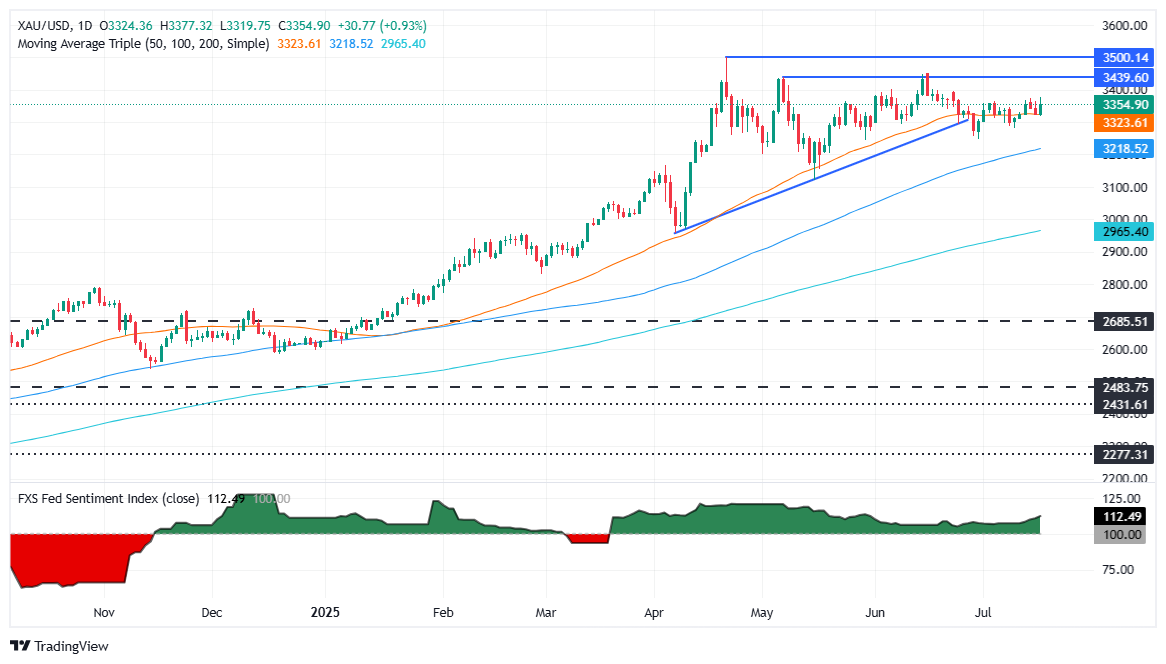
XAU/USD technical outlook: Gold recovers the 20-day SMA and $3,350
Gold’s uptrend remains intact, but it has consolidated at around $3,350. The Relative Strength Index (RSI) indicates that bullish momentum is increasing, although price action remains sideways. For a bullish continuation, XAU/USD must clear $3,400, which will expose the June 16 high of $3,452, ahead of the record high of $3,500.
On the downside, if XAU/USD drops below $3,300, look for a decline to the June 30 low of $3,246, followed by the 100-day Simple Moving Average (SMA) at $3,205.
Fed FAQs
Monetary policy in the US is shaped by the Federal Reserve (Fed). The Fed has two mandates: to achieve price stability and foster full employment. Its primary tool to achieve these goals is by adjusting interest rates. When prices are rising too quickly and inflation is above the Fed’s 2% target, it raises interest rates, increasing borrowing costs throughout the economy. This results in a stronger US Dollar (USD) as it makes the US a more attractive place for international investors to park their money. When inflation falls below 2% or the Unemployment Rate is too high, the Fed may lower interest rates to encourage borrowing, which weighs on the Greenback.
The Federal Reserve (Fed) holds eight policy meetings a year, where the Federal Open Market Committee (FOMC) assesses economic conditions and makes monetary policy decisions. The FOMC is attended by twelve Fed officials – the seven members of the Board of Governors, the president of the Federal Reserve Bank of New York, and four of the remaining eleven regional Reserve Bank presidents, who serve one-year terms on a rotating basis.
In extreme situations, the Federal Reserve may resort to a policy named Quantitative Easing (QE). QE is the process by which the Fed substantially increases the flow of credit in a stuck financial system. It is a non-standard policy measure used during crises or when inflation is extremely low. It was the Fed’s weapon of choice during the Great Financial Crisis in 2008. It involves the Fed printing more Dollars and using them to buy high grade bonds from financial institutions. QE usually weakens the US Dollar.
Quantitative tightening (QT) is the reverse process of QE, whereby the Federal Reserve stops buying bonds from financial institutions and does not reinvest the principal from the bonds it holds maturing, to purchase new bonds. It is usually positive for the value of the US Dollar.
Author

Christian Borjon Valencia
FXStreet
Markets analyst, news editor, and trading instructor with over 14 years of experience across FX, commodities, US equity indices, and global macro markets.

















