|

Gold Review: Drops to fresh session low, now seems vulnerable

   •  Surging US bond yields help ease USD bearish pressure and prompt some fresh selling.
   •  Fading safe-haven demand, amid easing global trade tensions adds to the downward pressure.
   •  Technical studies point to a possible resumption of the well-established bearish trend.

After an initial uptick to $1235 area, gold met with some fresh supply and has now eroded a part of gains recorded in the previous session.

Persistent US Dollar selling pressure, which tends to underpin demand for dollar-denominated commodities contributed to the initial uptick during the Asian session on Thursday. However, a goodish pickup in the US Treasury bond yields helped ease the USD bearish pressure and prompted some fresh selling around the non-yielding yellow metal.

This coupled with easing global trade tensions after the US President Donald Trump and European Commission President Jean-Claude Juncker agreed to work towards eliminating trade barriers, further weighed on the precious metal's safe-haven appeal and collaborated to the ongoing retracement slide. 

Technical Analysis

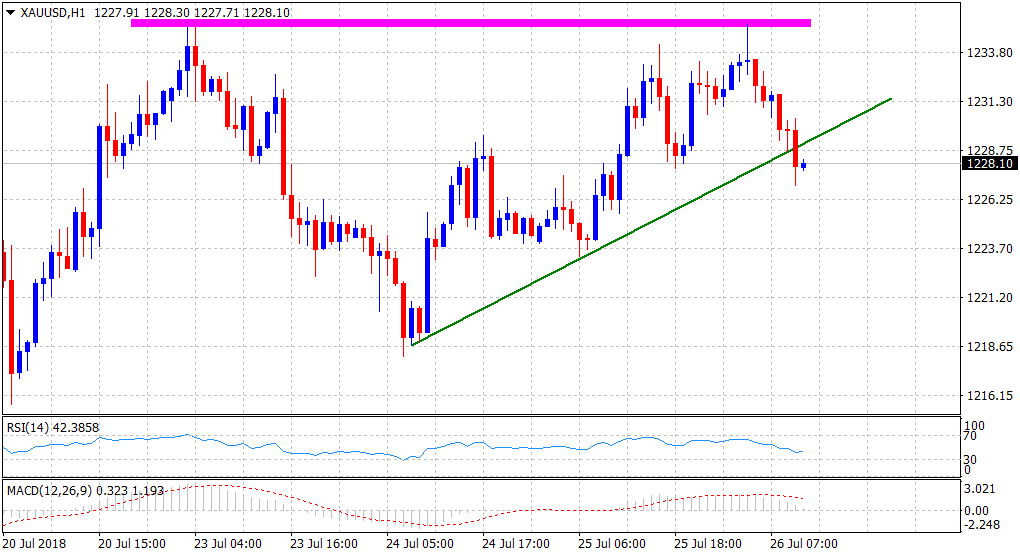
The commodity is retreating from weekly tops, set on Monday, which now seems to constitute towards forming a bearish double-top chart pattern on the 1-hourly chart. 

Meanwhile, the latest leg of downfall over the past hour or so could also be attributed to some technical selling below a short-term ascending trend-line support on the 1-hourly chart. 

Technical indicators have also started losing positive momentum and hence, a follow-through weakness, back closer to $1224 horizontal support, now looks a distinct possibility.

A convincing break below the mentioned support would confirm the bearish formation and pave the way for the resumption of the commodity's prior depreciating move. 

Spot rate: $1228
Daily High: $1235
Trend: Turning bearish again

Resistance
R1: $1235 (weekly tops)
R2: $1241 (horizontal zone)
R3: $1249 (July 12 swing high)

Support
S1: $1224 (horizontal zone)
S2: $1218 (weekly low set on Tuesday)
S3: $1212 (YTD swing low touched on July 19)
Author

Haresh Menghani

Haresh Menghani is a detail-oriented professional with 10+ years of extensive experience in analysing the global financial markets.


More from Haresh Menghani
Share:

Editor's Picks

AUD/USD bulls regain control above 0.6950 amid USD retreat

AUD/USD regains traction and extends the previous day's bounce from the weekly low, aiming for 0.7000 in Asia on Friday. The overnight pullback in US bond yields keeps the US Dollar below an 18-month high, which in turn offers some support to the pair. Meanwhile, hawkish RBA expectations also keep the major underpinned.

USD/JPY holds gains near 158.00 after Japan's weak Household Spending data

USD/JPY clings to gains around 158.00 after data showed on Friday that Japan's Household Spending fell for the ninth straight month, undermining the Japanese Yen. Meanwhile, the US Dollar remains depressed as the overnight fall in US bond yields counters a hawkish Fed and geopolitical uncertainties, could cap any downside in the pair.

Gold remains range-bound below $4,200

Gold has given up some ground after an initial bullish attempt to reach weekly highs, returning to below the $4,200 mark per troy ounce on Friday. The US Dollar’s strong upside momentum, combined with rising US Treasury yields across the curve, seems to keep further gains in the yellow metal under scrutiny.

Has Bitcoin really escaped the macro forces it was built to fight?
Over 17 years ago, Satoshi Nakamoto designed Bitcoin (BTC) on the back of a global financial crisis as an alternative to the global monetary system outside the control of central banks, governments and traditional intermediaries. This raises a key question: has Bitcoin really become independent of the macroeconomic forces it was built to challenge?
The Euro is not the sick man of Europe. France's bond market is
EUR/USD remains under pressure, near the 17-month low of 1.1161 reached on Monday. The pair has lost more than 7% since its yearly peak, as concerns over France's public finances increasingly weigh on the single currency. But behind the weakness of the Euro (EUR), the problem does not necessarily lie with the European economy as a whole.
Has Bitcoin really escaped the macro forces it was built to fight?
Over 17 years ago, Satoshi Nakamoto designed Bitcoin (BTC) on the back of a global financial crisis as an alternative to the global monetary system outside the control of central banks, governments and traditional intermediaries. This raises a key question: has Bitcoin really become independent of the macroeconomic forces it was built to challenge?














