Breaking: Gold spikes to a new all-time high on continued expectations of Fed rate cuts
- Gold breaks to new high above $2,490 as investors continue to expect the Fed to cut interest rates in September.
- Gold had pulled back earlier after the release of strong US retail sales data.
- Lower US initial jobless claims brought more positive news about the US economy, helping to dispel recession fears.
- The precious metal is probably unfolding a leg down within a sideways trend.

Gold (XAU/USD) is spiking to a new record high above $2,490 on Friday during the US session as investors continue to bet on the Federal Reserve (Fed) cutting interest rates in September despite the release of better-than-expected Retail Sales data on Thursday.
Earlier on in the day the precious metal had retreated from a key chart resistance line in the $2,470s, which it had been battling with for most of the earlier part of the week.
The pullback had been caused by better-than-expected US Retail Sales data which came out at 1.0% month-over-month in July, roundly beat economists estimates of 0.3%, and signaled a turnaround from June’s downwardly-revised 0.2% drop.
Gold bulls took a breather after strong US data
Gold bulls took a breather after the release of stronger-than-expected US macroeconomic data on Thursday. This not only brought into question the view that the US economy was at risk of entering a recession but also strengthened the US Dollar (USD) which Gold is mainly priced in, and readjusted investor expectations for the future path of interest rates in the US.
Analysts differ as to the overall significance of the strong data. Ulrich Leuchtmann, Head of FX Research at Commerzbank, cautions against reading too much positivity into it because Retail Sales is a lagging economic metric.
“In a hypothetical coming recession, the US labor market would certainly only suffer damage with a time lag. And it is only then that the US consumer typically notices,” says Leuchtmann.
“Do you remember Tom & Jerry? In the cartoon, you often see Tom the cat running over a cliff and continuing to run in the air for a moment before crashing all the harder. If the US economy were to slide into recession in the near future, it seems plausible to me that US retail sales would show a similar behavior,” he adds.
Economists at Capital Economics on the other hand, are more positive, headlining their note “Don’t bet against the US Consumer.”
“There was almost nothing in the July retail sales report for the perma-bears to latch on to,” they said in the report. “That increases the likelihood that the Fed will kick off its loosening cycle with a 25 bp cut in September, rather than a 50 bp move as markets were recently pricing in,” it adds.
US Jobs market also shows signs of resilience
In addition to the strong US Retail sales data, further data out on Thursday also showed US Initial Jobless Claims declining to 227K from an upwardly revised 234K, indicating a rebound in the jobs market – a further positive for the US economy.
Capital economics puts the encouraging jobs data down to the rapid reversal of temporary negative factors – Hurricane Beryl and the temporary shutdown of auto factories in Michigan.
Technical Analysis: Gold steps back from range ceiling
Gold has broken out of the range it has been trading in since July on an intraday basis and is threatening to follow through higher as the breakout evolves and gains momentum.
XAU/USD 4-hour Chart
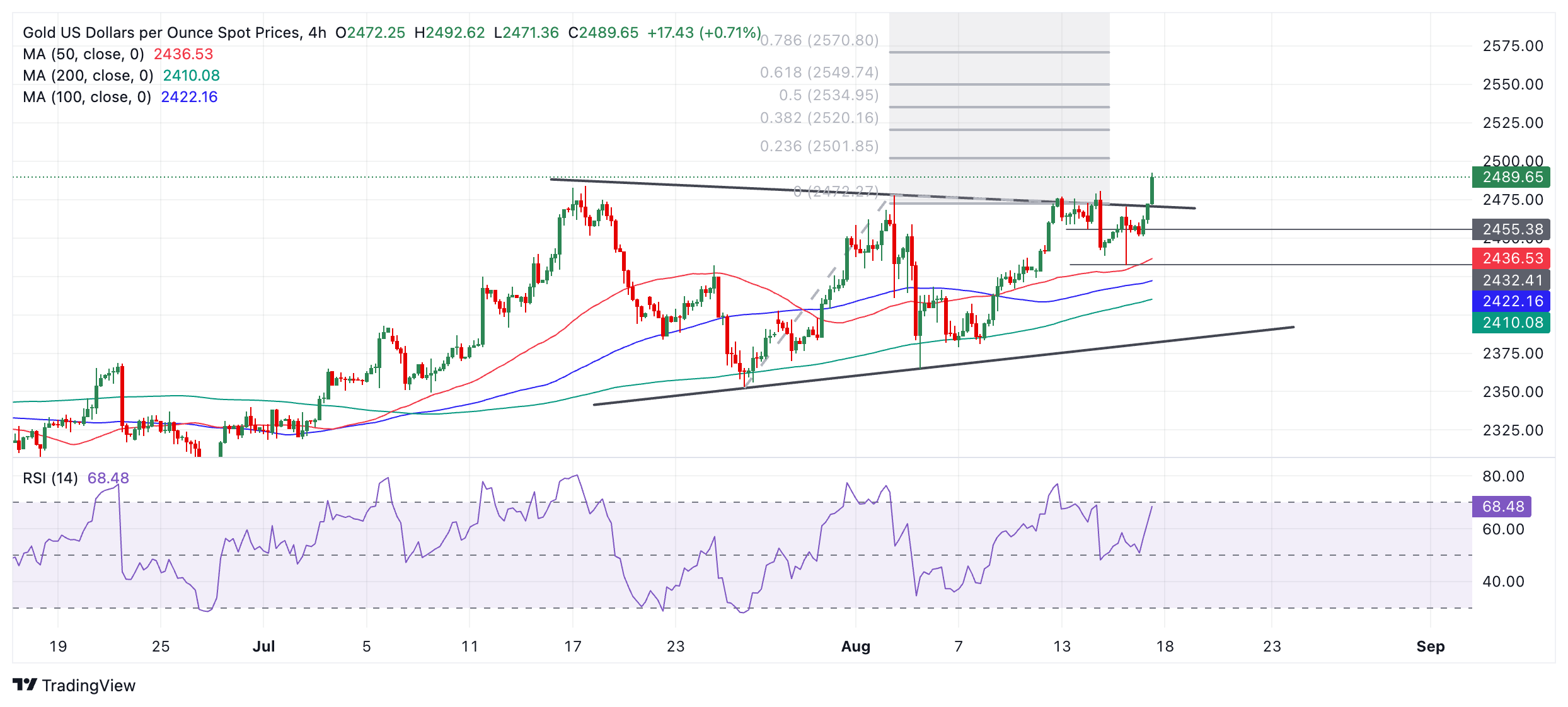
Gold has broken out higher, continuing the longer-term bullish trend that was in play prior to the formation of the range. It is in the process of decisively breaking above the range ceiling. A close on a 4-hour basis well above the range highs as looks possible would confirm an upside breakout. Such a breakout would then be expected to reach $2,550, a fresh all-time high, calculated by taking the 0.618 Fibonacci ratio of the range’s height and extrapolating it higher.
A decisive break would be one characterized by a long green candle that pierced clearly through the level and closed near its high, or three green candles in a row that breached the level.
Gold FAQs
Gold has played a key role in human’s history as it has been widely used as a store of value and medium of exchange. Currently, apart from its shine and usage for jewelry, the precious metal is widely seen as a safe-haven asset, meaning that it is considered a good investment during turbulent times. Gold is also widely seen as a hedge against inflation and against depreciating currencies as it doesn’t rely on any specific issuer or government.
Central banks are the biggest Gold holders. In their aim to support their currencies in turbulent times, central banks tend to diversify their reserves and buy Gold to improve the perceived strength of the economy and the currency. High Gold reserves can be a source of trust for a country’s solvency. Central banks added 1,136 tonnes of Gold worth around $70 billion to their reserves in 2022, according to data from the World Gold Council. This is the highest yearly purchase since records began. Central banks from emerging economies such as China, India and Turkey are quickly increasing their Gold reserves.
Gold has an inverse correlation with the US Dollar and US Treasuries, which are both major reserve and safe-haven assets. When the Dollar depreciates, Gold tends to rise, enabling investors and central banks to diversify their assets in turbulent times. Gold is also inversely correlated with risk assets. A rally in the stock market tends to weaken Gold price, while sell-offs in riskier markets tend to favor the precious metal.
The price can move due to a wide range of factors. Geopolitical instability or fears of a deep recession can quickly make Gold price escalate due to its safe-haven status. As a yield-less asset, Gold tends to rise with lower interest rates, while higher cost of money usually weighs down on the yellow metal. Still, most moves depend on how the US Dollar (USD) behaves as the asset is priced in dollars (XAU/USD). A strong Dollar tends to keep the price of Gold controlled, whereas a weaker Dollar is likely to push Gold prices up.
Author

FXStreet Team
FXStreet
Composed of a group of economic journalists and FX experts, the FXStreet content team produces and oversees all content published on FXStreet. It provides a purely journalistic approach to the Forex market.

















