Gold holds close to record highs as US Dollar softens on US PPI miss, focus shifts to CPI
- Gold steady near $3,650, close to its record high after near $3,675 seen on Tuesday.
- US PPI fell 0.1% MoM in August, after a downwardly revised 0.7% gain in July and below forecasts of a 0.3% increase.
- Technicals continue to show a strong bullish structure, with immediate support at $3,617 followed by $3,556.

Gold (XAU/USD) clings to gains on Wednesday after a sharp reversal the previous day, with the metal soaring to an all-time high near $3,675 before retreating to settle at $3,625. At the time of writing, XAU/USD is trading near $3,655, up about 0.80% on the day, extending gains after softer-than-expected US Producer Price Index (PPI) data reinforced bets on a Federal Reserve (Fed) rate cut next week, but offered little justification for a larger rate cut.
The US PPI for August delivered a significant downside surprise. Headline PPI fell 0.1% MoM, while forecasts had pointed to a 0.3% increase, and July’s reading was revised down to 0.7% from 0.9%.On an annual basis, headline inflation eased to 2.6% YoY, below the 3.3% forecast. Core PPI, excluding food and energy, also slipped 0.1% MoM compared to the expected 0.3% gain, while the annual rate slowed sharply to 2.8% from 3.7%.
Thursday’s Consumer Price Index (CPI) release will provide the final inflation checkpoint before the Fed's monetary policy meeting. Although a rate cut next week is widely expected, these figures will help shape expectations for the pace of easing beyond September.
Overall, Gold continues to draw support from a mix of underlying drivers. A broadly weaker US Dollar (USD) is making precious metals more attractive for overseas buyers. Central banks remain steady in their Gold purchases, reinforcing the metal’s role as a strategic asset. Growing trade frictions tied to US tariff policies, combined with persistent geopolitical tensions, are further fueling demand for safe havens. In addition, uncertainty surrounding the Fed’s autonomy amid rising political pressure is adding to investor caution, keeping Gold anchored near historic highs.
Gold Market movers: Looking for inflation cues
- Earlier on Tuesday, the Senate Banking Committee advanced Fed nominee Stephen Miran in a narrow 13-11 party-line vote, sending his nomination to the full Senate. Lawmakers noted that procedural timelines make it unlikely he will be confirmed in time to participate in the next week’s FOMC meeting, though his eventual confirmation would give President Trump another ally on the Fed Board.
- The US Dollar Index (DXY), which measures the Greenback's value against a basket of six major peers, is struggling to extend its rebound from seven-week lows. At the time of writing, the index is edging lower, last seen around 97.60.
- US Treasury yields are also steady across the curve after Tuesday’s mild pullback but remain near multi-month lows. The 10-year note is trading around 4.091%, the 30-year at 4.747%, while the rate-sensitive 2-year yield holds near 3.548%.
- Geopolitical risk remains elevated after Israel carried out an airstrike on Hamas leaders in Doha on Tuesday, killing several officials and a Qatari guard, while Poland intercepted Russian drones that violated its airspace during a large-scale assault on Ukraine in the early hours of Wednesday.
- On Tuesday, the US Supreme Court agreed to an expedited hearing in November to decide whether US President Donald Trump had legal authority to impose sweeping global tariffs. A potential ruling against the measure could force Washington to refund tens of billions of dollars in duties.
- President Trump urged the European Union (EU) on Tuesday to impose tariffs of up to 100% on imports from China and India as part of a broader plan to increase economic pressure on Russia, particularly due to its Oil trade.
- A federal judge has blocked President Trump’s attempt to remove Fed Governor Lisa Cook, ruling she can remain in office and vote at next week’s FOMC meeting. The court found that the “for cause” removal standard under the Federal Reserve Act only applies to misconduct during a governor’s tenure, so the administration’s claims were not considered valid grounds for dismissal.
Technical analysis: XAU/USD bulls eye fresh records above $3,675
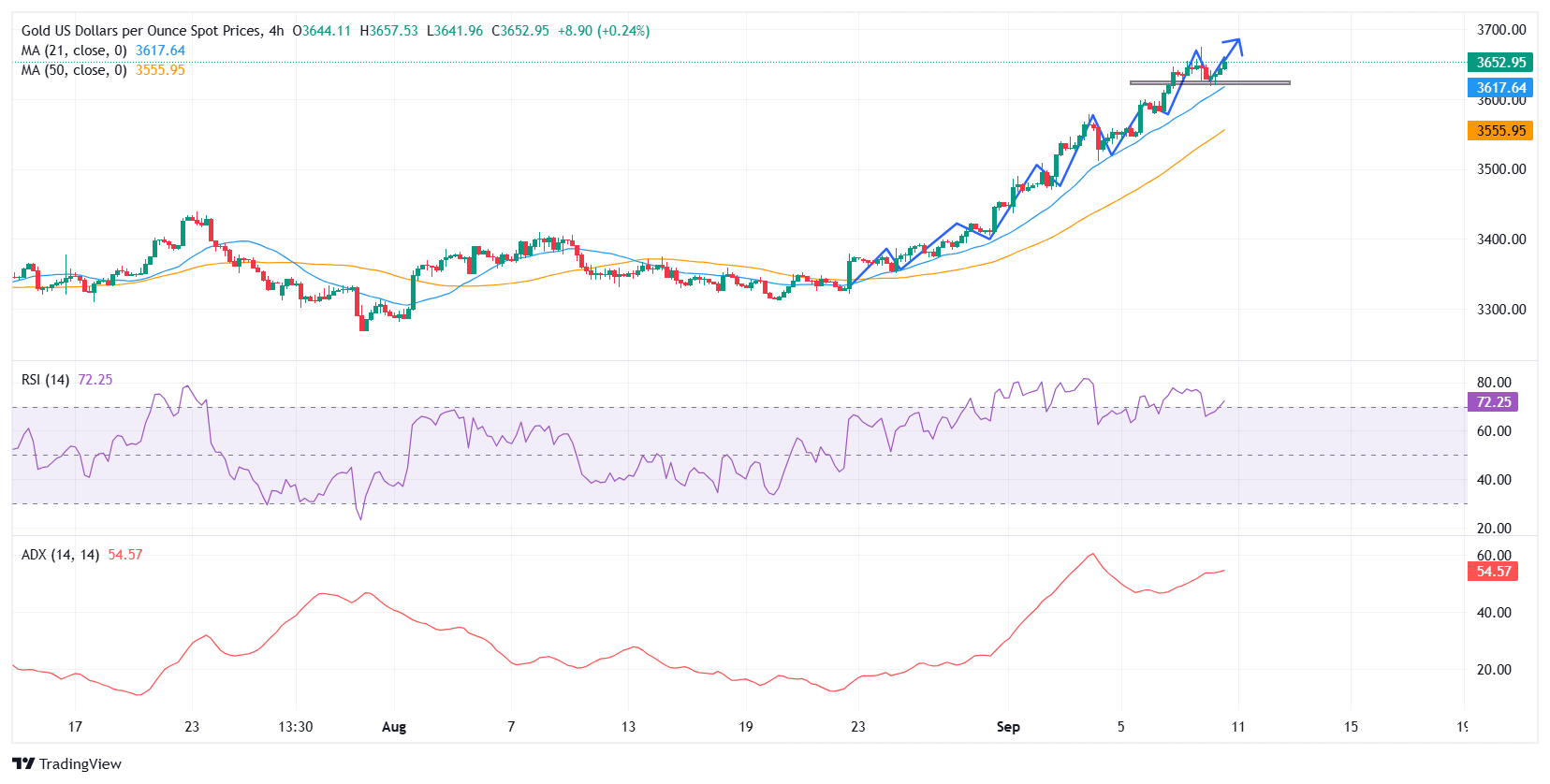
XAU/USD is extending its bullish structure on the 4-hour chart, carving out a staircase of higher highs and higher lows since bottoming near $3,300 in late August. The latest leg of the rally has lifted the metal into the $3,650 area and propelled it to a fresh all-time high around $3,675.
Price action remains comfortably above the 21-period Simple Moving Average (SMA) at $3,617, which continues to serve as dynamic support, while the 50-period SMA at $3,556 marks a deeper cushion.
Momentum indicators are aligned with the bullish tone. The Relative Strength Index (RSI) is holding above 73, reflecting overbought conditions but also confirming persistent buying pressure, while the Average Directional Index (ADX) above 54 signals a strong trend still in play.
As long as Gold holds above the immediate support near $3,600, the path of least resistance remains upwards, with scope for another run toward fresh record territory.
Fed FAQs
Monetary policy in the US is shaped by the Federal Reserve (Fed). The Fed has two mandates: to achieve price stability and foster full employment. Its primary tool to achieve these goals is by adjusting interest rates. When prices are rising too quickly and inflation is above the Fed’s 2% target, it raises interest rates, increasing borrowing costs throughout the economy. This results in a stronger US Dollar (USD) as it makes the US a more attractive place for international investors to park their money. When inflation falls below 2% or the Unemployment Rate is too high, the Fed may lower interest rates to encourage borrowing, which weighs on the Greenback.
The Federal Reserve (Fed) holds eight policy meetings a year, where the Federal Open Market Committee (FOMC) assesses economic conditions and makes monetary policy decisions. The FOMC is attended by twelve Fed officials – the seven members of the Board of Governors, the president of the Federal Reserve Bank of New York, and four of the remaining eleven regional Reserve Bank presidents, who serve one-year terms on a rotating basis.
In extreme situations, the Federal Reserve may resort to a policy named Quantitative Easing (QE). QE is the process by which the Fed substantially increases the flow of credit in a stuck financial system. It is a non-standard policy measure used during crises or when inflation is extremely low. It was the Fed’s weapon of choice during the Great Financial Crisis in 2008. It involves the Fed printing more Dollars and using them to buy high grade bonds from financial institutions. QE usually weakens the US Dollar.
Quantitative tightening (QT) is the reverse process of QE, whereby the Federal Reserve stops buying bonds from financial institutions and does not reinvest the principal from the bonds it holds maturing, to purchase new bonds. It is usually positive for the value of the US Dollar.
Author

Vishal Chaturvedi
FXStreet
I am a macro-focused research analyst with over four years of experience covering forex and commodities market. I enjoy breaking down complex economic trends and turning them into clear, actionable insights that help traders stay ahead of the curve.

















