Gold rises on haven demand due to increased geopolitical risk
- Gold rises on increased haven flows as geopolitical hotspots light up.
- Israel breaks its ceasefire agreement by attacking Hezbollah, and Putin threatens to use nuclear-capable missiles on Ukraine.
- XAU/USD is technically crawling up a major trendline but remains vulnerable to breakdowns.

Gold (XAU/USD) stages a bigger rebound on Friday and enters the $2,650s during the early US session. A rise in safe-haven flows due to a breakdown in the Israel – Hezbollah ceasefire agreement is one of the catalysts, as is Russian President Vladimir Putin’s warning Russia could launch nuclear-capable missiles at Ukraine.
Gold rallies as safe-haven demand increases
Gold experienced a drop in price of nearly 3.0% Monday on rumors Israel and Hezbollah were close to reaching a ceasefire agreement. An eventual deal emerged with both sides agreeing to a 60-day cessation of hostilities.
Gold is rebounding on Friday, however, after the ceasefire fell apart following a strike by the Israeli airforce on Hezbollah targets in southern Lebanon, who they claim were violating the ceasefire agreement.
Geopolitical risks have further ratcheted up in Ukraine after Russia left over a million inhabitants without electricity following widespread strikes on Wednesday night.
While speaking at a conference in Kazakhstan on Thursday, Putin said “he would consider further launches of Russia’s new Oreshnik medium-range ballistic missile, first fired at Ukraine’s Dnipro region last week,” according to CNN. Oreshnik’s have nuclear capability.
Gold supported by reduced risks of a US-Mexico trade war
Diminishing tariff fears could also be impacting Gold price after reports that US President-elect Donald Trump and Mexican President Claudia Sheinbaum had a constructive phone conversation on Wednesday. This suggests a lower risk of a costly trade war between the two countries.
The implementation of higher tariffs had been viewed as inflationary for the US and expected to keep interest rates elevated. This, in turn, would be negative for non-interest-paying assets like Gold. However, now many commentators are saying that Trump’s threat to put a 25% tariff on Mexican imports is probably more a negotiating tactic than anything else and, therefore, unlikely to materialize.
US Dollar edges lower, aiding Gold
A further factor supporting Gold on Friday is a weaker US Dollar (USD). The Dollar Index (DXY), which measures its value against a trade-weighted index of peers, has edged down during trading on Friday. This is positive for Gold, which is mainly priced and traded in USD.
Gold’s recovery on Thursday was partly spurred by increased bets the Fed would cut interest rates by 25 basis points (bps) at its December meeting, and whilst the expectations remain about the same, odds have not further increased as we draw to the end of the week.
The market-based probability of a rate hike is 66%, according to the CME FedWatch tool. This leaves a 34% chance the Fed will leave interest rates unchanged.
Technical Analysis: XAU/USD recovers along major trendline
Gold extends its recovery along a major trendline and is now entering the fourth day in a row of gains. The trendline reflects the precious metal’s long-term uptrend.
XAU/USD Daily Chart
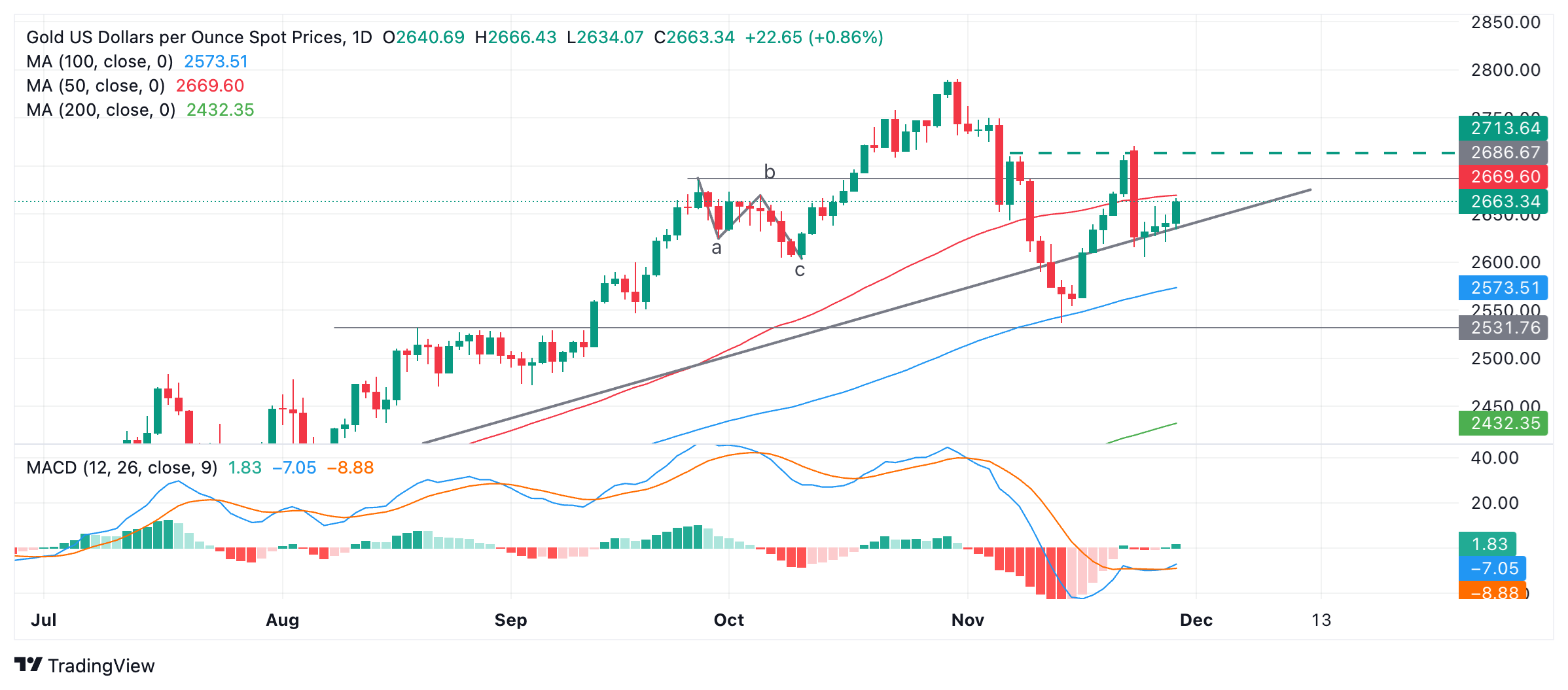
Gold’s short-term trend is unclear, but it is in a medium and long-term uptrend. Given the maxim that “the trend is your friend,” the odds still favor an eventual continuation higher.
A break above $2,721 (Monday’s high) would be a bullish sign and give the green light to a continuation higher. The next target would be at $2,790, matching the previous record high.
Alternatively, a decisive break below the major trendline would likely lead to further losses, probably to the $2,536 November lows. Such a move would confirm the short-term trend as bearish.
A decisive break would be one accompanied by a long red candlestick that broke cleanly through the trendline and closed near its low – or three red candlesticks in a row that broke below the line.
Gold FAQs
Gold has played a key role in human’s history as it has been widely used as a store of value and medium of exchange. Currently, apart from its shine and usage for jewelry, the precious metal is widely seen as a safe-haven asset, meaning that it is considered a good investment during turbulent times. Gold is also widely seen as a hedge against inflation and against depreciating currencies as it doesn’t rely on any specific issuer or government.
Central banks are the biggest Gold holders. In their aim to support their currencies in turbulent times, central banks tend to diversify their reserves and buy Gold to improve the perceived strength of the economy and the currency. High Gold reserves can be a source of trust for a country’s solvency. Central banks added 1,136 tonnes of Gold worth around $70 billion to their reserves in 2022, according to data from the World Gold Council. This is the highest yearly purchase since records began. Central banks from emerging economies such as China, India and Turkey are quickly increasing their Gold reserves.
Gold has an inverse correlation with the US Dollar and US Treasuries, which are both major reserve and safe-haven assets. When the Dollar depreciates, Gold tends to rise, enabling investors and central banks to diversify their assets in turbulent times. Gold is also inversely correlated with risk assets. A rally in the stock market tends to weaken Gold price, while sell-offs in riskier markets tend to favor the precious metal.
The price can move due to a wide range of factors. Geopolitical instability or fears of a deep recession can quickly make Gold price escalate due to its safe-haven status. As a yield-less asset, Gold tends to rise with lower interest rates, while higher cost of money usually weighs down on the yellow metal. Still, most moves depend on how the US Dollar (USD) behaves as the asset is priced in dollars (XAU/USD). A strong Dollar tends to keep the price of Gold controlled, whereas a weaker Dollar is likely to push Gold prices up.
Author

Joaquin Monfort
FXStreet
Joaquin Monfort is a financial writer and analyst with over 10 years experience writing about financial markets and alt data. He holds a degree in Anthropology from London University and a Diploma in Technical analysis.

















