Gold trades higher on Russia-Ukraine escalation
- Gold rallies for the fifth day in a row on Friday on the back of increased safe-haven demand due to Russia threats.
- Headwinds for the precious metal may come from shifting US interest rate expectations and the strong performance of the US Dollar.
- Technically, XAU/USD extends giants, fulfilling the promise of the bullish Three White Soldiers Japanese candlestick pattern.


Gold (XAU/USD) rallies for the fifth day in a row, making it a clean-sweep of green daily candlesticks for the week so far. The precious metal pulls back below $2,700 again during the US session on Friday after the US Dollar (USD) gains ground following the release of stronger-than-expected activity data. Overall, however, Gold sees gains as inflaming Russia-Ukraine tensions drive renewed safe-haven flows.
The preliminary US Global Composite PMI rises to 55.3 in November from 54.1 in October, according to data on Friday. The Manufacturing PMI rose to 48.8 in line with expectations and the Services PMI rose to 57.0 from 55.0 previously and beat expectations of 55.3.
The data was overall positive, especially when compared to European PMIs which declined. It further cements the view that interest rates will remain elevated in the US and increases the chances that the Federal Reserve (Fed) might hold back from cutting interest rates in December. Elevated interest rates are negative for Gold as they raise the opportunity cost of holding the non-interest paying asset.
The data further strengthens the US Dollar (USD), which is underpinned by the anticipation of the Trump government implementing Dollar-positive policies in January and recent data evidencing a robust US labor market.
Gold rises as Russia threatens United Kingdom
Gold is broadly rallying, however, on the back of increased haven flows after the Russian Ambassador for the UK, Andrey Kelin, told Sky News that the UK was now a legitimate target for Russian missile strikes after permitting Ukraine to use its British-made Storm Shadow missiles on Russian territory.
The comments mark an escalation in the conflict and come after Russia used intercontinental ballistic missiles in a strike on the Ukrainian city of Dnipro. This was a reprisal for an attack by Ukraine on Russian targets in the Kursk region, using British-made long-range missiles. This follows US President Biden’s decision to allow Ukraine to use its US-made ATACMS (Army Tactical Missile System) missiles against targets on Russian soil.
Technical Analysis: XAU/USD marches higher
Gold extends its march higher on Friday, fulfilling the promise of the bullish “Three White Soldiers” Japanese candlestick pattern (green rectangle on the chart below) it formed whilst rebounding from last week’s lows.
XAU/USD Daily Chart
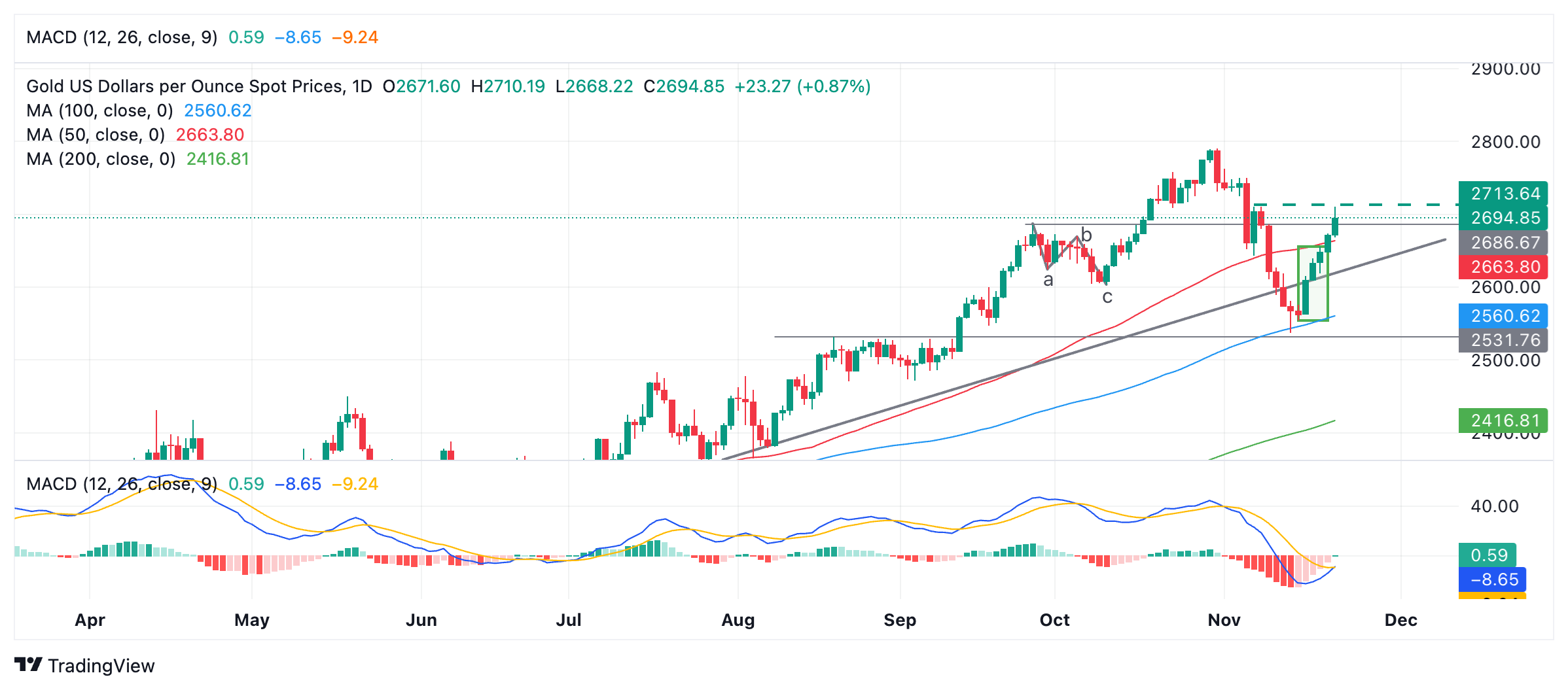
The up move is backed by the (blue) Moving Average Convergence Divergence (MACD) indicator crossing above its red signal line on an intraday basis. However, to give a proper signal, the crossover must endure until the day’s close.
The precious metal’s short-term trend is bullish, and given the maxim that “the trend is your friend,” the odds favor a continuation higher. Gold has already punched through the first target to the upside at $2,686, the September 26 high, and now prepares to meet resistance at the next key level of $2,710 at the November 8 swing high.
A break above $2,710 would be a very bullish sign as it would potentially cement the medium-term trend as bullish. This would mean all three major trends – the short, medium and long-term – were in the ascent, giving a green light to a continuation higher.
Until the level is broken, however, the precious metal could still arguably be in a downtrend on a medium-term basis, keeping alive downside risks to the outlook.
Gold FAQs
Gold has played a key role in human’s history as it has been widely used as a store of value and medium of exchange. Currently, apart from its shine and usage for jewelry, the precious metal is widely seen as a safe-haven asset, meaning that it is considered a good investment during turbulent times. Gold is also widely seen as a hedge against inflation and against depreciating currencies as it doesn’t rely on any specific issuer or government.
Central banks are the biggest Gold holders. In their aim to support their currencies in turbulent times, central banks tend to diversify their reserves and buy Gold to improve the perceived strength of the economy and the currency. High Gold reserves can be a source of trust for a country’s solvency. Central banks added 1,136 tonnes of Gold worth around $70 billion to their reserves in 2022, according to data from the World Gold Council. This is the highest yearly purchase since records began. Central banks from emerging economies such as China, India and Turkey are quickly increasing their Gold reserves.
Gold has an inverse correlation with the US Dollar and US Treasuries, which are both major reserve and safe-haven assets. When the Dollar depreciates, Gold tends to rise, enabling investors and central banks to diversify their assets in turbulent times. Gold is also inversely correlated with risk assets. A rally in the stock market tends to weaken Gold price, while sell-offs in riskier markets tend to favor the precious metal.
The price can move due to a wide range of factors. Geopolitical instability or fears of a deep recession can quickly make Gold price escalate due to its safe-haven status. As a yield-less asset, Gold tends to rise with lower interest rates, while higher cost of money usually weighs down on the yellow metal. Still, most moves depend on how the US Dollar (USD) behaves as the asset is priced in dollars (XAU/USD). A strong Dollar tends to keep the price of Gold controlled, whereas a weaker Dollar is likely to push Gold prices up.
Author
Joaquin Monfort
FXStreet
Joaquin Monfort is a financial writer and analyst with over 10 years experience writing about financial markets and alt data. He holds a degree in Anthropology from London University and a Diploma in Technical analysis.

















