Gold recovers as markets monitor Iran's potential retaliation and await Fed Powell's Testimony
- Gold prices recover as safe-haven flows increase amid potential retaliation from Iran, with the Fed Chair's Testimony on Tuesday in focus.
- Tensions between Iran and the US intensify, triggering a flight to safety and supporting a recovery in Gold prices.
- XAU/USD rebounds as Fed speaker Michelle Bowman signals the potential for rate cuts in July.

Gold prices are recovering during the US session on Monday, as escalating geopolitical tensions and shifts in the Federal Reserve's (Fed) interest rate narrative have led to a resurgence in bullish momentum. The US airstrikes on Iranian nuclear sites over the weekend triggered a sharp response from Tehran, which condemned the attacks as a major provocation and launched retaliatory missile and drone strikes on Israel. The renewed conflict has heightened fears of a broader regional escalation. Meanwhile, Fed Governor Michelle Bowman signaled openness to a potential interest rate cut as early as July, citing easing inflation pressures. Her comments added to speculation around the Fed’s next move, with markets now turning their focus to Chair Jerome Powell’s testimony before Congress on Tuesday for further policy clues.
Geopolitical risks surge, boosting Gold’s safe-haven flows
US President Donald Trump confirmed that American forces bombed three of Iran’s key nuclear facilities – Fordow, Natanz, and Isfahan on Saturday night.
In a televised address from the White House Briefing Room, Trump described the mission as “a very successful attack,” warning that “there are many other targets” if Iran does not seek peace.
The US coordinated strikes on Iran, dubbed Operation Midnight Hammer, involved B-2 Spirit bombers and Tomahawk missiles from US submarines. Iranian Foreign Minister Abbas Araghchi called the attacks “a heinous crime” in a state broadcast interview, warning of “everlasting consequences.” His remarks were later confirmed and quoted by Reuters on Sunday.
Iran’s parliament approved a motion to close the Strait of Hormuz — an Oil transit chokepoint for nearly 20% of global supply. The final decision now lies with the Supreme National Security Council. Oil prices spiked in response, adding to inflation risks and supporting safe-haven flows into Gold.
Gold daily digest market movers: Strait of Hormuz, inflation at risk
- Monday’s release of S&P Global’s preliminary Purchasing Managers’ Index (PMI) data for June. The manufacturing index came in at 52, unchanged from May but above consensus expectations of 51. The services component moderated slightly to 53.1 from 53.7 but still indicated expansion. These figures underscored resilience in the US economy, helping to stabilize bond yields and support the US Dollar.
- Speaking during an emergency session of the United Nations (UN) Security Council on Sunday, China’s Ambassador to the UN, Fu Cong, criticized the US strikes on Iran’s nuclear sites as “a serious breach of sovereignty” and warned of “potential consequences for regional stability.” He urged both the US and its allies to show restraint and emphasized that “force cannot resolve the issue.” His remarks were reported by Reuters and Chinese state media, which echoed Beijing’s call for diplomatic solutions and non-interference in Iran’s domestic affairs.
- Israeli Prime Minister Benjamin Netanyahu labeled the strikes “historic,” while UN Secretary-General António Guterres described them as a “dangerous escalation,” urging restraint. These comments were published across Reuters and major international outlets on Sunday.
- The mission to destroy Iran’s nuclear program was described by Trump as a “spectacular military success,” claiming Iran’s enrichment infrastructure was “completely and totally obliterated.”
- Iranian lawmaker and Revolutionary Guards commander Esmail Kosari told Press TV that parliament had “come to the conclusion we should close the Strait of Hormuz.” Kosari added that “the final decision is the responsibility of the Supreme National Security Council” and will be enacted “whenever necessary.” His remarks were echoed in a separate interview with the Young Journalist Club and widely reported by Reuters. The Strait remains critical for global energy flows, handling nearly 20% of daily Oil exports.
- Geopolitical tensions bolster Gold’s safe-haven appeal. The threat of retaliation from Iran and potential energy disruptions have fueled investor demand for Gold, even as prices consolidate below the $3,400 level. Uncertainty surrounding the security of maritime routes and the broader Middle East outlook continues to support risk-off positioning.
- The possibility of a prolonged conflict and a spike in energy prices has renewed concern over inflation risks, particularly if the Strait closure materializes. Rising Oil prices could pressure input costs and delay central bank rate-cut plans globally, especially in the US.
- Federal Reserve (Fed) Chair Jerome Powell is scheduled to deliver his semi-annual monetary policy testimony to Congress on Tuesday and Wednesday. Markets are watching for any indication that the Fed is shifting away from its “higher-for-longer” stance, although officials have stressed the need for more concrete disinflation before easing policy.
Gold technical analysis: XAU/USD recovers with $3,400 in sight
The daily chart for Gold (XAU/USD) shows that prices are consolidating just below a key resistance zone after a strong uptrend. Prices are currently holding above both the 20-day and 50-day Simple Moving Averages (SMA), which are providing dynamic support near $3,352 and $3,321, respectively. A key support level is also marked by the 23.6% Fibonacci retracement of the February 20 low to the April high at $3,342.
On the upside, resistance is clearly defined around the psychological level of $3,400 and the recent highs at $3,452–$3,500.
Gold (XAU/USD) daily chart
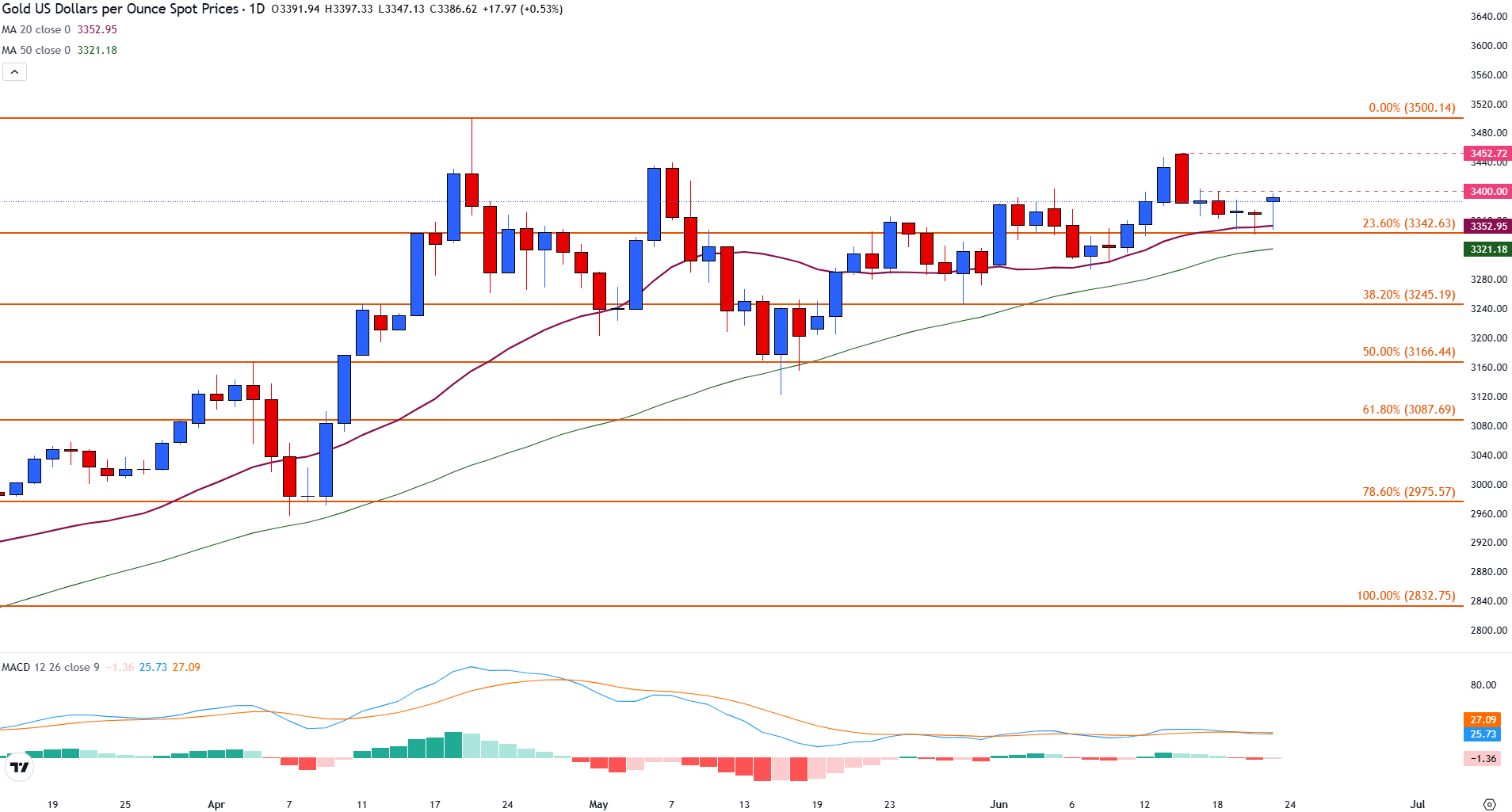
A break below $3,342 and the moving averages could open the path toward $3,245, which corresponds to the 38.2% Fibonacci retracement level.
Conversely, a daily close above $3,400 would signal bullish momentum, potentially retargeting the June high of $3,452 and the all-time high of $3,500.
Risk sentiment FAQs
In the world of financial jargon the two widely used terms “risk-on” and “risk off'' refer to the level of risk that investors are willing to stomach during the period referenced. In a “risk-on” market, investors are optimistic about the future and more willing to buy risky assets. In a “risk-off” market investors start to ‘play it safe’ because they are worried about the future, and therefore buy less risky assets that are more certain of bringing a return, even if it is relatively modest.
Typically, during periods of “risk-on”, stock markets will rise, most commodities – except Gold – will also gain in value, since they benefit from a positive growth outlook. The currencies of nations that are heavy commodity exporters strengthen because of increased demand, and Cryptocurrencies rise. In a “risk-off” market, Bonds go up – especially major government Bonds – Gold shines, and safe-haven currencies such as the Japanese Yen, Swiss Franc and US Dollar all benefit.
The Australian Dollar (AUD), the Canadian Dollar (CAD), the New Zealand Dollar (NZD) and minor FX like the Ruble (RUB) and the South African Rand (ZAR), all tend to rise in markets that are “risk-on”. This is because the economies of these currencies are heavily reliant on commodity exports for growth, and commodities tend to rise in price during risk-on periods. This is because investors foresee greater demand for raw materials in the future due to heightened economic activity.
The major currencies that tend to rise during periods of “risk-off” are the US Dollar (USD), the Japanese Yen (JPY) and the Swiss Franc (CHF). The US Dollar, because it is the world’s reserve currency, and because in times of crisis investors buy US government debt, which is seen as safe because the largest economy in the world is unlikely to default. The Yen, from increased demand for Japanese government bonds, because a high proportion are held by domestic investors who are unlikely to dump them – even in a crisis. The Swiss Franc, because strict Swiss banking laws offer investors enhanced capital protection.
Author

Tammy Da Costa, CFTe®
FXStreet
Tammy is an economist and market analyst with a deep passion for financial markets, particularly commodities and geopolitics.