Gold recovers as Fed announcement looms
- Gold recovers after pulling back ahead of the Federal Reserve policy meeting announcement on Wednesday.
- Better-than-expected US Retail Sales data released on Tuesday caused a temporary backslide in the precious metal.
- Bridgewater Associates CIO Ray Dalio considers a 25 basis points rate cut as more appropriate in the current context.

Gold (XAU/USD) trades in the $2,570s on Wednesday, ahead of the main financial-market event of the week: the Federal Reserve (Fed) policy meeting announcement at 18:00 GMT.
Gold surges as bets the Fed will double cut increase
Gold hit a record high of $2,589 at the start of the week after market bets that the Fed would make a double-dose 0.50% cut to interest rates at its meeting later today rose sharply.
A bigger rate cut from the Fed would be positive for Gold because it lowers the opportunity cost of holding the yellow metal, which is a non-interest-paying asset. This makes it more attractive to investors.
Gold pulls back after Retail Sales data
Gold slid lower on Tuesday after US Retail Sales rose 0.1% in August, compared to the 1.0% advance registered in July. However, this was still better than the consensus expectations (revised down at the last minute from a 0.2% gain to a 0.2% decline).
A 50 bps cut highly probable, according to futures markets
The probability of a larger 0.50% cut stands at 61%, according to the CME FedWatch tool, which bases its calculation on the price of 30-day fed funds futures. The probability of a smaller 0.25% cut, meanwhile, is at 39%. The probability of a cut of any size is therefore 100%.
In an interview with Bloomberg News on Wednesday, Ray Dalio, CIO of Bridgewater Associates said that the Fed would be looking to balance the needs of creditors to earn a real yield (the gain from debt interest after inflation) with the desire to lower interest repayments for debtors.
“[A] 25 pbs [interest-rate cut] would be the right thing to do if you are looking at the whole picture. If you are looking at the mortgage situation, which is worse – and affects more people – then it’s probably 50 bps,” Dalio said.
Based on the economic data alone, he said the “[US] economy is very close to an equilibrium level, except for the debt situation.” Significant socio-economic and political factors, including political polarization were further variables to consider, added Dalio.
Another factor that could influence financial markets and the price of Gold is the Fed’s Summary of Economic Projections (SEP), which is published along with its accompanying policy statement.
The SEP shows the projected path of interest rates in the future based on officials’ views, as well as growth and inflation forecasts for the US economy. Any revisions from past SEP projections could cause volatility.
Technical Analysis: Gold undertakes modest pullback
Gold pulls back to the $2,570-$2,560s after rallying higher. At the same time, the trend remains bullish in the short, medium, and long-term.
Based on the technical analysis dictum that “the trend is your friend,” this means the odds favor more upside in line with the trend. If there is a correction, therefore, it is likely to be short-lived before Gold resumes its broader uptrend.
XAU/USD Daily Chart
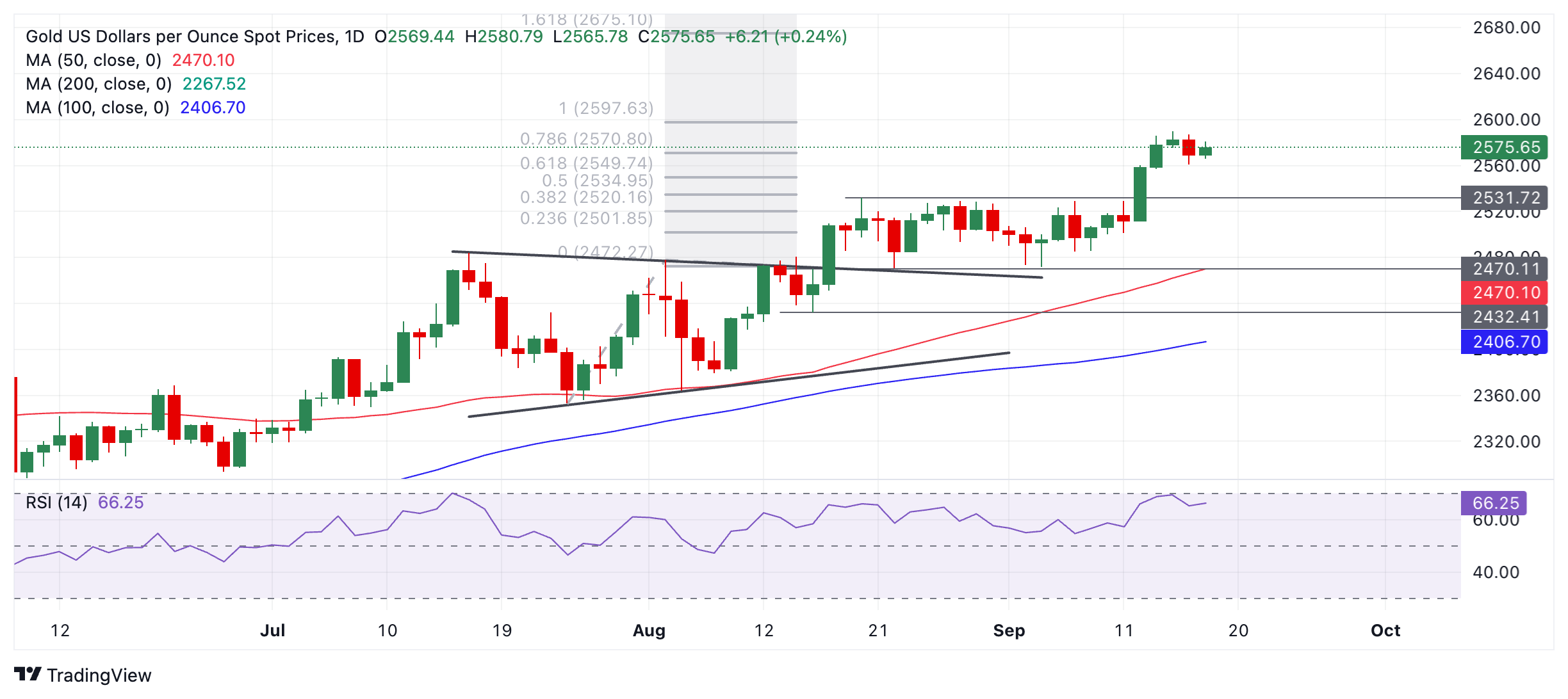
Gold is not overbought, according to the Relative Strength Index (RSI), leaving room for more upside.
If Gold does enter the overbought zone on a closing basis, however, it will advise traders not to add to their long positions.
If it enters and then exits overbought, it will be a sign to close longs and sell as it would suggest a deeper correction is in the process of unfolding.
In the event of a correction, firm support lies at $2,550, $2,544 (0.382 Fibonacci retracement of the September rally), and $2,530 (former range high).
Given prices are into uncharted territory when it comes to further upside, traders may target whole numbers, with $2,600 as an obvious first target for profit-taking if the rally continues.
Economic Indicator
Retail Sales (MoM)
The Retail Sales data, released by the US Census Bureau on a monthly basis, measures the value in total receipts of retail and food stores in the United States. Monthly percent changes reflect the rate of changes in such sales. A stratified random sampling method is used to select approximately 4,800 retail and food services firms whose sales are then weighted and benchmarked to represent the complete universe of over three million retail and food services firms across the country. The data is adjusted for seasonal variations as well as holiday and trading-day differences, but not for price changes. Retail Sales data is widely followed as an indicator of consumer spending, which is a major driver of the US economy. Generally, a high reading is seen as bullish for the US Dollar (USD), while a low reading is seen as bearish.
Read more.Last release: Tue Sep 17, 2024 12:30
Frequency: Monthly
Actual: 0.1%
Consensus: -0.2%
Previous: 1%
Source: US Census Bureau
Retail Sales data published by the US Census Bureau is a leading indicator that gives important information about consumer spending, which has a significant impact on the GDP. Although strong sales figures are likely to boost the USD, external factors, such as weather conditions, could distort the data and paint a misleading picture. In addition to the headline data, changes in the Retail Sales Control Group could trigger a market reaction as it is used to prepare the estimates of Personal Consumption Expenditures for most goods.
Author

Joaquin Monfort
FXStreet
Joaquin Monfort is a financial writer and analyst with over 10 years experience writing about financial markets and alt data. He holds a degree in Anthropology from London University and a Diploma in Technical analysis.