Gold breaks above $2,920 with tariffs rolling through markets
- Gold set for a near 1% on Tuesday after US President Trump presses tariff button.
- Canada set to impose 25% retaliatory tariffs from Tuesday, China is set to slap 15% levies on US agricultural goods from March 10.
- US yields tanked again on Tuesday, hitting a near 5-month low at 4.11%.

Gold’s price (XAU/USD) stretches higher to around $2,915 at the time of writing on Tuesday after surging over 1% the prior day and set to surge another 1% this Tuesday. The recent upsurge came in after United States (US) President Donald Trump confirmed on Monday that tariffs for Canada, Mexico and China were underway. Markets were still doubting on Monday if President Trump would still allow an extension to tariffs implementation based on the efforts the countries were making to meet the demands of the Trump administration. Little too late, it seemed, with President Trump going ahead with imposing the committed tariffs starting on Tuesday.
Meanwhile, Canada and China have already pushed back on imposing unilateral tariffs from the US. A statement released by Canadian prime minister Justin Trudeau’s office confirmed that Canada will impose retaliatory tariffs on US imports from Tuesday if US tariffs go into effect. “Canada will start with 25% tariffs on US imports worth C$30 billion from Tuesday,” read the statement, while tariffs on other C$125 billion of products will come into effect in 21 days.
On the other hand, China’s Commerce Ministry announced early Tuesday that it would slap additional tariffs of up to 15% on imports of key farm products, including chicken, pork, soy and beef from the US. The Ministry said that the tariffs announced will take effect from March 10..
Amidst this tit-for-tat trade war, US yields are rolling off again. The US 10-year benchmark hit 4.11% on the downside in early Asian trading on Tuesday. A nearly five-month low, going back to levels not seen since mid-October.
Daily digest market movers: Inflation fears
- On the geopolitical front, a senior defense official said the US was pausing all military aid to Ukraine, Bloomberg reports.
- After Monday’s turn of events, the CME Fedwatch tool is seeing the market's cry for a Federal Reserve (Fed) interest rate cut by June getting even bigger. The odds currently stand at 85.6%, with a minor 14.4% chance for rates to remain unchanged.
- A string of recent US data showing resurgent inflation and slowing activity is stoking fears the world’s biggest economy could be heading toward a period of stagflation, Reuters reports.
Technical Analysis: Propping up
Bullion extends its Monday’s gains at the start of the European trading session on Tuesday. Ranges have become tighter for the daily Pivot Point levels, confirming the current indecision among investors after last week’s decline. Watch out for a continuation in any direction. However, uncertainty about a tit-for-tat trade war will see Gold being supported.
The daily Pivot Point at $2,879 and the daily R1 resistance at $2,903 are currently providing support to bounce off from and attempt to push Bullion higher. In case Gold has enough oomph to continue higher, the daily R2 resistance at $2,917 will possibly be the final cap on Tuesday ahead of the all-time high of $2,956 reached on February 24.
On the downside, apart from the abovementioned Pivot Point and the R1 resistance levels, the S1 support at $2,866 converges with Thursday’s low. That will be the vital support for this Tuesday. If Bullion bulls want to avoid another leg lower, that level must hold. Further down, the daily S2 support at $2,842 should be able to catch any additional downside pressure.
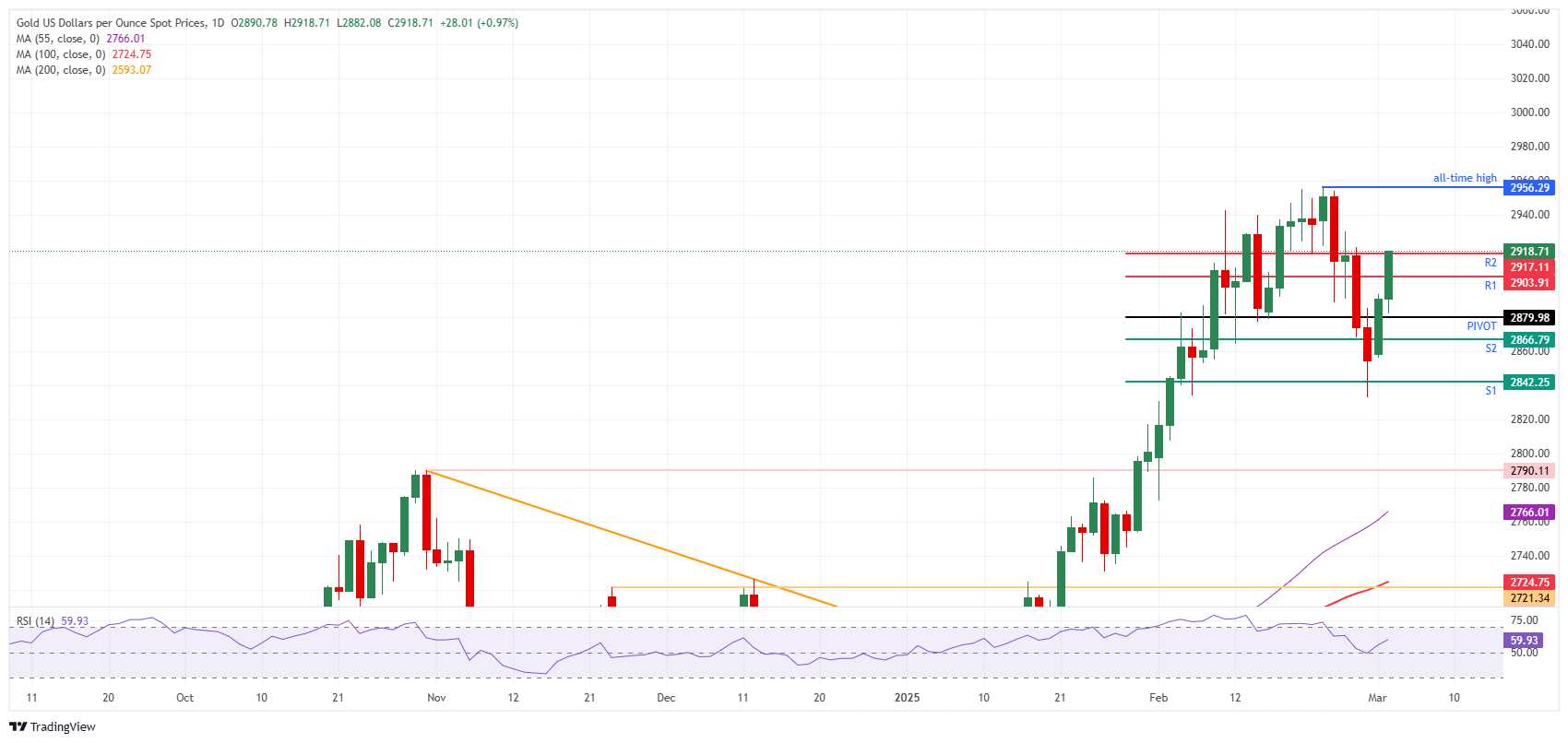
XAU/USD: Daily Chart
Interest rates FAQs
Interest rates are charged by financial institutions on loans to borrowers and are paid as interest to savers and depositors. They are influenced by base lending rates, which are set by central banks in response to changes in the economy. Central banks normally have a mandate to ensure price stability, which in most cases means targeting a core inflation rate of around 2%. If inflation falls below target the central bank may cut base lending rates, with a view to stimulating lending and boosting the economy. If inflation rises substantially above 2% it normally results in the central bank raising base lending rates in an attempt to lower inflation.
Higher interest rates generally help strengthen a country’s currency as they make it a more attractive place for global investors to park their money.
Higher interest rates overall weigh on the price of Gold because they increase the opportunity cost of holding Gold instead of investing in an interest-bearing asset or placing cash in the bank. If interest rates are high that usually pushes up the price of the US Dollar (USD), and since Gold is priced in Dollars, this has the effect of lowering the price of Gold.
The Fed funds rate is the overnight rate at which US banks lend to each other. It is the oft-quoted headline rate set by the Federal Reserve at its FOMC meetings. It is set as a range, for example 4.75%-5.00%, though the upper limit (in that case 5.00%) is the quoted figure. Market expectations for future Fed funds rate are tracked by the CME FedWatch tool, which shapes how many financial markets behave in anticipation of future Federal Reserve monetary policy decisions.
Author

Filip Lagaart
FXStreet
Filip Lagaart is a former sales/trader with over 15 years of financial markets expertise under its belt.