Gold sets bar of all-time highs above $3,030 with Ukraine ceasefire deal talks underway
- Gold keeps printing fresh all-time highs and even breaks above $3,030.
- Traders add more positioning in precious metal after Israeli strikes on Gaza end the ceasefire deal.
- Gold braces for impact German vote on spending and the Trump-Putin phone call up ahead.

Gold’s price (XAU/USD) surges again and reaches a fresh all-time high currently at $3,031 on Tuesday. The precious metal trades around $3,029 at the time of writing ahead of some important events set to take place. The rise comes after Israel executed military operations on possible Hamas tactical positions and buildings. The move is seen as the end of the ceasefire deal, which started in January and is likely to bring more Red Sea attacks by Houthi rebels and retaliation by Hamas as a counter-response to the recent intervention by Israel.
The ceasefire failure comes just hours before United States (US) President Donald Trump has a phone call with Russian President Vladimir Putin to reach a final deal to end the war in Ukraine. Concerns are plentiful after Trump said on Sunday that Russia and the US are dividing assets amongst themselves, which would mean that Ukraine has no word in the process while Trump bypasses the North Atlantic Treaty Organisation (NATO) and the European Union (EU). Meanwhile, the German parliament, the Bundestag, will vote this Tuesday on a new budget that could boost defense spending by roughly $49 billion, Bloomberg reports.
Daily digest market movers: Carte Blanche
- Just hours before the possible historic phone call between US President Trump and Russian President Putin, details are leaked on the demands from Russia before concluding a deal. One of those demands is that President Putin demands an immediate end to the arms being delivered to Ukraine, according to Bloomberg.
- Several analysts are pointing out that sluggish US data is another driver that benefits Gold. The influx of buyers on this commodity on Monday after rather sluggish US Retail Sales numbers shows that as the economic sentiment in the US turns, Gold is benefiting from traders looking for safe-haven assets, Bloomberg reports.
- With the upcoming Federal Reserve (Fed) meeting on Wednesday, the odds to keep interest rates at the current range are at 99%. Meanwhile, rate cut odds for next June’s meeting are at 68.6%, according to the CME Fedwatch tool.
- The global Silver market is under stress as trade-war concerns unsettle investors, with key indicators flashing red, millions of ounces on the move between trading hubs, and months of disruption in prospect. A surge in rates to borrow the precious metal has become the latest sign of alarm, according to Yahoo Finance.
Technical Analysis: Slicing through
Gold traders have several reasons and arguments for one would push Gold higher. As several banks start to call $3,200, it sets a clear target for the coming weeks and months. However, traders will need to keep in mind that once markets are positioned in one single direction, that is the moment when the turnaround could occur.
The daily resistance levels R1 and R2 have already been taken out on Tuesday. That means the big figures are being used as guidance from here on out. Look for $3,020 and $3,030 as the following anchor points in the intraday trading.
On the downside, the intraday R1 and R2 resistances should be acting as support now. So that means $3,014 and $3,007 should support any brief pullbacks. The intraday Pivot Point at $2,994 is the first line of defense in case the $3,000 level cracks under selling pressure.
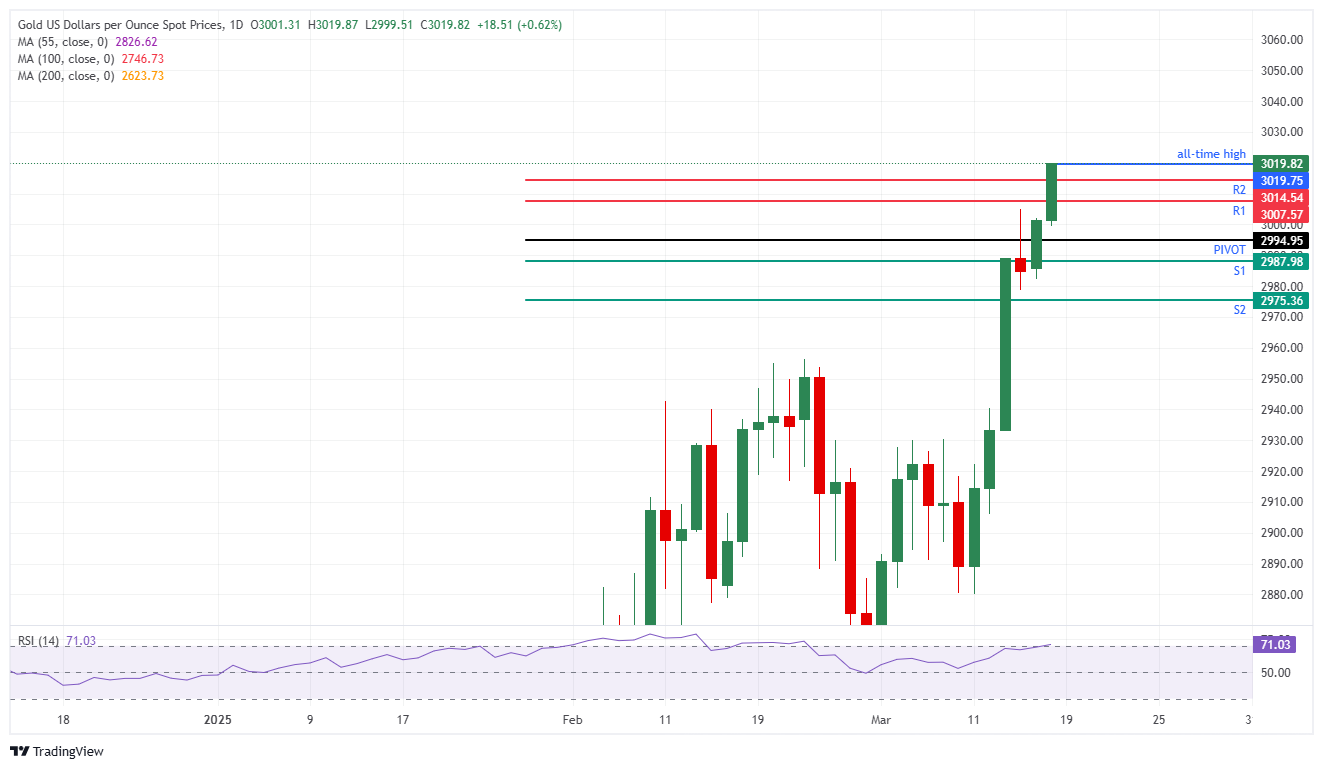
XAU/USD: Daily Chart
Central banks FAQs
Central Banks have a key mandate which is making sure that there is price stability in a country or region. Economies are constantly facing inflation or deflation when prices for certain goods and services are fluctuating. Constant rising prices for the same goods means inflation, constant lowered prices for the same goods means deflation. It is the task of the central bank to keep the demand in line by tweaking its policy rate. For the biggest central banks like the US Federal Reserve (Fed), the European Central Bank (ECB) or the Bank of England (BoE), the mandate is to keep inflation close to 2%.
A central bank has one important tool at its disposal to get inflation higher or lower, and that is by tweaking its benchmark policy rate, commonly known as interest rate. On pre-communicated moments, the central bank will issue a statement with its policy rate and provide additional reasoning on why it is either remaining or changing (cutting or hiking) it. Local banks will adjust their savings and lending rates accordingly, which in turn will make it either harder or easier for people to earn on their savings or for companies to take out loans and make investments in their businesses. When the central bank hikes interest rates substantially, this is called monetary tightening. When it is cutting its benchmark rate, it is called monetary easing.
A central bank is often politically independent. Members of the central bank policy board are passing through a series of panels and hearings before being appointed to a policy board seat. Each member in that board often has a certain conviction on how the central bank should control inflation and the subsequent monetary policy. Members that want a very loose monetary policy, with low rates and cheap lending, to boost the economy substantially while being content to see inflation slightly above 2%, are called ‘doves’. Members that rather want to see higher rates to reward savings and want to keep a lit on inflation at all time are called ‘hawks’ and will not rest until inflation is at or just below 2%.
Normally, there is a chairman or president who leads each meeting, needs to create a consensus between the hawks or doves and has his or her final say when it would come down to a vote split to avoid a 50-50 tie on whether the current policy should be adjusted. The chairman will deliver speeches which often can be followed live, where the current monetary stance and outlook is being communicated. A central bank will try to push forward its monetary policy without triggering violent swings in rates, equities, or its currency. All members of the central bank will channel their stance toward the markets in advance of a policy meeting event. A few days before a policy meeting takes place until the new policy has been communicated, members are forbidden to talk publicly. This is called the blackout period.
Author

Filip Lagaart
FXStreet
Filip Lagaart is a former sales/trader with over 15 years of financial markets expertise under its belt.

















