Gold prices steady near key technical levels ahead of US-China trade talks
- Gold prices finds support above $3,300 with technical resistance at $3,400.
- US-China trade talks in London begin, with Gold waiting for the next catalyst for the next move.
- Gold prices remain in a near-term bull trend with the US Dollar driving the next move.

Gold prices remained at an elevated level on Monday, despite the start of US-China trade talks in London. Alongside the United States’ (US) 50% tariffs on steel and aluminium imports, Gold has been supported by broader geopolitical tensions, such as the ongoing warfare between Ukraine and Russia over the weekend, which have reinforced Gold's safe-haven status.
Gold Daily Digest: Can US-China Talks Lift Safe-Haven Gold?
- Friday’s Nonfarm Payrolls (NFP) report came in better than expected, which has eased fears of the Federal Reserve (Fed) cutting rates in the short term.
- On Thursday, Reuters reported that the Canadian Prime Minister called US tariffs “illegal,” while Mexico and the European Union expressed similar frustration.
- On Wednesday, Mexican President Claudia Sheinbaum called the new tariffs "unjust, unsustainable, and without legal grounds," warning that if a deal is not reached, Mexico will be forced to respond with retaliatory measures.
- Canada and the EU have also threatened to retaliate if no progress is made in trade talks this week.
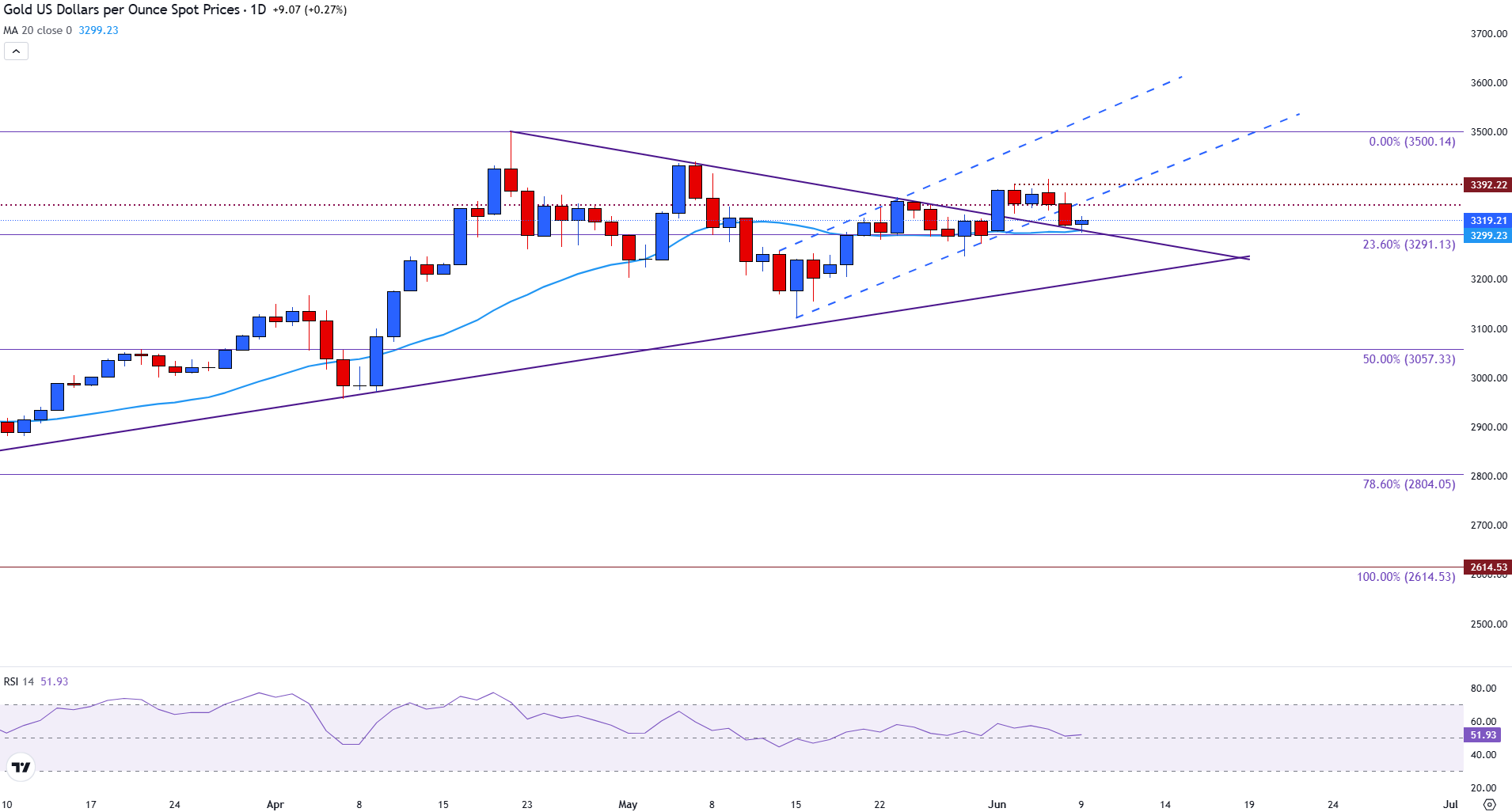
Gold prices remain under pressure on Monday, retreating from last week's highs as technical indicators suggest waning bullish momentum. After failing to hold above the $3,339–$3,392 resistance zone, prices broke below short-term support near $3,320 and are now testing the 23.6% Fibonacci retracement level at $3,291. This level has become a key pivot in the near term, with a daily close below it likely to attract fresh selling pressure.
The broader price action continues to consolidate within a symmetrical triangle, suggesting indecision among market participants. The lower boundary of this pattern is currently under threat, and a confirmed breakdown could expose the ascending trendline support around $3,250–$3,260. Below that, deeper losses could take prices toward the 50% Fibonacci retracement at $3,057, a level that aligns with previous structural support.
On the upside, any rebound must clear the $3,339–$3,392 region to reassert bullish control. A break above this zone would pave the way toward the $3,500 mark, which remains the medium-term target for Gold bulls. However, with the 20-day Simple Moving Average (SMA) turning flat near $3,299, upside momentum has clearly stalled.
Momentum indicators also reflect this indecision. The Relative Strength Index (RSI) is currently hovering near 52, indicating neutral sentiment with no immediate overbought or oversold conditions. This suggests that Gold may continue to consolidate unless triggered by a major fundamental catalyst, such as updates to US interest rates or further geopolitical developments.
Gold’s technical structure has weakened slightly following the breakdown below short-term support on Friday. A decisive close below $3,291 would likely shift the outlook to bearish in the near term, while holding above the triangle base could still offer a path back toward resistance.
Gold daily chart
Risk sentiment FAQs
In the world of financial jargon the two widely used terms “risk-on” and “risk off'' refer to the level of risk that investors are willing to stomach during the period referenced. In a “risk-on” market, investors are optimistic about the future and more willing to buy risky assets. In a “risk-off” market investors start to ‘play it safe’ because they are worried about the future, and therefore buy less risky assets that are more certain of bringing a return, even if it is relatively modest.
Typically, during periods of “risk-on”, stock markets will rise, most commodities – except Gold – will also gain in value, since they benefit from a positive growth outlook. The currencies of nations that are heavy commodity exporters strengthen because of increased demand, and Cryptocurrencies rise. In a “risk-off” market, Bonds go up – especially major government Bonds – Gold shines, and safe-haven currencies such as the Japanese Yen, Swiss Franc and US Dollar all benefit.
The Australian Dollar (AUD), the Canadian Dollar (CAD), the New Zealand Dollar (NZD) and minor FX like the Ruble (RUB) and the South African Rand (ZAR), all tend to rise in markets that are “risk-on”. This is because the economies of these currencies are heavily reliant on commodity exports for growth, and commodities tend to rise in price during risk-on periods. This is because investors foresee greater demand for raw materials in the future due to heightened economic activity.
The major currencies that tend to rise during periods of “risk-off” are the US Dollar (USD), the Japanese Yen (JPY) and the Swiss Franc (CHF). The US Dollar, because it is the world’s reserve currency, and because in times of crisis investors buy US government debt, which is seen as safe because the largest economy in the world is unlikely to default. The Yen, from increased demand for Japanese government bonds, because a high proportion are held by domestic investors who are unlikely to dump them – even in a crisis. The Swiss Franc, because strict Swiss banking laws offer investors enhanced capital protection.
Author

Tammy Da Costa, CFTe®
FXStreet
Tammy is an economist and market analyst with a deep passion for financial markets, particularly commodities and geopolitics.














