Gold spikes amid tensions but can't shake off weekly losses
- Gold gains 0.67% in late session, but geopolitical strife keeps it above $2,600 despite monthly losses.
- Escalation in Russia-Ukraine conflict and Middle East tensions underline Gold's safe-haven appeal.
- Market optimism grows for a 25 bps Fed rate cut in December, bolstering Bullion’s short-term prospects.

Gold's price advanced late during the North American session on Friday, up by 0.67%, yet it remains set to print monthly losses of over 3%. Geopolitical risks continue to drive price action with the non-yielding metal fluctuating at around $2,600. The XAU/USD trades at $2,652 after hitting a daily low of $2,634.
Geopolitical tensions eased in the Middle East after Israel and Lebanon agreed to a ceasefire. Nevertheless, both countries accused each other of violating the agreement.
Recently, Sky News Arabia revealed that the Israeli Army announced the bombing of a mobile rocket platform belonging to Hezbollah in southern Lebanon in an air strike.
Gold prices could remain bid after the escalation of the Russia-Ukraine conflict. During the week, Russia attacked Ukraine’s energy infrastructure and threatened to attack with ballistic missiles. Russia’s response is a retaliation to the US and UK authorizing the deployment of missiles manufactured in both countries inside Russia.
In November, Bullion prices were hampered by US President-elect Donald Trump's victory on November 5. Some of his proposals are inflation-prone, like imposing tariffs and cutting taxes.
This bolstered the Greenback, which is set to end November with gains of over 2%, according to the US Dollar Index (DXY). Speculation that the new US administration's fiscal policy is expansionary might prevent the Federal Reserve (Fed) from continuing to lower interest rates.
The choice of Scott Bessent as Treasury Secretary for the upcoming Trump administration calmed the markets and bolstered Gold prices last week. Investors see Bessent as market-friendly, which could moderate harsh Trump trade policies.
Consequently, market participants are optimistic that the Fed will cut rates by 25 basis points at the December meeting. According to the CME FedWatch Tool, the swaps market sees a probability of 66% of such a decision.
Daily digest market movers: Gold price underpinned by lower US real yields
- Gold prices recovered as US real yields dropped seven basis points to 1.92%.
- The US 10-year Treasury bond yield falls six basis points to 4.182%.
- The US Dollar Index (DXY), which tracks the performance of the buck against six currencies, edged down 0.37% at 105.75 on the day. However, it is set to print gains of over 1.79% for the month.
- The latest US GDP figures and the Core Personal Consumption Expenditures (PCE) Price Index hint that the US economy remains robust and that easing policy could need to be paused.
- However, Fed officials seemed convinced that further easing is needed and may cut rates at the December meeting. However, they adopted a more cautious stance, opening the door to pause the easing cycle.
- Data from the Chicago Board of Trade, via the December fed funds rate futures contract, shows investors estimate 24 bps of Fed easing by the end of 2024.
Technical outlook: Gold price climbs but remains below 50-day SMA
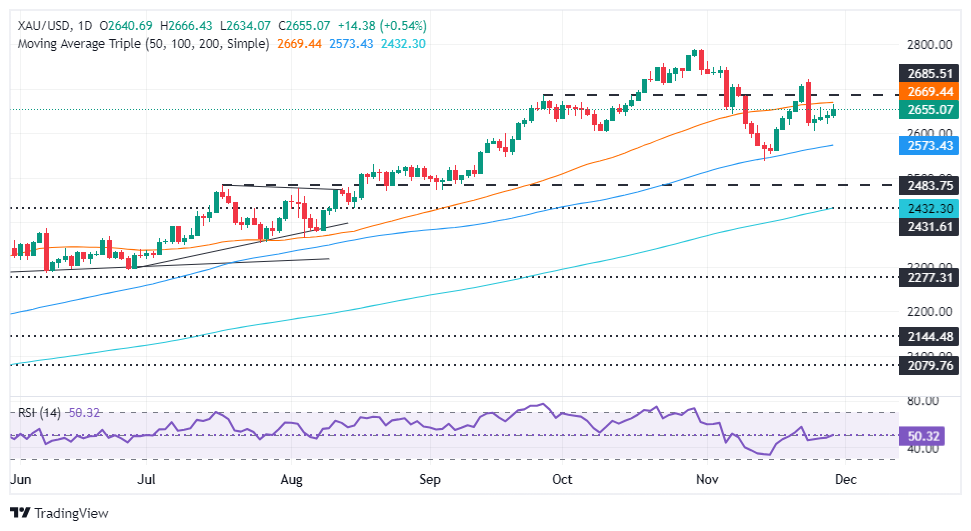
Gold prices remain upwardly biased yet contained within the 50 and 100-day Simple Moving Averages (SMAs), each at $2,668 and $2,572, respectively. Buyers need to clear the 50-day SMA so they can test $2,700. On further strength, XAU/USD's next resistance level would be the psychological $2,750 and the all-time high at $2,790.
On the other hand, if sellers drag the non-yielding metal below $2,600, they could target the 100-day SMA, ahead of the November 14 swing low of $2,536.
Gold FAQs
Gold has played a key role in human’s history as it has been widely used as a store of value and medium of exchange. Currently, apart from its shine and usage for jewelry, the precious metal is widely seen as a safe-haven asset, meaning that it is considered a good investment during turbulent times. Gold is also widely seen as a hedge against inflation and against depreciating currencies as it doesn’t rely on any specific issuer or government.
Central banks are the biggest Gold holders. In their aim to support their currencies in turbulent times, central banks tend to diversify their reserves and buy Gold to improve the perceived strength of the economy and the currency. High Gold reserves can be a source of trust for a country’s solvency. Central banks added 1,136 tonnes of Gold worth around $70 billion to their reserves in 2022, according to data from the World Gold Council. This is the highest yearly purchase since records began. Central banks from emerging economies such as China, India and Turkey are quickly increasing their Gold reserves.
Gold has an inverse correlation with the US Dollar and US Treasuries, which are both major reserve and safe-haven assets. When the Dollar depreciates, Gold tends to rise, enabling investors and central banks to diversify their assets in turbulent times. Gold is also inversely correlated with risk assets. A rally in the stock market tends to weaken Gold price, while sell-offs in riskier markets tend to favor the precious metal.
The price can move due to a wide range of factors. Geopolitical instability or fears of a deep recession can quickly make Gold price escalate due to its safe-haven status. As a yield-less asset, Gold tends to rise with lower interest rates, while higher cost of money usually weighs down on the yellow metal. Still, most moves depend on how the US Dollar (USD) behaves as the asset is priced in dollars (XAU/USD). A strong Dollar tends to keep the price of Gold controlled, whereas a weaker Dollar is likely to push Gold prices up.
Author

Christian Borjon Valencia
FXStreet
Markets analyst, news editor, and trading instructor with over 14 years of experience across FX, commodities, US equity indices, and global macro markets.

















