Gold price appreciates due to a potential central bank purchases this year
- Gold price continues to extend gains following an impressive 27% gain, marking the strongest annual performance since 2010.
- The precious metal Gold receives support as the US Dollar Index retreats from the multi-year high of 108.58, reached on Tuesday.
- The non-yielding Gold may struggle due to the Fed’s hawkish shift in its monetary policy stance.

Gold price (XAU/USD) rises for the third consecutive session on Thursday, following a more than 27% increase in 2024, marking its best performance since 2010. This upward momentum has been driven by US monetary easing, persistent geopolitical tensions, and record central bank purchases.
However, the non-interest-bearing Gold may encounter some headwinds as the Federal Reserve (Fed) is expected to take a more cautious approach toward further rate cuts in 2025, signaling a hawkish shift in its monetary policy stance. This change is influenced by uncertainties surrounding potential policy shifts under the incoming Trump administration’s economic plans.
Geopolitical tensions in the Middle East and the ongoing Russia-Ukraine conflict are expected to continue supporting Gold, a traditional safe-haven asset, in the near term. Additionally, a World Gold Council survey suggests that major central banks are likely to increase Gold purchases in 2025, further boosting demand for the precious metal.
Gold price receives support from safe-haven flows amid ongoing geopolitical tensions
- The US Dollar Index (DXY), which tracks the value of the US Dollar against six major currencies, retreats from multi-year highs, trading around 108.30 at the time of writing. The softer US Dollar (USD) may have provided support for dollar-denominated Gold, making it more affordable for buyers using foreign currencies.
- Gold, which offers no yield, could have faced challenges as the 10-year US Treasury bond yield rose to 4.58% on Tuesday.
- Investors are cautiously monitoring a potential recovery in China's economy and fuel Gold demand, following President Xi Jinping's pledge to prioritize growth. In his New Year's address on Tuesday, Xi stated that China would implement more proactive policies to promote growth in 2025, according to Reuters.
- While China's manufacturing activity showed minimal growth in December, services and construction sectors have seen a recovery. The data indicates that policy stimulus is beginning to have an impact on certain sectors, as China prepares for new trade risks stemming from tariffs proposed by US President-elect Donald Trump.
- Reuters cited that Russia launched a drone strike on Ukraine's capital, Kyiv, on New Year's Day early Wednesday, resulting in two deaths, at least six injuries, and damage to buildings in two districts. Explosions echoed across the morning sky as Ukraine's air force issued warnings of incoming drones.
- Meanwhile, the Israeli military maintained pressure on northern Gaza, carrying out strikes in a suburb of Gaza City on Wednesday, according to medics. Airstrikes in Shejaia, a suburb of Gaza City, killed at least eight Palestinians. The Israeli military has not yet commented, and the identities of those killed in the attack remain unclear.
Technical Analysis: Gold price surpasses nine-day EMA to near $2,650
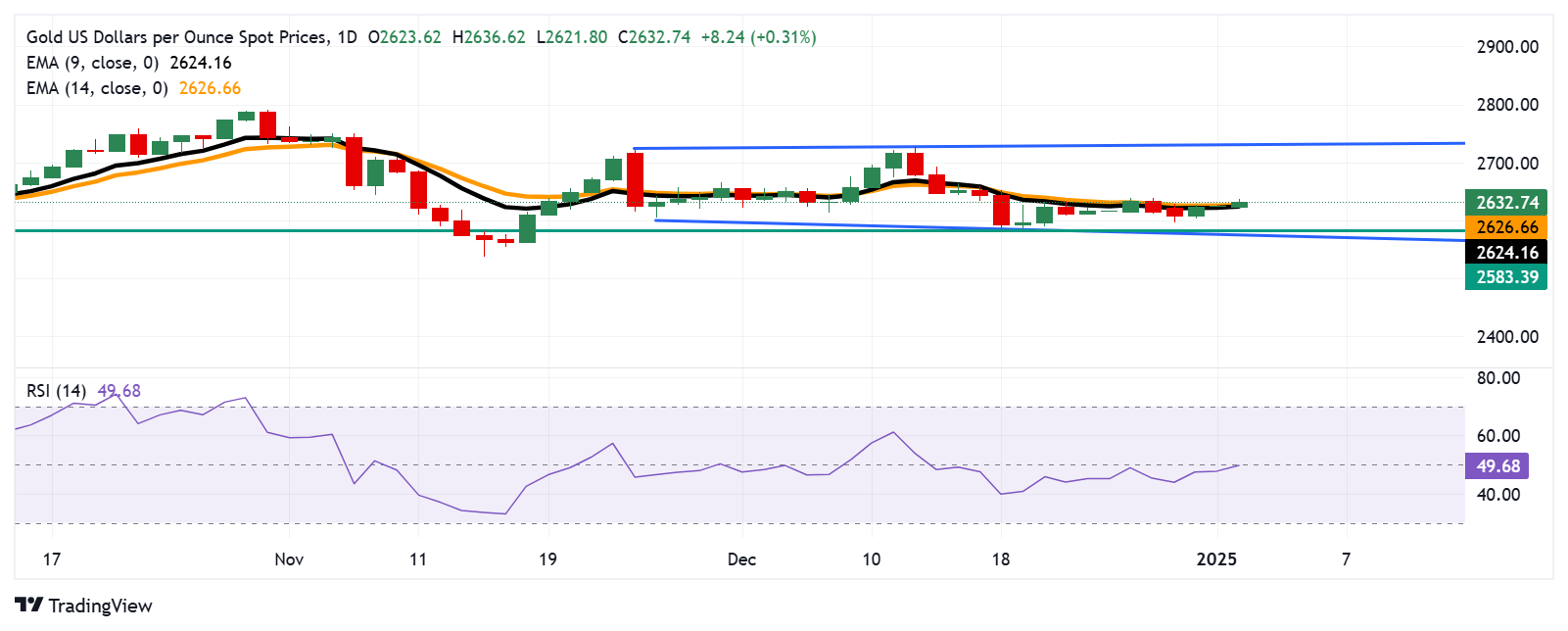
Gold price trades near $2,630.00 per troy ounce on Thursday, with the daily chart indicating a consolidation phase as the metal moves sideways. However, the price of the yellow metal moves above the nine- and 14-day Exponential Moving Averages (EMAs), suggesting a bullish shift in the short-term momentum. Additionally, the 14-day Relative Strength Index (RSI) hovers around the 50 mark, reflecting a neutral sentiment.
The XAU/USD pair may explore the area around the psychological resistance of $2,700.00, followed by the next barrier at its monthly high of $2,726.34, reached on December 12.
Regarding its support, the XAU/USD pair may test immediate 14- and nine-day EMAs at $2,626.00 and $2,624.00, respectively. Further support appears around its monthly low of $2,583.39, recorded on December 19.
XAU/USD: Daily Chart
Gold FAQs
Gold has played a key role in human’s history as it has been widely used as a store of value and medium of exchange. Currently, apart from its shine and usage for jewelry, the precious metal is widely seen as a safe-haven asset, meaning that it is considered a good investment during turbulent times. Gold is also widely seen as a hedge against inflation and against depreciating currencies as it doesn’t rely on any specific issuer or government.
Central banks are the biggest Gold holders. In their aim to support their currencies in turbulent times, central banks tend to diversify their reserves and buy Gold to improve the perceived strength of the economy and the currency. High Gold reserves can be a source of trust for a country’s solvency. Central banks added 1,136 tonnes of Gold worth around $70 billion to their reserves in 2022, according to data from the World Gold Council. This is the highest yearly purchase since records began. Central banks from emerging economies such as China, India and Turkey are quickly increasing their Gold reserves.
Gold has an inverse correlation with the US Dollar and US Treasuries, which are both major reserve and safe-haven assets. When the Dollar depreciates, Gold tends to rise, enabling investors and central banks to diversify their assets in turbulent times. Gold is also inversely correlated with risk assets. A rally in the stock market tends to weaken Gold price, while sell-offs in riskier markets tend to favor the precious metal.
The price can move due to a wide range of factors. Geopolitical instability or fears of a deep recession can quickly make Gold price escalate due to its safe-haven status. As a yield-less asset, Gold tends to rise with lower interest rates, while higher cost of money usually weighs down on the yellow metal. Still, most moves depend on how the US Dollar (USD) behaves as the asset is priced in dollars (XAU/USD). A strong Dollar tends to keep the price of Gold controlled, whereas a weaker Dollar is likely to push Gold prices up.
Author

Akhtar Faruqui
FXStreet
Akhtar Faruqui is a Forex Analyst based in New Delhi, India. With a keen eye for market trends and a passion for dissecting complex financial dynamics, he is dedicated to delivering accurate and insightful Forex news and analysis.
















