Gold edges up as traders hedge bets ahead Fed moves, US NFP report
- Gold rallies to four-day high as DXY recovers after touching fresh three-year low.
- US Senate passes $4.5T tax cut bill; Bullion market largely unmoved by fiscal headlines.
- JOLTS Job Openings and ISM data support Powell’s wait-and-see stance; ADP and NFP in focus next.

The Gold price rises over 1% as the Greenback pares some of its earlier losses, which sent the US Dollar Index (DXY) to a three-year low. Meanwhile, the US Senate passed the Trump tax bill, which is ready to be sent to the House of Representatives for its approval. At the time of writing, XAU/USD trades at $3,340, trading around four-day highs.
Bloomberg revealed that “Senators voted 51-50 to pass the bill. Vice President JD Vance cast the tie-breaking vote. The package, which now goes to the House, combines $4.5 trillion in tax cuts with $1.2 trillion in spending cuts.”
The passage of the bill was ignored by Bullion traders so far. Economic data from the United States (US) was not ignored, justifying Federal Reserve (Fed) Chair Jerome Powell's wait-and-see stance.
The US Job Openings and Labor Turnover Survey (JOLTS) revealed that vacancies increased in May, exceeding economists’ forecasts. Manufacturing activity, as reported by the Institute for Supply Management (ISM), contracted for the fourth consecutive month but showed signs of improvement, approaching the expansion/contraction threshold.
Recently, Powell crossed the wires and remained slightly hawkish.
Aside from this, US Treasury Secretary Scott Bessent warned that countries could be notified of higher tariffs as the July 9 deadline approaches.
This shortened week, ahead of the US Independence Day on July 4, will feature ADP employment figures, Initial Jobless Claims, and the Nonfarm Payrolls report for June.
Daily digest market movers: Gold price climbs as US yields and US Dollar advanced
- Gold continues to rally, even as US Treasury yields rise. The 10-year US Treasury note is yielding 4.242%, a three-and-a-half basis point increase. US real yields, which are calculated by subtracting inflation expectations from the nominal yield, are also moving up close to four basis points to 1.979%.
- The latest JOLTS report revealed that job openings in May rose to their highest level since November, reaching 7.769 million, up from 7.391 million, and exceeding forecasts of 7.3 million.
- The ISM Manufacturing PMI in June improved, although it remained in contraction for the fourth consecutive month. The index rose to 49.0, up from 48.5 in May and above estimates of 48.8.
- Powell revealed that policy is modestly restrictive and added that he can’t say if July is too early to cut rates, though he wouldn’t rule anything out. He said that if not for President Donald Trump’s tariffs, the US central bank probably would have cut rates further.
- Citi expects Gold prices to return to $2,500 - $2,700 by the second half of 2026.
- The jobs data will be announced on Wednesday and Thursday. The ADP Employment Change is projected to improve from 37K private jobs added to the workforce to 85K. June’s Nonfarm Payrolls figures are likely to show that the labor market is indeed cooling down, projected at 110,000, down from May’s 139,000.
- Money markets suggest that traders are pricing in 62 basis points of easing toward the end of the year, according to Prime Market Terminal data.
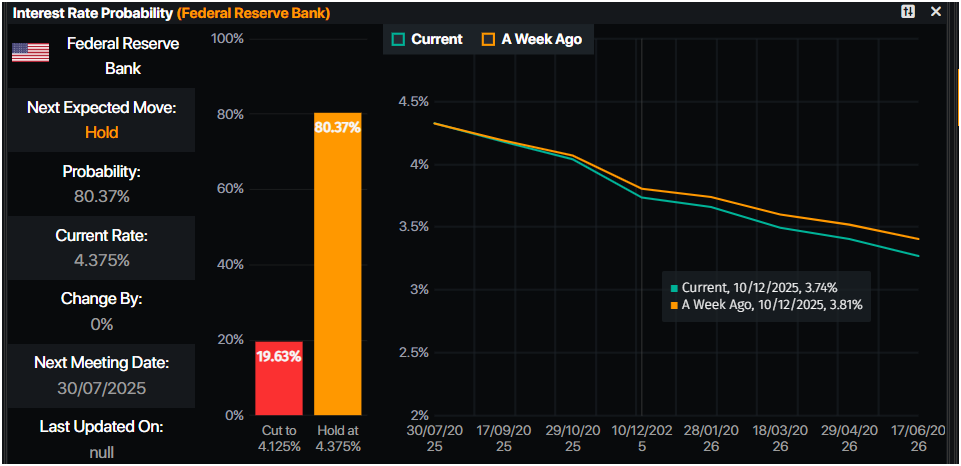
Source: Prime Market Terminal
XAU/USD technical outlook: Gold price poised to challenge $3,400
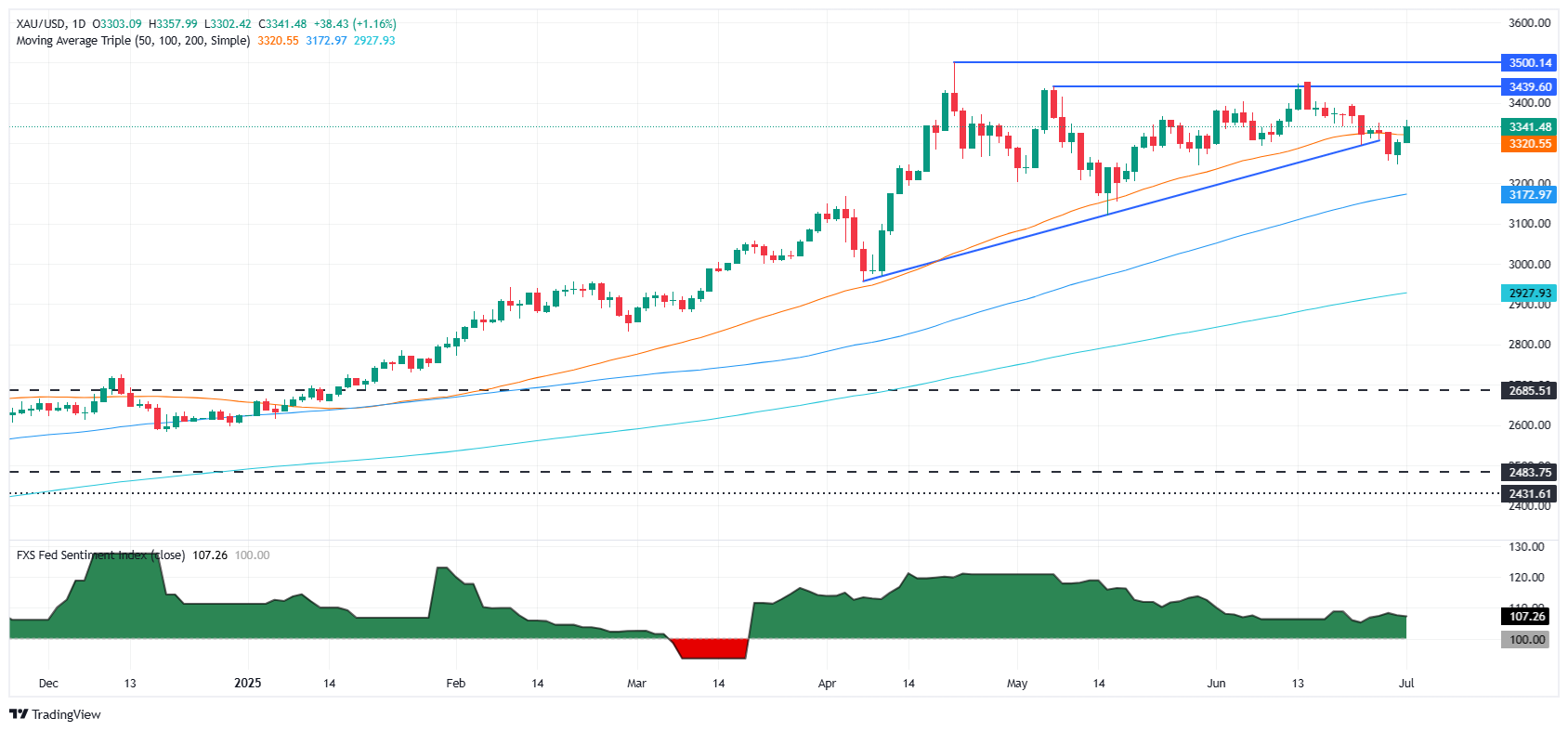
Gold uptrend remains intact, although traders need to achieve a daily close above the 50-day Simple Moving Average (SMA) at $3,322, which would keep them hopeful of higher prices. Bullish momentum has increased as portrayed by the Relative Strength Index (RSI).
That said, if XAU/USD climbs past $3,350, the next area of interest would be $3,400. On further strength, the following resistance levels would be $3,450 and the all-time high (ATH) at $3,500.
On the flipside, if Gold falls below the 50-day SMA, the first support would be $3,300. A breach of the latter will expose the June 30 swing low of $3,246.
Interest rates FAQs
Interest rates are charged by financial institutions on loans to borrowers and are paid as interest to savers and depositors. They are influenced by base lending rates, which are set by central banks in response to changes in the economy. Central banks normally have a mandate to ensure price stability, which in most cases means targeting a core inflation rate of around 2%. If inflation falls below target the central bank may cut base lending rates, with a view to stimulating lending and boosting the economy. If inflation rises substantially above 2% it normally results in the central bank raising base lending rates in an attempt to lower inflation.
Higher interest rates generally help strengthen a country’s currency as they make it a more attractive place for global investors to park their money.
Higher interest rates overall weigh on the price of Gold because they increase the opportunity cost of holding Gold instead of investing in an interest-bearing asset or placing cash in the bank. If interest rates are high that usually pushes up the price of the US Dollar (USD), and since Gold is priced in Dollars, this has the effect of lowering the price of Gold.
The Fed funds rate is the overnight rate at which US banks lend to each other. It is the oft-quoted headline rate set by the Federal Reserve at its FOMC meetings. It is set as a range, for example 4.75%-5.00%, though the upper limit (in that case 5.00%) is the quoted figure. Market expectations for future Fed funds rate are tracked by the CME FedWatch tool, which shapes how many financial markets behave in anticipation of future Federal Reserve monetary policy decisions.
Author

Christian Borjon Valencia
FXStreet
Markets analyst, news editor, and trading instructor with over 14 years of experience across FX, commodities, US equity indices, and global macro markets.

















