Gold price orbits around $3,120 awaiting Trump's reciprocal tariffs announcement
- Gold price is enjoying some support around $3,120 on Wednesday ahead of Trump's announcement.
- Markets mull the impact of the official announcement of the implementation of reciprocal tariffs.
- Gold traders could unwind the Gold rally, should the size of tariffs be far less severe than anticipated.

Gold price (XAU/USD) stabilizes above $3,120 at the time of writing on Wednesday with still the fresh all-time nearby, at $3,149. The Gold rush rally stalled ahead of United States (US) President Donald Trump officially announcing the reciprocal tariff implementation later this Wednesday at the White House with his entire cabinet present. However, with uncertainty building up towards this day, the announcement itself could be less impactful than initially thought, resulting in a sharp correction for Gold this week as a "buy the rumour, sell the news" event.
Meanwhile, traders are gearing up for the always-important private sector employment data provided by Automatic Data Processing (ADP). Although there is no proven correlation with the Nonfarm Payrolls (NFP) release on Friday, traders still see it as a litmus test. Expectations are for a surge of 105,000 new employment in private jobs in March, compared to 77,000 in February. This could make sense as the Department of Government Efficiency (DOGE) has been trying to push public sector employees towards private jobs.
Daily digest market movers: Markets hold their breath
- The White House has been reluctant to provide details of the targets and scale of the levies, which will be applied right after they are rolled out at the 20:00 GMT event in Washington this Wednesday. The pending announcement has driven a new wave of volatility, including a US stock selloff. While uncertain times are generally good for Gold, investors are keen to see the impact of the next set of levies on trade, the global economy and geopolitics, Bloomberg reports.
- The CME FedWatch tool sees chances for a rate cut in May standing at 15.8%. A rate cut in June is still the most plausible outcome, with only a 25.6% chance for rates to remain at current levels.
- Huaan Yifu Gold ETF, the largest such investment vehicle in China, received record inflows of 1.4 billion Yuan ($194 million) on Monday. Followed by another 1 billion Yuan, the second-highest, on the following day. The frantic pace of buying means Gold ETFs now have the biggest assets under management among all commodity-related peers in China, Reuters reports.
- Strong central bank demand and constraints in supply reinforce the bullish rally in gold, while the challenging growth-policy trade-off present risks for European equities, according to JPMorgan derivatives strategists, Reuters reports.
Gold Price Technical Analysis: How to avoid a massacre
Again, this is a “parental advisory” just ahead of the main event for this Wednesday. With the primary tailwind for the Goldrush set to be officially announced, the “buy the rumour, sell the fact” rule of thumb should be considered. The risk could be that once the reciprocal tariffs take effect on Wednesday, only easing due to profit-taking in Gold could occur once separate trade agreements and partial unwinds take place.
On the upside, the daily R1 resistance at $3,141 is the first level to consider, followed by the $3,149 all-time high. Further up, the R2 resistance at $3,169 could still be targeted later in the day. Beyond that, the broader upside target stands at $3,200.
On the downside, the S1 support at $3,093 is quite far, though it could still be tested without completely erasing this week’s gains. Further down, the S2 support at $3,073 should ensure that Gold does not fall back below $3,000.
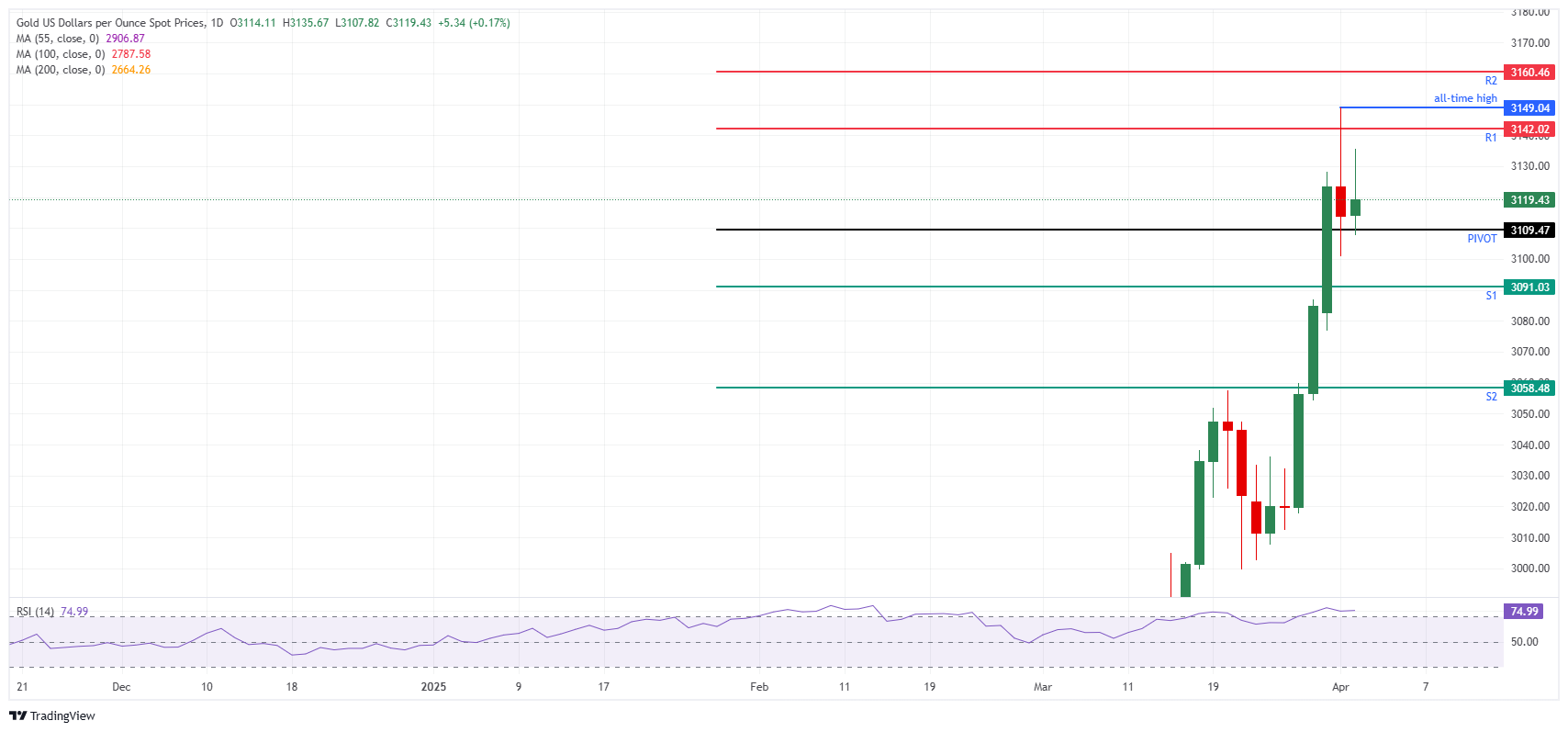
XAU/USD: Daily Chart
Interest rates FAQs
Interest rates are charged by financial institutions on loans to borrowers and are paid as interest to savers and depositors. They are influenced by base lending rates, which are set by central banks in response to changes in the economy. Central banks normally have a mandate to ensure price stability, which in most cases means targeting a core inflation rate of around 2%. If inflation falls below target the central bank may cut base lending rates, with a view to stimulating lending and boosting the economy. If inflation rises substantially above 2% it normally results in the central bank raising base lending rates in an attempt to lower inflation.
Higher interest rates generally help strengthen a country’s currency as they make it a more attractive place for global investors to park their money.
Higher interest rates overall weigh on the price of Gold because they increase the opportunity cost of holding Gold instead of investing in an interest-bearing asset or placing cash in the bank. If interest rates are high that usually pushes up the price of the US Dollar (USD), and since Gold is priced in Dollars, this has the effect of lowering the price of Gold.
The Fed funds rate is the overnight rate at which US banks lend to each other. It is the oft-quoted headline rate set by the Federal Reserve at its FOMC meetings. It is set as a range, for example 4.75%-5.00%, though the upper limit (in that case 5.00%) is the quoted figure. Market expectations for future Fed funds rate are tracked by the CME FedWatch tool, which shapes how many financial markets behave in anticipation of future Federal Reserve monetary policy decisions.
BRANDED CONTENT
Not all brokers provide the same benefits for Gold trading, making it essential to compare key features. Knowing each broker’s strengths will help you find the ideal fit for your trading strategy. Explore our detailed guide on the best Gold brokers.
Author

Filip Lagaart
FXStreet
Filip Lagaart is a former sales/trader with over 15 years of financial markets expertise under its belt.