Gold rallies past $3,350 as Trump escalates trade war with EU
- XAU/USD rallies as Trump warns of 50% tariffs on EU imports, escalating trade war and boosting safe-haven demand.
- The US House passes a $4 trillion debt-heavy budget, with the Senate vote and inflation data in focus.
- Talks on Ukraine and Iran ease geopolitical stress, but markets remain risk-averse.

Gold's price uptrend resumed on Friday, with the yellow metal rising close to 2% daily and 5% in the week, as the US Dollar (USD) weakened further after US President Donald Trump escalated the ‘trade war’ with the European Union (EU). This and investors' woes regarding the US fiscal stance propel bullion prices higher, with XAU/USD trading at $3,359 after bouncing off a daily low of $3,287.
Before Wall Street opened, Trump said that discussions with the EU “are going nowhere” while threatening to impose 50% tariffs on the EU’s imports on June 1. US Treasury Secretary Scott Bessent also commented, “The president believes that the EU proposals have not been of the same quality that we’ve seen from our other important trading partners.”
Meanwhile, Bullion was boosted by the passage of Trump’s ‘One Big Beautiful Bill’ at the US House of Representatives, which would add close to $4 trillion to the US debt ceiling. The bill will next be passed to the Senate for its approval.
In the geopolitical front, the Russian Foreign Minister said the work on the memorandum leading to a ceasefire in Ukraine is advanced. Meanwhile,the US and Iran concluded on Friday a fifth round of negotiations in Rome over Tehran’s advancing nuclear program.
Data-wise, US housing data in May was mixed as Building Permits collapsed, but New Home Sales improved in April. In the meantime, a flurry of Fed speakers, led by St. Louis Fed Alberto Musalem and Chicago's Fed Austan Goolsbee, crossed the news wires.
Next week, the US economic docket will feature Durable Goods Orders, the release of the Fed’s last meeting minutes, the second estimate of GDP, and the Fed’s preferred inflation gauge, the Core Personal Consumption Expenditures (PCE) Price Index.
Gold daily market movers: Skyrockets amid risk-aversion spurred by Trump’s comments
- US Treasury bond yields halted their advance, with the 10-year Treasury note yield falling almost three basis points (bps) to 4.505%. Meanwhile, US real yields are also down 2.4 bps to 2.165%.
- Gold price outlook is optimistic, given the fragile market mood toward US assets sparked by the growing fiscal deficit in the United States, which ignited Moody’s downgrade of US government debt from AAA to AA1.
- The fiscal package approved by the US lower house is projected to raise the debt ceiling by $4 trillion.
- The US Dollar Index (DXY), which tracks the buck’s value against a basket of six currencies, sinks over 0.66%, down at 99.24, a tailwind for the Dollar-denominated precious metal.
- US Building Permits in April dipped from 1.481 million to 1.422 million for a loss of 4% MoM. Contrarily, New Home Sales for the same period increased by 10.9% MoM from 0.67 million to 0.743 million, revealed the US Census Bureau.
- St. Louis Fed Musalem said that companies are struggling to figure out how to manage uncertainty about supply chains, inventory and inflation. Meanwhile, Chicago's Fed Goolsbee said the Fed needs to wait for the dust to clear, the bar for action is higher until it happens.
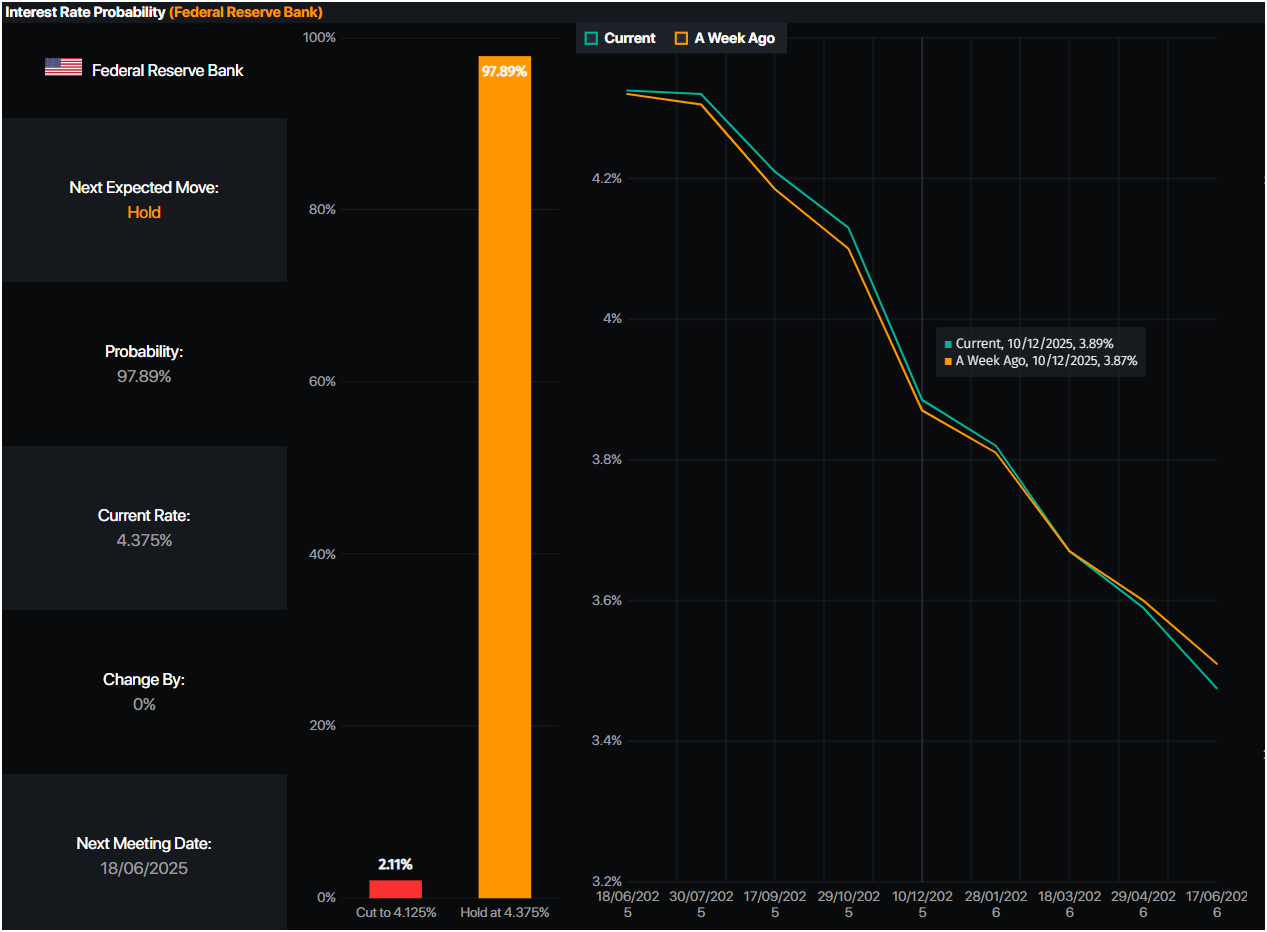
- Money markets suggest that traders are pricing in 49.5 basis points of easing toward the end of the year, according to Prime Market Terminal data.
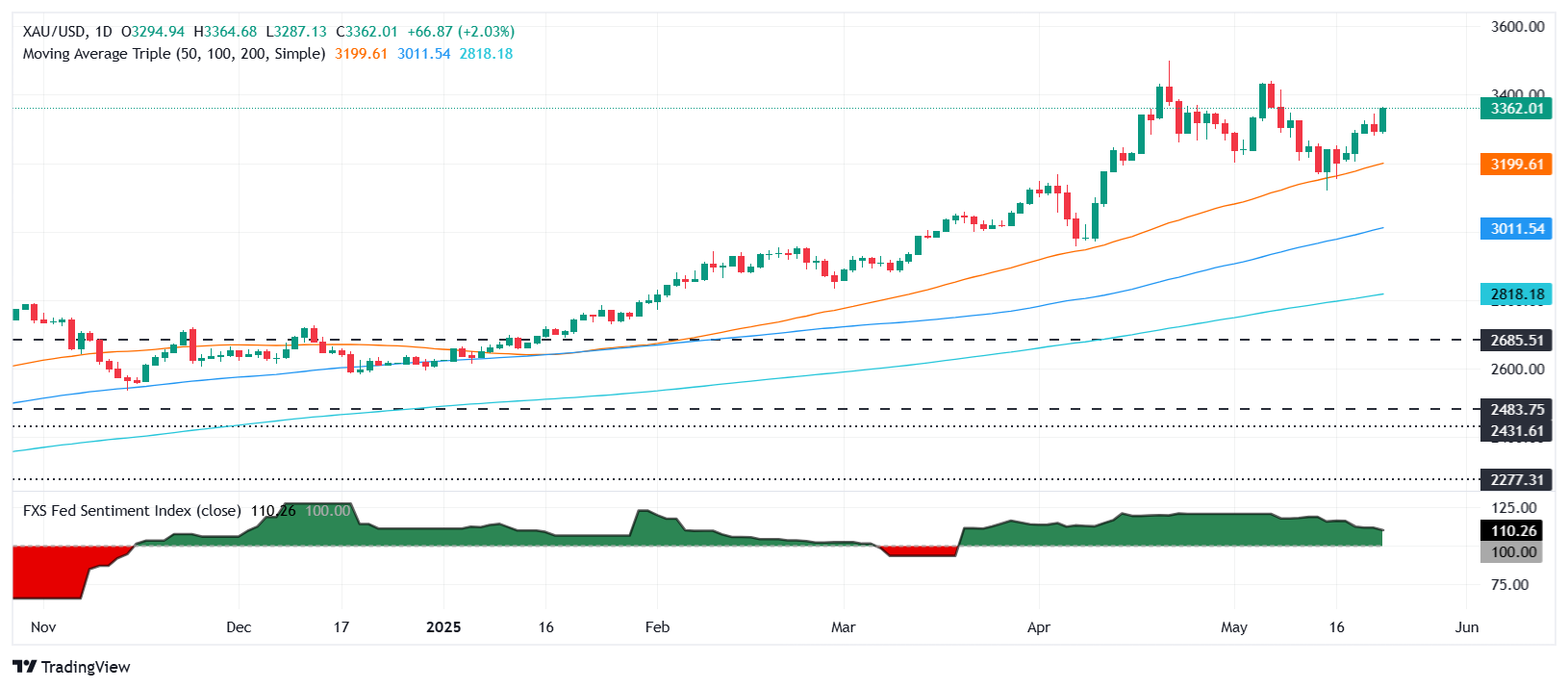
XAU/USD technical outlook: Jumps above $3,350 as uptrend resumes
Gold price extended its gains, poised to test the $3,400 figure in the near term. Bullish momentum remains strong, as depicted by the Relative Strength Index (RSI), which aims upwards with enough room before turning overbought.
That said, XAU/USD's first resistance is $3,400, the May 7 swing high at $3,438, followed by $3,450 and the all-time high (ATH) at $3,500.
On the bearish side, if Gold drops below $3,300, expect a move to the May 20 daily low of $3,204, ahead of the 50-day Simple Moving Average (SMA) at $3,199.
US-China Trade War FAQs
Generally speaking, a trade war is an economic conflict between two or more countries due to extreme protectionism on one end. It implies the creation of trade barriers, such as tariffs, which result in counter-barriers, escalating import costs, and hence the cost of living.
An economic conflict between the United States (US) and China began early in 2018, when President Donald Trump set trade barriers on China, claiming unfair commercial practices and intellectual property theft from the Asian giant. China took retaliatory action, imposing tariffs on multiple US goods, such as automobiles and soybeans. Tensions escalated until the two countries signed the US-China Phase One trade deal in January 2020. The agreement required structural reforms and other changes to China’s economic and trade regime and pretended to restore stability and trust between the two nations. However, the Coronavirus pandemic took the focus out of the conflict. Yet, it is worth mentioning that President Joe Biden, who took office after Trump, kept tariffs in place and even added some additional levies.
The return of Donald Trump to the White House as the 47th US President has sparked a fresh wave of tensions between the two countries. During the 2024 election campaign, Trump pledged to impose 60% tariffs on China once he returned to office, which he did on January 20, 2025. With Trump back, the US-China trade war is meant to resume where it was left, with tit-for-tat policies affecting the global economic landscape amid disruptions in global supply chains, resulting in a reduction in spending, particularly investment, and directly feeding into the Consumer Price Index inflation.
Author

Christian Borjon Valencia
FXStreet
Markets analyst, news editor, and trading instructor with over 14 years of experience across FX, commodities, US equity indices, and global macro markets.