Gold price slips as markets eye Powell at Jackson Hole
- XAU/USD falls 0.30% as traders await Fed's Chair Powell’s Jackson Hole speech.
- US PMI signals stronger growth at a 2.5% annualized pace, but jobless claims rise to the highest since late 2021.
- Fed officials Hammack, Schmid and Bostic warn inflation risks outweigh jobs concerns, pushing for restrictive policy.
- Russia demands Ukraine cede Donbas, no NATO and no Western troops.

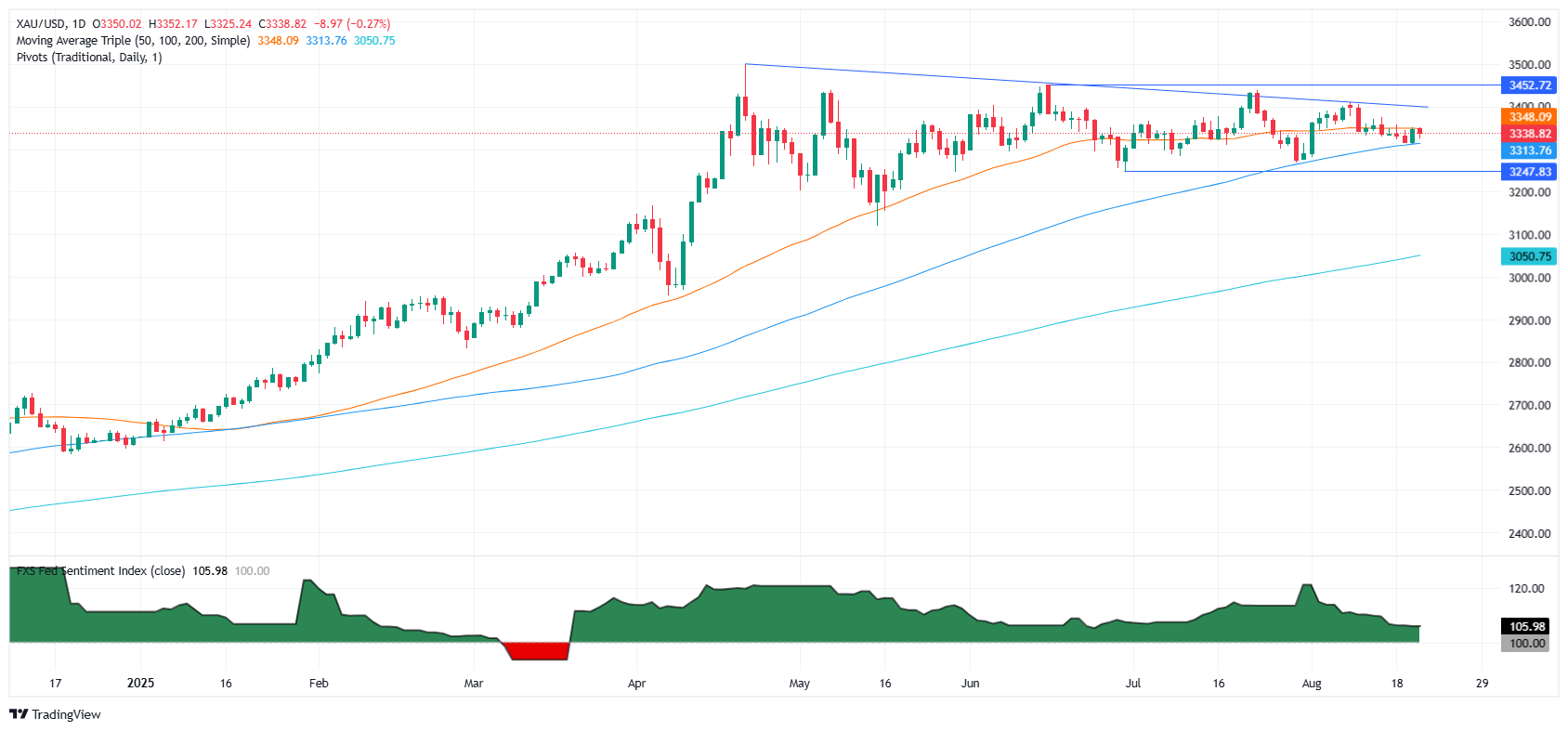
Gold price retreats slightly on Thursday following the release of mixed data from the United States (US) as traders brace for the Jackson Hole Symposium, waiting for the Federal Reserve’s (Fed) Chair Jerome Powell's speech on Friday. The XAU/USD pair trades at $3,339, down 0.30% at the time of writing.
The yellow metal choppy’s price action seems to continue until Powell hits the stand. Solid economic data revealed by S&P Global showed that business activity is expanding solidly. The agency noted, “The data are consistent with the economy expanding at a 2.5% annualized rate, up from the average 1.3% expansion seen over the first two quarters of the year.”
Jobs data revealed by the US Department of Labor (DoL) showed that jobless claims for the week ending August 16 surprisingly jumped above estimates and the previous week’s print. Continuing Claims, which reflect unemployed people re-applying for unemployment benefits, reached their highest level since November 2021.
Fed officials began to cross the wires. Cleveland’s Fed Beth Hammack made some hawkish comments, as she favors maintaining “modestly restrictive policy to lower inflation.”
Kansas City Fed Jeffrey Schmid commented that the risks of inflation are higher relative to the jobs situation, and Atlanta Fed Raphael Bostic reiterated that inflation remains above target.
Regarding geopolitics, Russia's Foreign Minister Sergey Lavrov says Ukraine is showing that it is not interested in a sustainable and long-lasting peace settlement, RIA reports. Meanwhile, Reuters sources revealed that President Vladimir Putin demands that Ukraine cede Donbas, with no NATO and no Western troops.
Daily digest market movers: Gold slides as US business activity improves
- US S&P Global Manufacturing PMI Flash for August rose by 53.3, above estimates of 49.5 and crushed July’s 49.8. The Services PMI for the same period expanded to 55.4, down from 55.7, but exceeded forecasts of 54.2.
- S&P noted that “The resulting rise in selling prices for goods and services suggests that consumer price inflation will rise further above the Fed’s 2% target in the coming months. Indeed, combined with the upturn in business activity and hiring, the rise in prices signaled by the survey puts the PMI data more into rate hiking, rather than cutting, territory according to the historical relationship between these economic indicators and FOMC policy changes.”
- US Initial Jobless Claims for the week ending August 16 rose by 235K, well above estimates of 225K. Continuing Claims jumped to 1.972 million, above expectations of 1.96 million.
- Cleveland Fed Hammack said that both sides of the mandate are under pressure, though added that her biggest concern is that inflation is too high and trending in the wrong direction. She said that tariffs are starting to affect the economy and reiterated the Fed’s laser focus on “too high inflation.” She said if the meeting were tomorrow, there would be no case for cutting rates.
- Kansas City Fed Schmid said that officials will be watching August and September inflation, that policy is modestly restrictive, and that the central bank is in no rush to cut interest rates.
- Atlanta’s Fed Bostic said that inflation remains above target, adding that the “Unemployment Rate is consistent with full employment for some time.” He eyes one cut in 2025, as business contacts had said that prices are rising.
- US Treasury yields rise across the yield curve. The 10-year Treasury note is up nearly four basis points at 4.328%. US real yields —which are calculated from the nominal yield minus inflation expectations— are up four bps at 1.978% at the time of writing.
- Expectations that the Fed will reduce rates in September continued to drop. A day ago, it was 85%, compared to 72% at the time of writing, according to Prime Market Terminal data.
Technical outlook: Gold price retraces below $3,350
Gold price consolidates below the confluence of the 20 and 50-day Simple Moving Averages (SMAs), each at $3,344-$3,348, respectively, and with a lack of direction. The Relative Strength Index (RSI) turned bearish, though it remains near the RSI’s neutral line.
If XAU/USD clears the confluence of the 20- and 50-day Simple Moving Averages (SMAs) between $3,344/48, the yellow metal would be poised to test the 100-day Simple Moving Average (SMA) at $3,306 ahead of $3,300. Conversely, if Gold rises above $3,350, the next resistance would be $3,400. Further resistance levels lie overhead, like the June 16 high at $3,452 and ultimately the all-time peak of $3,500.
Gold FAQs
Gold has played a key role in human’s history as it has been widely used as a store of value and medium of exchange. Currently, apart from its shine and usage for jewelry, the precious metal is widely seen as a safe-haven asset, meaning that it is considered a good investment during turbulent times. Gold is also widely seen as a hedge against inflation and against depreciating currencies as it doesn’t rely on any specific issuer or government.
Central banks are the biggest Gold holders. In their aim to support their currencies in turbulent times, central banks tend to diversify their reserves and buy Gold to improve the perceived strength of the economy and the currency. High Gold reserves can be a source of trust for a country’s solvency. Central banks added 1,136 tonnes of Gold worth around $70 billion to their reserves in 2022, according to data from the World Gold Council. This is the highest yearly purchase since records began. Central banks from emerging economies such as China, India and Turkey are quickly increasing their Gold reserves.
Gold has an inverse correlation with the US Dollar and US Treasuries, which are both major reserve and safe-haven assets. When the Dollar depreciates, Gold tends to rise, enabling investors and central banks to diversify their assets in turbulent times. Gold is also inversely correlated with risk assets. A rally in the stock market tends to weaken Gold price, while sell-offs in riskier markets tend to favor the precious metal.
The price can move due to a wide range of factors. Geopolitical instability or fears of a deep recession can quickly make Gold price escalate due to its safe-haven status. As a yield-less asset, Gold tends to rise with lower interest rates, while higher cost of money usually weighs down on the yellow metal. Still, most moves depend on how the US Dollar (USD) behaves as the asset is priced in dollars (XAU/USD). A strong Dollar tends to keep the price of Gold controlled, whereas a weaker Dollar is likely to push Gold prices up.
Author

Christian Borjon Valencia
FXStreet
Markets analyst, news editor, and trading instructor with over 14 years of experience across FX, commodities, US equity indices, and global macro markets.

















