Gold price keeps the red amid resurgent USD demand; holds above $3,300 mark
- Gold price drops to a multi-day low on Monday amid modest USD strength.
- Fed rate cut bets and US fiscal concerns should act as a headwind for the USD.
- Geopolitical risks could further offer support to the safe-haven precious metal.

Gold price (XAU/USD) retains intraday bearish bias through the first half of the European session, though it manages to bounce off the $3,300 mark, or a one-week low touched this Monday. A goodish pickup in the US Dollar (USD) demand turns out to be a key factor driving flows away from the commodity. However, the growing acceptance that the US Federal Reserve (Fed) will lower borrowing costs further this year might hold back the USD bulls from placing aggressive bets and lend some support to the non-yielding yellow metal.
Furthermore, concerns that US President Donald Trump's massive tax-cut and spending bill would worsen America’s long-term debt problems might contribute to capping gains for the USD. Meanwhile, the market sentiment remains fragile on the back of the uncertainty surrounding US President Donald Trump's erratic trade policies. Apart from this, fresh Israeli strikes on Yemen in almost a month temper investors' appetite for riskier assets, which further helps limit the downside for the safe-haven Gold price and warrants caution for bears.
Daily Digest Market Movers: Gold price continues to be weighed down by notable USD strength
- The US Dollar kicks off the new week on a slightly positive note and weighs on the Gold price, though the downside potential seems limited amid a combination of supporting factors.
- US President Donald Trump's ‘One Big Beautiful Bill’ is now a law and is expected to add $3.4 trillion to the nation’s debt over the next decade, worsening the long-term debt problem.
- This comes amid worries about the potential economic fallout from Trump's reciprocal tariffs and dovish Federal Reserve bets, which should keep a lid on any meaningful USD strength.
- Trump said on his social media early this Monday that the US tariff letters, and/or deals, with various countries from around the world, will be delivered starting 12:00 P.M. on July 7th.
- Trump followed up with a warning, stating that any country aligning with the anti-American policies of BRICS will be charged an additional 10% tariff and there will be no exceptions to this policy.
- Traders are currently pricing in over a 70% chance that the US central bank would lower borrowing costs in September and deliver at least two 25 basis points rate reductions by the year-end.
- The Israeli military carried out intense strikes on Houthi targets in three Yemeni ports and a power plant early this Monday in response to repeated attacks by the Iran-aligned group on Israel.
- This keeps geopolitical risks in play and should offer some support to the safe-haven precious metal. Traders now look to the release of FOMC minutes on Wednesday for a fresh impetus.
Gold price bears await sustained break below $3,300 mark before positioning for deeper losses
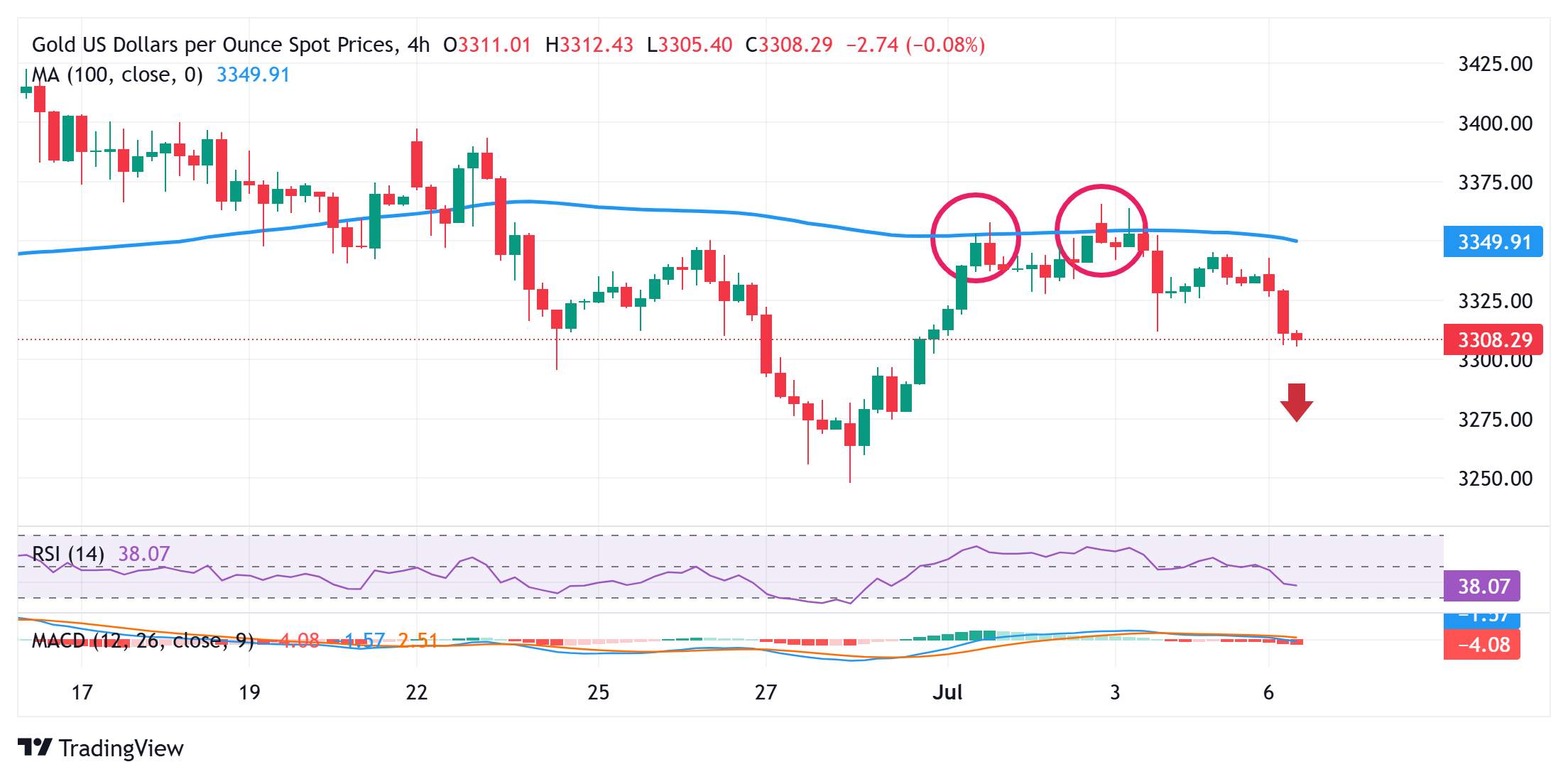
The recent repeated failures to build on momentum beyond the 100-period Simple Moving Average (SMA) on the 4-hour chart and the subsequent fall below the $3,300 mark will be seen as a fresh trigger for the XAU/USD bears. Given that oscillators on the daily chart have just started gaining negative traction, the Gold price might then accelerate the slide to the next relevant support near the $3,270 horizontal zone en route to the $3,248-3,248 region.
On the flip side, the $3,324-3,325 region now seems to act as an immediate hurdle ahead of the $3,342-3,343 zone. Some follow-through buying, leading to a further strength beyond the $3,352-3,355 area, could provide a goodish lift to the Gold price and allow bulls to aim towards reclaiming the $3,400 round figure.
US Dollar FAQs
The US Dollar (USD) is the official currency of the United States of America, and the ‘de facto’ currency of a significant number of other countries where it is found in circulation alongside local notes. It is the most heavily traded currency in the world, accounting for over 88% of all global foreign exchange turnover, or an average of $6.6 trillion in transactions per day, according to data from 2022. Following the second world war, the USD took over from the British Pound as the world’s reserve currency. For most of its history, the US Dollar was backed by Gold, until the Bretton Woods Agreement in 1971 when the Gold Standard went away.
The most important single factor impacting on the value of the US Dollar is monetary policy, which is shaped by the Federal Reserve (Fed). The Fed has two mandates: to achieve price stability (control inflation) and foster full employment. Its primary tool to achieve these two goals is by adjusting interest rates. When prices are rising too quickly and inflation is above the Fed’s 2% target, the Fed will raise rates, which helps the USD value. When inflation falls below 2% or the Unemployment Rate is too high, the Fed may lower interest rates, which weighs on the Greenback.
In extreme situations, the Federal Reserve can also print more Dollars and enact quantitative easing (QE). QE is the process by which the Fed substantially increases the flow of credit in a stuck financial system. It is a non-standard policy measure used when credit has dried up because banks will not lend to each other (out of the fear of counterparty default). It is a last resort when simply lowering interest rates is unlikely to achieve the necessary result. It was the Fed’s weapon of choice to combat the credit crunch that occurred during the Great Financial Crisis in 2008. It involves the Fed printing more Dollars and using them to buy US government bonds predominantly from financial institutions. QE usually leads to a weaker US Dollar.
Quantitative tightening (QT) is the reverse process whereby the Federal Reserve stops buying bonds from financial institutions and does not reinvest the principal from the bonds it holds maturing in new purchases. It is usually positive for the US Dollar.
Author

Haresh Menghani
FXStreet
Haresh Menghani is a detail-oriented professional with 10+ years of extensive experience in analysing the global financial markets.