Gold price hangs near daily low, bears flirt with $3,300 mark ahead of US macro releases
- Gold price attracts some sellers for the second straight day amid receding safe-haven demand.
- A stronger USD further exerts pressure on the commodity amid signs of easing trade tensions.
- Fed rate cut bets cap the USD upside and limit deeper losses for the non-yielding yellow metal.

Gold price (XAU/USD) struggles to lure buyers and languishes near the daily low, just above the $3,300 mark through the first half of the European session on Wednesday as signs of easing US-China trade tensions continue to undermine safe-haven assets. Apart from this, month-end flows provide a modest lift to the US Dollar (USD), which is seen as another factor weighing on the precious metal.
Meanwhile, Trump's rapidly shifting stance on trade and mixed US-China trade talks signals add to the global uncertainty. This, along with bets for more aggressive policy easing by the Federal Reserve (Fed), keeps a lid on any meaningful upside for the USD and acts as a tailwind for the non-yielding Gold price. Traders now look forward to the key US macro releases for short-term opportunities.
Daily Digest Market Movers: Gold price keeps the red amid mixed cues as traders keenly await key US macro data
- President Donald Trump signed an order on Tuesday to ease tariff effects on the auto industry, giving carmakers two years to increase the share of domestic parts in US-assembled vehicles. This adds to the optimism over progress on trade negotiations and signs of the potential de-escalation of US-China trade tensions.
- The US Dollar attracts some buyers for the second straight day and also acts as a headwind for the Gold price. Investors, however, remain on the edge as Trump's erratic trade policies continue to fuel worries about a sharp economic slowdown. Moreover, bets that the Federal Reserve will resume its rate-cutting cycle soon should cap any meaningful USD upside.
- Dovish Fed expectations were reaffirmed by the disappointing US Job Openings and Labor Turnover Survey (JOLTS) and the US Conference Board’s Consumer Confidence Index released on Tuesday. In fact, the US Bureau of Labor Statistics (BLS) reported that US job openings fell to 7.19 million by the last day of March from 7.480 million in the previous month.
- Adding to this, the US Consumer Confidence Index slumped to 86.0 in April, or a nearly five-year low. Furthermore, the Present Situation Index and the Expectations Index dropped to 133.5 and 54.4, respectively, during the reported month. The data strengthens the case for more aggressive policy easing by the Fed and should support the non-yielding yellow metal.
- On the geopolitical front, Russia dismissed Ukraine’s proposal to extend Russian President Vladimir Putin’s unilateral three-day ceasefire to 30 days. Moreover, the US threatened to stop its efforts to end the conflict between Russia and Ukraine if both parties didn't deliver concrete proposals. This further contributes to limiting the downside for the XAU/USD pair.
- Traders now look to Wednesday's US economic docket – featuring the ADP report on private-sector employment, the Advance Q1 GDP print, and the Personal Consumption and Expenditure (PCE) Price Index. This, along with the US Nonfarm Payrolls report on Friday, should provide cues about the Fed's policy outlook and influence the commodity in the near term.
Gold price slide below the $3,300 mark might continue to find decent support near the $3,265-3,260 area
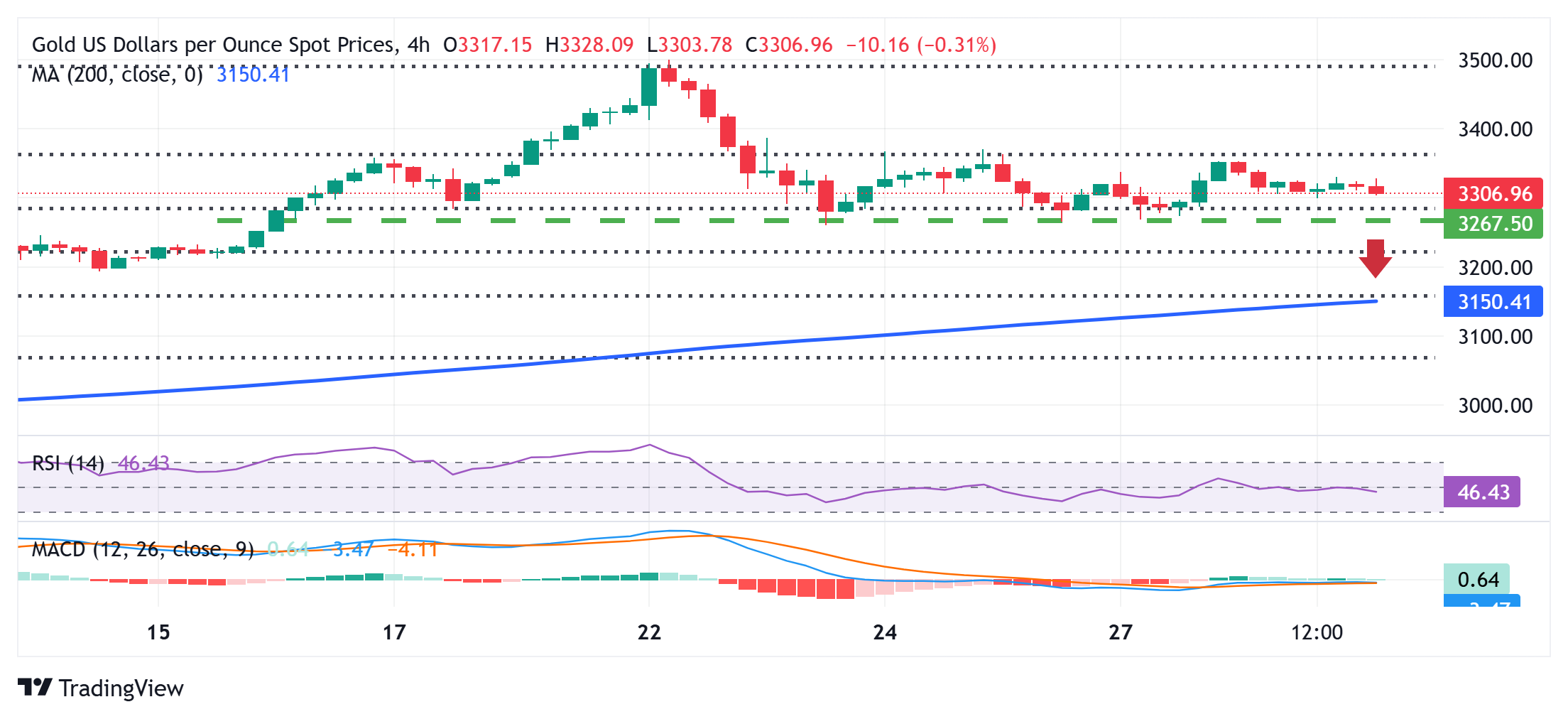
Technical indicators on the daily chart hold comfortably in the positive territory and favor the XAU/USD bulls. Hence, any further weakness below the $3,300-3,290 immediate support, representing the 38.2% Fibonacci retracement level of the latest leg up from the vicinity of mid-$2,900s or the monthly swing low, might continue to find decent support near the $3,265-3,260 zone. A convincing break below the latter, however, would set the stage for an extension of the recent pullback from the all-time peak touched last week. The downward trajectory might then drag the Gold price to the 50% retracement level, around the $3,225 region, en route to the $3,200 mark.
On the flip side, the Asian session high, around the $3,328 region, could act as an immediate hurdle ahead of the $3,348-3,353 area. This is closely followed by the $3,366-3,368 supply zone, which if cleared should allow the Gold price to reclaim the $3,400 mark. The momentum could extend further toward the $3,425-3,427 intermediate hurdle before bulls make a fresh attempt to conquer the $3,500 psychological mark.
US Dollar PRICE Today
The table below shows the percentage change of US Dollar (USD) against listed major currencies today. US Dollar was the strongest against the Japanese Yen.
| USD | EUR | GBP | JPY | CAD | AUD | NZD | CHF | |
|---|---|---|---|---|---|---|---|---|
| USD | 0.02% | 0.15% | 0.31% | -0.01% | -0.19% | 0.05% | 0.10% | |
| EUR | -0.02% | 0.14% | 0.29% | -0.04% | -0.22% | 0.03% | 0.08% | |
| GBP | -0.15% | -0.14% | 0.15% | -0.17% | -0.34% | -0.10% | -0.06% | |
| JPY | -0.31% | -0.29% | -0.15% | -0.33% | -0.50% | -0.21% | -0.19% | |
| CAD | 0.01% | 0.04% | 0.17% | 0.33% | -0.17% | 0.07% | 0.12% | |
| AUD | 0.19% | 0.22% | 0.34% | 0.50% | 0.17% | 0.24% | 0.29% | |
| NZD | -0.05% | -0.03% | 0.10% | 0.21% | -0.07% | -0.24% | 0.05% | |
| CHF | -0.10% | -0.08% | 0.06% | 0.19% | -0.12% | -0.29% | -0.05% |
The heat map shows percentage changes of major currencies against each other. The base currency is picked from the left column, while the quote currency is picked from the top row. For example, if you pick the US Dollar from the left column and move along the horizontal line to the Japanese Yen, the percentage change displayed in the box will represent USD (base)/JPY (quote).
Author

Haresh Menghani
FXStreet
Haresh Menghani is a detail-oriented professional with 10+ years of extensive experience in analysing the global financial markets.