Gold price retreats further from record high amid positive risk tone, modest USD strength
- Gold price retreats from the record high as bulls opt to take some profits off the table.
- A modest USD bounce and a positive risk tone seem to undermine the XAU/USD pair.
- US-China trade war fears and Fed rate cut bets should limit losses for the commodity.

Gold price (XAU/USD) extends its steady intraday descent through the first half of the European session on Thursday and for now, seems to have snapped a five-day winning streak to the all-time peak through the previous day. A modest US Dollar (USD) rebound from over a one-week low, along with a positive risk tone, prompts bullish traders to take some profits off the table amid slightly overbought conditions. The fundamental backdrop, however, warrants some caution before confirming that the commodity has topped out and positioning for deeper losses.
Investors remain concerned about the potential economic fallout from US President Donald Trump's protectionist policies and escalating US-China trade war, which should continue to underpin the safe-haven Gold price. Apart from this, expectations that the Federal Reserve (Fed) would stick to its easing bias, along with the recent fall in the US Treasury bond yields, could act as a headwind for the USD and contribute to limiting the downside for the bullion. Traders now look forward to the release of the US Weekly Initial Jobless Claims data for short-term opportunities.
Gold price is pressured by a combination of factors; downside potential seems limited
- US President Donald Trump's new 10% tariffs on Chinese imports came into effect on Tuesday. Furthermore, China announced retaliatory tariffs on some US goods, fueling worries about an escalating trade war and lifting the safe-haven Gold price to a fresh record high on Wednesday.
- The Automatic Data Processing (ADP) reported that private-sector added 183K in January compared to the previous month's upwardly revised reading of 176K. This, however, was offset by the disappointing release of the US ISM Services PMI, which declined to 52.8 in January.
- The US Treasury yields dropped to their lowest level since mid-December in reaction to the softer data. Moreover, expectations the Federal Reserve will lower borrowing costs twice this year drag the US Dollar to over a one-week low and further benefit the non-yielding yellow metal.
- US Treasury Secretary Scott Bessent said late Wednesday, the focus is on bringing down 10-year Treasury yields, rather than the Fed’s benchmark short-term interest rate. Bessent added that interest rates will take care of themselves if we get energy costs down and deregulate the economy.
- The USD bulls failed to gain respite from Fed Vice Chair Philip Jefferson's hawkish remarks on Thursday, saying that he is happy to keep the Fed Funds on hold at the current level. He will wait to see the net effect of US President Donald Trump's policies, Jefferson noted further.
- Investors are looking to the US monthly employment details – popularly known as the Nonfarm Payrolls report – on Friday for further clues on the outlook for rates. In the meantime, traders on Thursday will take cues from the release of the usual US Weekly Initial Jobless Claims data.
Gold price bulls have the upper hand while above the $2,773-2,772 breakout region
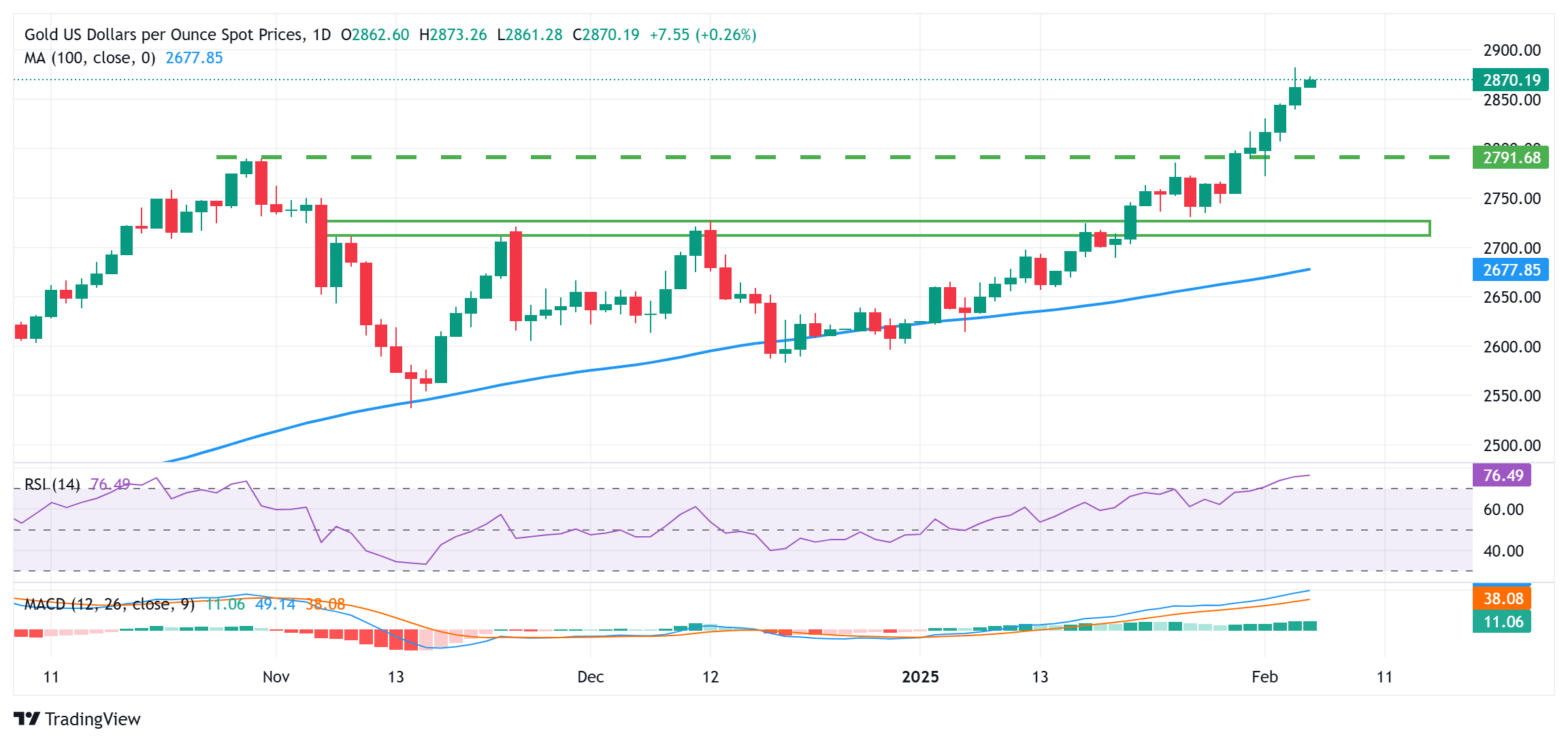
From a technical perspective, the Relative Strength Index (RSI) has moved above the 70 mark and warrants some caution for bullish traders. Hence, it will be prudent to wait for some near-term consolidation or a modest pullback before positioning for any further appreciating move. Nevertheless, the recent breakout through key barriers suggests that the path of least resistance for the Gold price remains to the upside.
In the meantime, any corrective slide is likely to find some support near the $2,855-2,850 area, below which the Gold price could slide further toward the $2,810-2,800 region. This is followed by the $2,773-2,772 horizontal resistance breakpoint, now turned support, which if broken might prompt some technical selling and pave the way for deeper losses.
Interest rates FAQs
Interest rates are charged by financial institutions on loans to borrowers and are paid as interest to savers and depositors. They are influenced by base lending rates, which are set by central banks in response to changes in the economy. Central banks normally have a mandate to ensure price stability, which in most cases means targeting a core inflation rate of around 2%. If inflation falls below target the central bank may cut base lending rates, with a view to stimulating lending and boosting the economy. If inflation rises substantially above 2% it normally results in the central bank raising base lending rates in an attempt to lower inflation.
Higher interest rates generally help strengthen a country’s currency as they make it a more attractive place for global investors to park their money.
Higher interest rates overall weigh on the price of Gold because they increase the opportunity cost of holding Gold instead of investing in an interest-bearing asset or placing cash in the bank. If interest rates are high that usually pushes up the price of the US Dollar (USD), and since Gold is priced in Dollars, this has the effect of lowering the price of Gold.
The Fed funds rate is the overnight rate at which US banks lend to each other. It is the oft-quoted headline rate set by the Federal Reserve at its FOMC meetings. It is set as a range, for example 4.75%-5.00%, though the upper limit (in that case 5.00%) is the quoted figure. Market expectations for future Fed funds rate are tracked by the CME FedWatch tool, which shapes how many financial markets behave in anticipation of future Federal Reserve monetary policy decisions.
US-China Trade War FAQs
Generally speaking, a trade war is an economic conflict between two or more countries due to extreme protectionism on one end. It implies the creation of trade barriers, such as tariffs, which result in counter-barriers, escalating import costs, and hence the cost of living.
An economic conflict between the United States (US) and China began early in 2018, when President Donald Trump set trade barriers on China, claiming unfair commercial practices and intellectual property theft from the Asian giant. China took retaliatory action, imposing tariffs on multiple US goods, such as automobiles and soybeans. Tensions escalated until the two countries signed the US-China Phase One trade deal in January 2020. The agreement required structural reforms and other changes to China’s economic and trade regime and pretended to restore stability and trust between the two nations. However, the Coronavirus pandemic took the focus out of the conflict. Yet, it is worth mentioning that President Joe Biden, who took office after Trump, kept tariffs in place and even added some additional levies.
The return of Donald Trump to the White House as the 47th US President has sparked a fresh wave of tensions between the two countries. During the 2024 election campaign, Trump pledged to impose 60% tariffs on China once he returned to office, which he did on January 20, 2025. With Trump back, the US-China trade war is meant to resume where it was left, with tit-for-tat policies affecting the global economic landscape amid disruptions in global supply chains, resulting in a reduction in spending, particularly investment, and directly feeding into the Consumer Price Index inflation.
Author

Haresh Menghani
FXStreet
Haresh Menghani is a detail-oriented professional with 10+ years of extensive experience in analysing the global financial markets.

















