Gold tumbles under $3,000 as US Dollar dominates as trade war tensions grow
- Gold reaches mid-March low amid US-China trade war escalation and global risk-off sentiment.
- Trump refutes 90-day tariff pause rumors, propelling DXY to 103.29 and 10-year yields to 4.15%.
- Investors await FOMC minutes, CPI, and PPI; inflation outlook and rate cut bets grow uncertain.

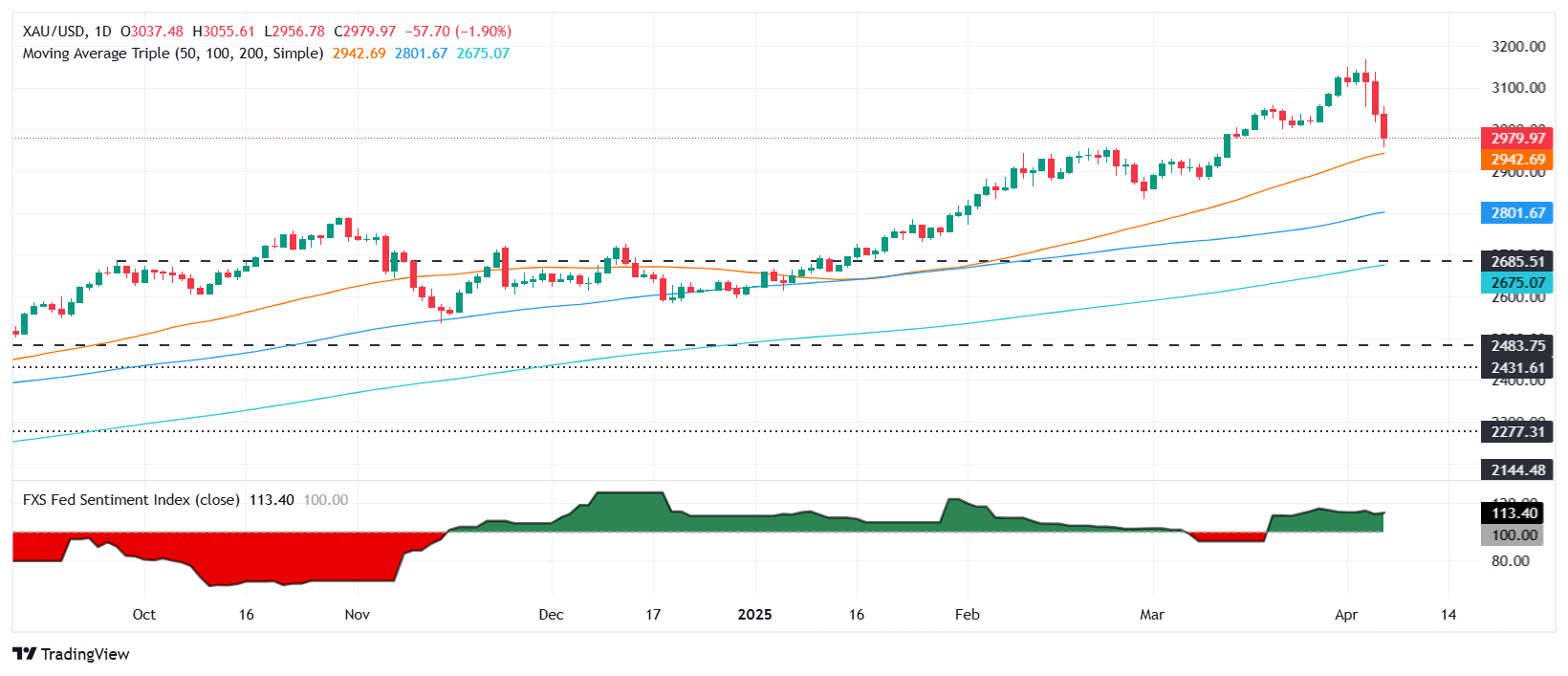
Gold (XAU) price prolongs its agony and plummets by over 2% on Monday as investors seeking safety bid the US Dollar, with US trade policy fueling speculation of a global recession. XAU/USD trades at $2,971, its lowest level since mid-March, below $3,000.
The King Dollar is back after reaching a six-month low last week, after US President Donald Trump revealed reciprocal tariffs on Wednesday. Last Friday, China retaliated by imposing a 34% duty on all imports from the US, sparking turmoil in the financial markets as most global equity indices posted losses.
Earlier, the White House advisor Hassett announced that the government might approve a 90-day pause in tariffs, though it would depend on Trump. Nevertheless, the Trump administration rejected that statement, which was later revealed as “fake news,” according to CNBC.
Bullion prices were also undermined by the rise in US Treasury yields, with the 10-year note coupon increasing by almost fifteen basis points to 4.147%. In the meantime, the US Dollar Index (DXY), which tracks the performance of the USD against a basket of six currencies, climbs 0.39% to 103.29.
Ahead this week, the US economic docket will feature the release of the Federal Open Market Committee (FOMC) meeting minutes on Wednesday, followed by the announcement of the consumer and producer inflation data.
Daily digest market movers: Gold price tanks as the US Dollar counterattacks
- US real yields edge surge 14 bps to 1.967%, according to US 10-year Treasury Inflation-Protected Securities (TIPS) yields.
- The US Consumer Price Index (CPI) is expected to fall from 2.8% to 2.6% YoY in March. The Core CPI is projected to decline over the next twelve months, from 3.1% to 3%.
- Recently, Fed Governor Adriana Kugler said that tariffs and shortages are important to consider when forecasting inflation. She added that new tariffs will be “consequential” and have already begun to see some price increases.
- Recession fears ignited as depicted by the US10s to 3 months yield curve inversion, with the latter paying 27 bps more than the US 10-year yield.
XAU/USD technical outlook: Gold price plummets below $3,000 a troy ounce
Gold is puking at the time of writing, as sellers continue to push prices lower, beneath the $3,000 mark. The Relative Strength Index (RSI) fell sharply, turning bearish, hinting that the golden metal could consolidate around the 50-day Simple Moving Average (SMA) of $2,942 - $3000. A breach below the former could push prices toward the $2,900 mark, followed by the 100-day SMA at $2,801.
Conversely, if buyers push Gold back above $3,000, look for a test of the $3,050 figure.
Tariffs FAQs
Tariffs are customs duties levied on certain merchandise imports or a category of products. Tariffs are designed to help local producers and manufacturers be more competitive in the market by providing a price advantage over similar goods that can be imported. Tariffs are widely used as tools of protectionism, along with trade barriers and import quotas.
Although tariffs and taxes both generate government revenue to fund public goods and services, they have several distinctions. Tariffs are prepaid at the port of entry, while taxes are paid at the time of purchase. Taxes are imposed on individual taxpayers and businesses, while tariffs are paid by importers.
There are two schools of thought among economists regarding the usage of tariffs. While some argue that tariffs are necessary to protect domestic industries and address trade imbalances, others see them as a harmful tool that could potentially drive prices higher over the long term and lead to a damaging trade war by encouraging tit-for-tat tariffs.
During the run-up to the presidential election in November 2024, Donald Trump made it clear that he intends to use tariffs to support the US economy and American producers. In 2024, Mexico, China and Canada accounted for 42% of total US imports. In this period, Mexico stood out as the top exporter with $466.6 billion, according to the US Census Bureau. Hence, Trump wants to focus on these three nations when imposing tariffs. He also plans to use the revenue generated through tariffs to lower personal income taxes.
Author

Christian Borjon Valencia
FXStreet
Markets analyst, news editor, and trading instructor with over 14 years of experience across FX, commodities, US equity indices, and global macro markets.