Gold price shines as US Dollar retreats despite US-China talks optimism
- Gold gains despite risk-on mood as yields retreat and US Dollar weakens.
- Trump grants Bessent flexibility on export controls, aiding US-China talks.
- Russia-Ukraine tensions persist, keeping safe haven demand for Gold alive.

Gold prices posted solid gains on Monday as the US Dollar weakened during the North American session despite positive news regarding US-China trade talks. A retracement of US Treasury bond yields underpins the golden metal, which trades at $3,329 a troy ounce at the time of writing.
An improvement in risk appetite was not an excuse for Bullion buyers to extend the XAU/USD uptrend despite the reduced demand for safe haven assets. A Wall Street Journal article mentioned that US President Donald Trump granted some flexibility on export controls to US Treasury Secretary Scott Bessent as talks between the US and China got underway on Monday.
Easing tensions between Washington and Beijing could undermine the appeal of Gold. However, if US Treasury bond yields continue to drop, this would put a lid on Bullion’s fall.
The US Dollar Index (DXY), which tracks the US Dollar’s performance against a basket of six currencies, falls by 0.25% to 98.95, making the US Dollar-denominated asset more expensive for foreign buyers.
Geopolitical tensions remain high as Russia claimed control of territory in Ukraine’s east-central region. An escalation of the conflict could push Gold prices higher, clearing the path to test $3,350 in the short term.
Ahead this week, traders are eyeing the release of the latest US Consumer Price Index (CPI) report, followed by the Producer Price Index (PPI), jobs data, and the University of Michigan (UoM) Consumer Sentiment survey.
Daily digest market movers: Gold climbs as US yields tumble, undermining the US Dollar
- The US 10-year Treasury yield falls three basis points to 4.478%. US real yields have followed suit and are also down for the same amount at 2.168%, a headwind for Bullion prices.
- Gold prices are recovering following an upbeat May US Nonfarm Payrolls report. The print exceeded forecasts of 130K, rising by 139K, while the Unemployment Rate remained steady at 4.2%. The data reinforced the Federal Reserve’s (Fed) approach of wait-and-see, fueling a reduction of rate cut bets pricing, with traders eyeing less than two rate cuts this year.
- On Wednesday, the US CPI is expected to rise from 2.3% to 2.5% YoY, with core figures projected to increase from 2.8% to 2.9% YoY. If the numbers come as expected, the Fed would not have room to reduce interest rates as demanded by President Trump.
- Data over the weekend showed that China's central bank added Gold to its reserves in May for the seventh straight month.
- The de-escalation of US-Sino trade war tensions could exert downward pressure on Gold, which so far has gained over 26% this year.
- Money markets suggest that traders are pricing in 44.5 basis points of easing toward the end of the year, according to Prime Market Terminal data.

Source: Prime Market Terminal
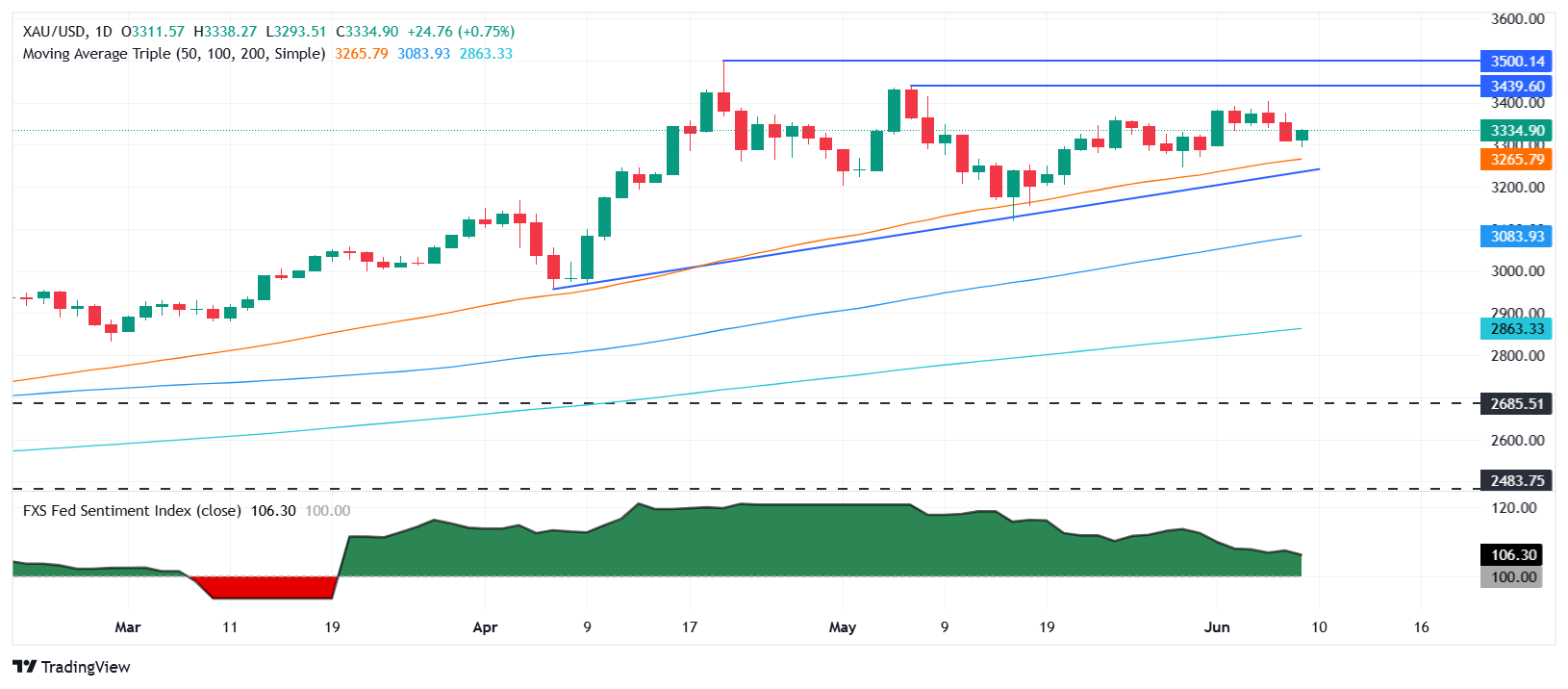
XAU/USD technical outlook: Gold price advances toward $3,350
Gold prices dipped to a support trendline below $3,300 before bouncing off those levels toward the daily high near $3,340, which has opened the door to challenge the $3,350 level. The Relative Strength Index (RSI) remains bullish; therefore, if XAU/USD clears $3,400, the yellow metal would be poised to challenge key resistance levels.
Next lies the $3,450 mark, followed by the all-time high of $3,500. Conversely, if Gold tumbles beneath $3,300, sellers could drive the non-yielding metal lower to test the 50-day Simple Moving Average (SMA) at $3,260, followed by the April 3 high, which has since turned into support at $3,167.
Gold FAQs
Gold has played a key role in human’s history as it has been widely used as a store of value and medium of exchange. Currently, apart from its shine and usage for jewelry, the precious metal is widely seen as a safe-haven asset, meaning that it is considered a good investment during turbulent times. Gold is also widely seen as a hedge against inflation and against depreciating currencies as it doesn’t rely on any specific issuer or government.
Central banks are the biggest Gold holders. In their aim to support their currencies in turbulent times, central banks tend to diversify their reserves and buy Gold to improve the perceived strength of the economy and the currency. High Gold reserves can be a source of trust for a country’s solvency. Central banks added 1,136 tonnes of Gold worth around $70 billion to their reserves in 2022, according to data from the World Gold Council. This is the highest yearly purchase since records began. Central banks from emerging economies such as China, India and Turkey are quickly increasing their Gold reserves.
Gold has an inverse correlation with the US Dollar and US Treasuries, which are both major reserve and safe-haven assets. When the Dollar depreciates, Gold tends to rise, enabling investors and central banks to diversify their assets in turbulent times. Gold is also inversely correlated with risk assets. A rally in the stock market tends to weaken Gold price, while sell-offs in riskier markets tend to favor the precious metal.
The price can move due to a wide range of factors. Geopolitical instability or fears of a deep recession can quickly make Gold price escalate due to its safe-haven status. As a yield-less asset, Gold tends to rise with lower interest rates, while higher cost of money usually weighs down on the yellow metal. Still, most moves depend on how the US Dollar (USD) behaves as the asset is priced in dollars (XAU/USD). A strong Dollar tends to keep the price of Gold controlled, whereas a weaker Dollar is likely to push Gold prices up.
Author

Christian Borjon Valencia
FXStreet
Markets analyst, news editor, and trading instructor with over 14 years of experience across FX, commodities, US equity indices, and global macro markets.