Gold price sticks to positive bias ahead of US PPI; lacks bullish conviction
- Gold price attracts buyers for the second straight day amid a combination of supportive factors.
- Concerns about Trump’s trade tariff and a modest USD weakness underpin the XAU/USD pair.
- Reduced Fed rate cut bets warrant some caution before positioning for a further positive move.

Gold price (XAU/USD) sticks to modest intraday gains through the first half of the European session on Thursday, though it lacks follow-through and remains below the record high touched earlier this week. Investors remain worried that US President Donald Trump's trade tariffs might trigger a global trade war, which continues to act as a tailwind for the safe-haven bullion. Apart from this, a fresh leg down in the US Treasury bond yields drags the US Dollar (USD) to the weekly low and turns out to be another factor that benefits the commodity.
Moreover, expectations that Trump's protectionist policies will boost already elevated inflation in the US and further benefit the Gold price, which is seen as a hedge against rising prices. Meanwhile, the stronger US Consumer Price Index (CPI) print released on Wednesday reaffirmed market expectations that the Federal Reserve (Fed) will stick to its hawkish stance and hold interest rates steady for an extended period. This caps the upside for the non-yielding yellow metal as traders now look to the US Producer Price Index (PPI), due later today.
Gold price bulls seem non-committed amid receding Fed rate cut bets
- The initial market reaction to the latest US consumer inflation figures turned out to be short-lived amid worries over US President Donald Trump's trade tariffs, which continue to benefit the safe-haven Gold price.
- Trump signed executive orders on Monday to impose 25% tariffs on steel and aluminum imports into the US and also promised broader reciprocal tariffs to match the levies other governments charge on US products.
- The US Bureau of Labor Statistics reported on Wednesday that the headline US Consumer Price Index rose 0.5% in January – the most since August 2023 – and the yearly rate climbed to 3% from 2.9% in December.
- Meanwhile, the core CPI, which excludes food and energy prices, nudged up by 0.4% on a monthly basis and jumped 3.3% from a year ago compared to 3.1% expected, pointing to underlying inflationary pressures.
- Fed Chair Jerome Powell told US lawmakers that the battle with rising prices wasn't finished yet, which meant that any further interest rate cuts would have to wait until it was clear inflation would return to the 2% target.
- The Atlanta Fed President noted that the labor market is performing incredibly well and the GDP is more resilient than expected, though the latest inflation numbers show careful monitoring is still needed.
- Market participants were quick to react and now see just one Fed rate cut by the end of this year, assisting the yield on the benchmark 10-year US government bond to register its biggest one-day rise since December.
- The US Dollar (USD), however, struggles to attract any meaningful buyers and languishes near the lower end of its weekly range touched on Wednesday, further lending support to the USD-denominated commodity.
- Thursday's US economic docket features the release of the Producer Price Index and the usual Weekly Initial Jobless Claims, which might influence the USD and provide some impetus to the XAU/USD pair.
Gold price dips could be seen as buying opportunity amid constructive setup
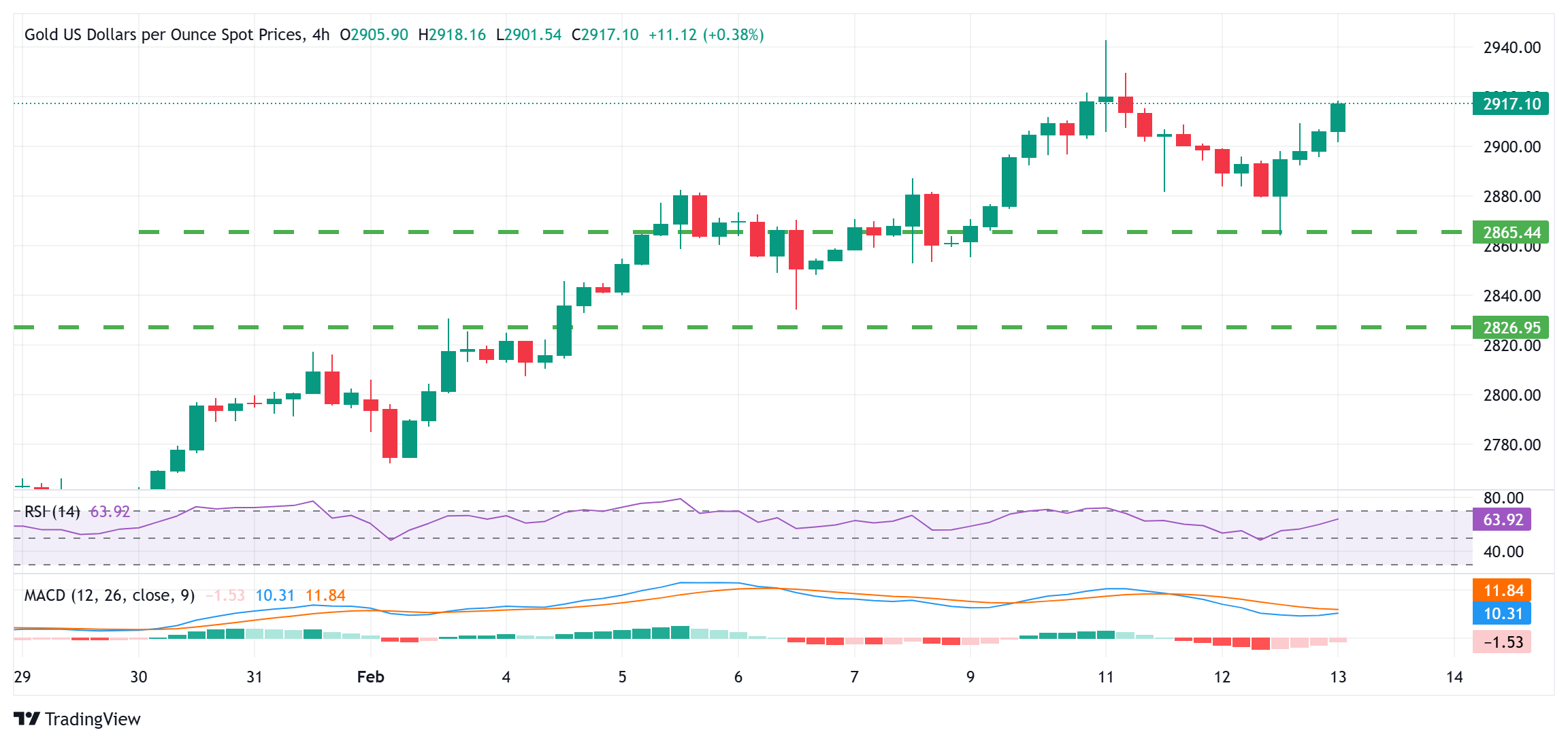
From a technical perspective, the daily Relative Strength Index (RSI) remains in the overbought territory and warrants some caution before positioning for any further gains. Bulls are more likely to take a brief pause near the $2,942-2,943 area, or the all-time peak touched on Tuesday, which should now act as an immediate strong barrier for the Gold price.
On the flip side, weakness back below the $2,900 round figure might expose the overnight swing low, around the $2,864 area. Some follow-through selling could make the Gold price vulnerable to accelerate the corrective pullback towards intermediate support near the $2,834-2,832 region en route to the $2,800 mark.
Economic Indicator
Producer Price Index (YoY)
The Producer Price Index released by the Bureau of Labor statistics, Department of Labor measures the average changes in prices in primary markets of the US by producers of commodities in all states of processing. Changes in the PPI are widely followed as an indicator of commodity inflation. Generally speaking, a high reading is seen as positive (or bullish) for the USD, whereas a low reading is seen as negative (or bearish).
Read more.Next release: Thu Feb 13, 2025 13:30
Frequency: Monthly
Consensus: 3.2%
Previous: 3.3%
Source: US Bureau of Labor Statistics
Tariffs FAQs
Tariffs are customs duties levied on certain merchandise imports or a category of products. Tariffs are designed to help local producers and manufacturers be more competitive in the market by providing a price advantage over similar goods that can be imported. Tariffs are widely used as tools of protectionism, along with trade barriers and import quotas.
Although tariffs and taxes both generate government revenue to fund public goods and services, they have several distinctions. Tariffs are prepaid at the port of entry, while taxes are paid at the time of purchase. Taxes are imposed on individual taxpayers and businesses, while tariffs are paid by importers.
There are two schools of thought among economists regarding the usage of tariffs. While some argue that tariffs are necessary to protect domestic industries and address trade imbalances, others see them as a harmful tool that could potentially drive prices higher over the long term and lead to a damaging trade war by encouraging tit-for-tat tariffs.
During the run-up to the presidential election in November 2024, Donald Trump made it clear that he intends to use tariffs to support the US economy and American producers. In 2024, Mexico, China and Canada accounted for 42% of total US imports. In this period, Mexico stood out as the top exporter with $466.6 billion, according to the US Census Bureau. Hence, Trump wants to focus on these three nations when imposing tariffs. He also plans to use the revenue generated through tariffs to lower personal income taxes.
Author

Haresh Menghani
FXStreet
Haresh Menghani is a detail-oriented professional with 10+ years of extensive experience in analysing the global financial markets.