Gold price sees uptick ahead of US CPI and Tuesday's US trading session
- Gold price ties up with 0.5% gain on Tuesday while the US-China trade deal euphoria quickly fades.
- Traders question the recent deals as no details are provided on the content of current deals with the UK and China.
- Traders are buying some safe haven protection at current discounted prices around $3,250.

Gold (XAU/USD) still has quite a long way to go back and test that all-time high at $3,500, currently trading near $3,256 at the time of writing on Tuesday. The precious metal recovers parts from the 2.65% correction that took place on Monday after the US-China trade deal was announced. Traders are starting to get wary about the lack of detail in the announcement, and another flare-up could propel bullion back toward the record high set last month. Thus, the current move in the precious metal price might be a good time to buy the dip.
Federal Reserve (Fed) Bank President of Chicago Austan Goolsbee warned that even current tariff levels will still have an inflationary impulse, the New York Times reports, while Deutsche Bank issued a report saying that the easing of China trade will not fuel a quick Fed interest rate cut. Meanwhile, “The devil is in the details during negotiations,” said Christopher Wong, a strategist from Oversea-Chinese Banking Corp. “Some degree of caution remains warranted, as we see consolidation in the range of $3,150 to $3,350 an ounce.”, Bloomberg reports.
Daily digest market movers: CPI up ahead
- For the Perth-based mining company Northern Star, getting the equipment and materials needed to run a Gold mine in a remote part of Alaska was already costly. US President Donald Trump's trade war isn't helping, and sees its Pogo mine venture flirting with becoming break-even or even at a loss if tariff relief is not coming soon, Bloomberg reports.
- On Monday, President Trump said the US has the upper hand in its trade discussions with the European Union. "The European Union is in many ways nastier than China. We've just started with them. We have all the cards. They treated us very unfairly," Trump said at the White House.
- A big drop in US-China trade barriers lessens the prospects of a serious inflationary supply crunch. Even so, inflation remains stubborn enough that the Fed probably still won't be in a rush to cut interest rates, economists at Deutsche Bank write. Despite the trade war's easing, "policies are likely to keep inflation at uncomfortably high levels for the Fed," Deutsche's team suggests. "This announcement therefore reinforces our view that the Fed is going to be slow to cut rates this year." Deutsche's baseline assumption is that the Fed's next rate cut won't come before December, Deutsche Bank reports in a Monday brief. Gold and US interest rates have an inverse relationship where lower rates often support a higher Gold price and vice versa.
- At 12:30 GMT, the April US Consumer Price Index data will be released:
- Monthly headline CPI is expected to surge to 0.3%, from the disinflationary -0.1% in March. The yearly figure is set to remain stable at 2.4%.
- The Monthly core CPI is expected to tick up to 0.3%, from 0.1% in March. The yearly figure is set to remain unchanged at 2.8%.
Gold Price Technical Analysis: Are these deals just empty shells and brief shots for equities?
“Close but no cigar”, it seems for President Trump again. Several traders and analysts are wary of the conceived trade deal with China, which is only a 90-day relief. Besides reducing tariffs for 90 days, there are no fundamental elements for markets to cling to, such as forward dates for negotiations, topics, additional numbers, or anything material to see a continuation of momentum. It makes sense for experienced traders to remain cautious and buy securities such as Gold after Monday’s correction.
The daily Pivot Point at $3,248 roughly coincides with that technical pivotal level at $3,245, the April 11 high, identified in previous weeks. From here on out, it would be healthy to see if Gold bulls can push the price back up to $3,289, the R1 resistance for this Tuesday. Further up, $3,341 might be a stretch, though it would mean a test of Friday’s high and the R2 resistance.
On the downside, a double bottom is getting formed near $3,195, which coincides with the S1 intraday support. From there, the next pivotal technical level comes into play at $3,167 (April 3 high), just ahead of the S2 support at $3,155. In case those two levels snap under pressure, the 55-day Simple Moving Average (SMA) comes into play at $3,121.
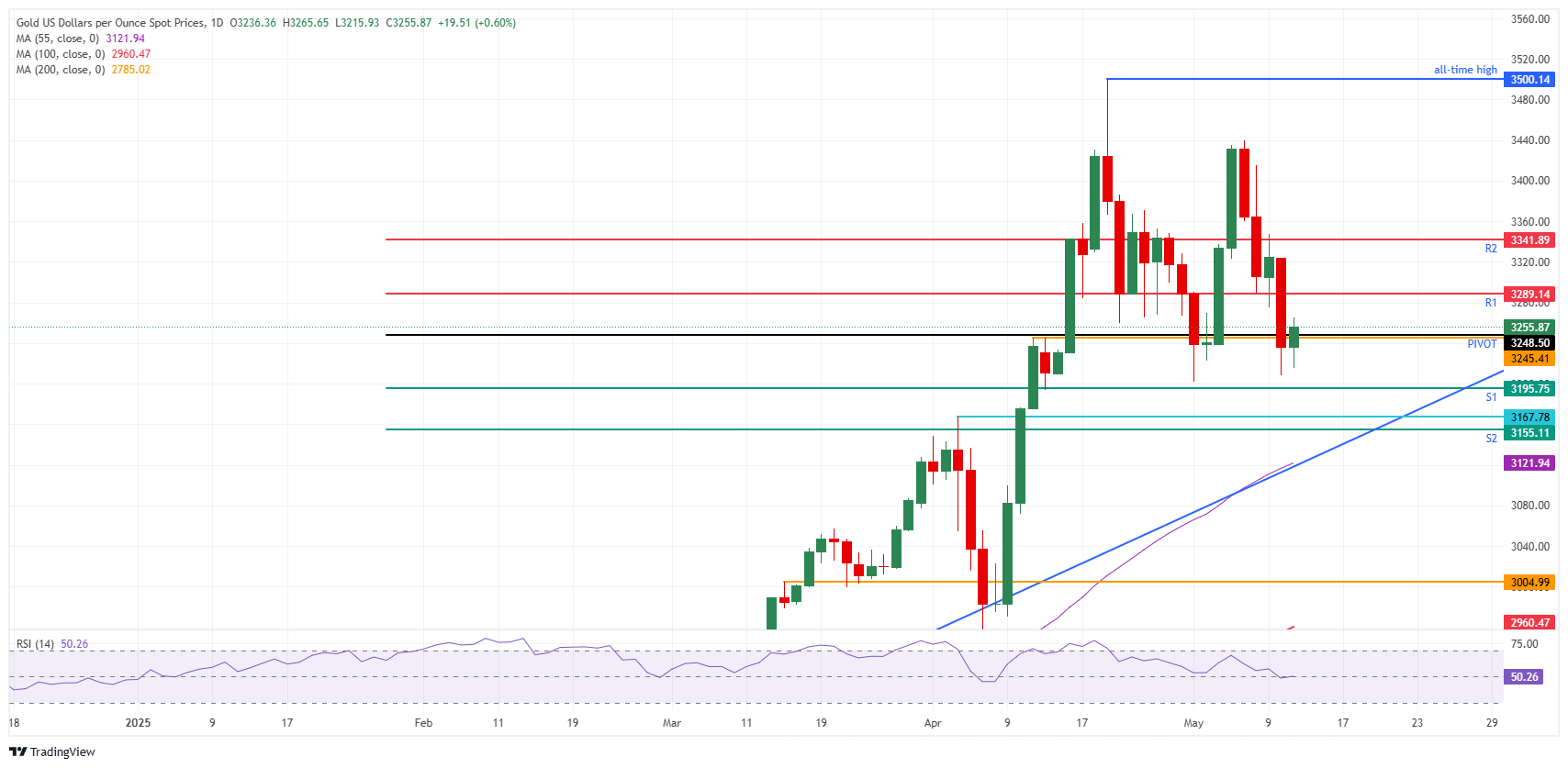
XAU/USD: Daily Chart
Inflation FAQs
Inflation measures the rise in the price of a representative basket of goods and services. Headline inflation is usually expressed as a percentage change on a month-on-month (MoM) and year-on-year (YoY) basis. Core inflation excludes more volatile elements such as food and fuel which can fluctuate because of geopolitical and seasonal factors. Core inflation is the figure economists focus on and is the level targeted by central banks, which are mandated to keep inflation at a manageable level, usually around 2%.
The Consumer Price Index (CPI) measures the change in prices of a basket of goods and services over a period of time. It is usually expressed as a percentage change on a month-on-month (MoM) and year-on-year (YoY) basis. Core CPI is the figure targeted by central banks as it excludes volatile food and fuel inputs. When Core CPI rises above 2% it usually results in higher interest rates and vice versa when it falls below 2%. Since higher interest rates are positive for a currency, higher inflation usually results in a stronger currency. The opposite is true when inflation falls.
Although it may seem counter-intuitive, high inflation in a country pushes up the value of its currency and vice versa for lower inflation. This is because the central bank will normally raise interest rates to combat the higher inflation, which attract more global capital inflows from investors looking for a lucrative place to park their money.
Formerly, Gold was the asset investors turned to in times of high inflation because it preserved its value, and whilst investors will often still buy Gold for its safe-haven properties in times of extreme market turmoil, this is not the case most of the time. This is because when inflation is high, central banks will put up interest rates to combat it. Higher interest rates are negative for Gold because they increase the opportunity-cost of holding Gold vis-a-vis an interest-bearing asset or placing the money in a cash deposit account. On the flipside, lower inflation tends to be positive for Gold as it brings interest rates down, making the bright metal a more viable investment alternative.
Author

Filip Lagaart
FXStreet
Filip Lagaart is a former sales/trader with over 15 years of financial markets expertise under its belt.















