Gold prices increase but stay under $2,350 ahead of key PCE data
- Gold bounces to $2,347 from daily lows of $2,322, up 0.41%.
- Slower US GDP growth and rising unemployment claims weaken the Greenback.
- Traders eye April’s PCE inflation data, which could dictate XAU/USD’s direction.

Gold prices trimmed some of Wednesday’s losses and rose 0.41% on Thursday after the US Gross Domestic Product (GDP) showed the economy is slowing, reigniting hopes that the US Federal Reserve (Fed) may cut rates later in the year.
The XAU/USD trades at $2,347, bouncing off daily lows of $2,322. The yield of the US 10-year note collapsed almost seven basis points (bps) to 4.548%, while the Greenback followed suit. The US Dollar Index (DXY) lost 0.43%, at 104.67.
The US economy grew at a slower rate than in the fourth quarter of last year, indicating that higher borrowing costs set by the Fed are taking their toll on the economy. Meanwhile, the US Department of Labor revealed an increase in the number of people applying for unemployment benefits.
Recently, New York Fed President John Williams grabbed the headlines. He said that monetary policy is well-positioned, that inflation is too high, and that he doesn’t feel urgency to slash interest rates. He added that inflation would reach the Fed’s 2% goal in early 2026.
Even though he was hawkish, Gold prices barely heeded his words, standing at current spot prices. The US housing market is also weakening, according to the Pending Home Sales data revealed by the National Association of Realtors.
Ahead in the week, traders are anticipating the release of April’s Personal Consumption Expenditures (PCE) Price Index, which is the Fed’s preferred measure of inflation. The core PCE figure is expected to be 2.8% YoY, while the headline PCE is projected to increase by 0.3% MoM.
Daily digest market movers: Gold price rises as US Treasury yields retreat from multi-week high
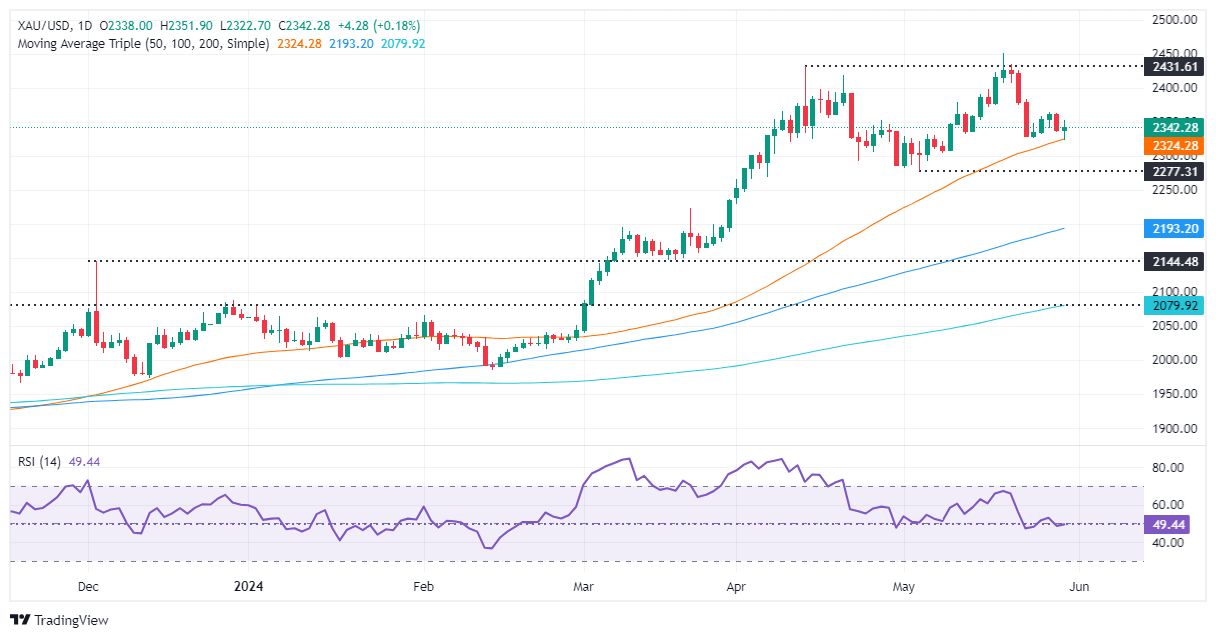
- Gold prices advance after bouncing off 50-day Simple Moving Average (SMA) at $2,324.
- US economic docket includes second estimate of Gross Domestic Product (GDP) for Q1 2024, which showed a decline from 3.4% to 1.3% quarter-over-quarter and aligned with analyst expectations.
- Initial Jobless Claims for the week ending May 25 increased to 219K, slightly above the consensus estimate of 218K and higher than the previous week's reading of 216K.
- Pending Home Sales for April tumbled from 3.6% to -7.7% MoM and, on an annual basis, plunged -7.4% from a 0.1% expansion.
- Fed funds rate futures estimate just 27 basis points of interest rate cuts in 2024, according to data provided by the Chicago Board of Trade (CBOT).
Technical analysis: Gold price climbs, yet remains below $2,350
Gold’s rally is set to continue, yet buyers are struggling to crack the psychological $2,350 mark, which could pave the way for further gains. Short-term momentum favors sellers as the Relative Strength Index (RSI) remains bearish after punching below the 50 midline on Wednesday.
Further gains could be anticipated if XAU/USD buyers reclaim the psychological mark of $2,350. The next target would be the $2,400 level, followed by the year-to-date high of $2,450 and, subsequently, the $2,500 mark.
Conversely, if XAU/USD falls below the 50-day Simple Moving Average (SMA) at $2,321, that could pave the way to challenge the May 8 low of $2,303, followed by the May 3 cycle low of $2,277.
Gold FAQs
Gold has played a key role in human’s history as it has been widely used as a store of value and medium of exchange. Currently, apart from its shine and usage for jewelry, the precious metal is widely seen as a safe-haven asset, meaning that it is considered a good investment during turbulent times. Gold is also widely seen as a hedge against inflation and against depreciating currencies as it doesn’t rely on any specific issuer or government.
Central banks are the biggest Gold holders. In their aim to support their currencies in turbulent times, central banks tend to diversify their reserves and buy Gold to improve the perceived strength of the economy and the currency. High Gold reserves can be a source of trust for a country’s solvency. Central banks added 1,136 tonnes of Gold worth around $70 billion to their reserves in 2022, according to data from the World Gold Council. This is the highest yearly purchase since records began. Central banks from emerging economies such as China, India and Turkey are quickly increasing their Gold reserves.
Gold has an inverse correlation with the US Dollar and US Treasuries, which are both major reserve and safe-haven assets. When the Dollar depreciates, Gold tends to rise, enabling investors and central banks to diversify their assets in turbulent times. Gold is also inversely correlated with risk assets. A rally in the stock market tends to weaken Gold price, while sell-offs in riskier markets tend to favor the precious metal.
The price can move due to a wide range of factors. Geopolitical instability or fears of a deep recession can quickly make Gold price escalate due to its safe-haven status. As a yield-less asset, Gold tends to rise with lower interest rates, while higher cost of money usually weighs down on the yellow metal. Still, most moves depend on how the US Dollar (USD) behaves as the asset is priced in dollars (XAU/USD). A strong Dollar tends to keep the price of Gold controlled, whereas a weaker Dollar is likely to push Gold prices up.
Economic Indicator
Core Personal Consumption Expenditures - Price Index (YoY)
The Core Personal Consumption Expenditures (PCE), released by the US Bureau of Economic Analysis on a monthly basis, measures the changes in the prices of goods and services purchased by consumers in the United States (US). The PCE Price Index is also the Federal Reserve’s (Fed) preferred gauge of inflation. The YoY reading compares the prices of goods in the reference month to the same month a year earlier. The core reading excludes the so-called more volatile food and energy components to give a more accurate measurement of price pressures." Generally, a high reading is bullish for the US Dollar (USD), while a low reading is bearish.
Read more.Next release: Fri May 31, 2024 12:30
Frequency: Monthly
Consensus: 2.8%
Previous: 2.8%
Source: US Bureau of Economic Analysis
After publishing the GDP report, the US Bureau of Economic Analysis releases the Personal Consumption Expenditures (PCE) Price Index data alongside the monthly changes in Personal Spending and Personal Income. FOMC policymakers use the annual Core PCE Price Index, which excludes volatile food and energy prices, as their primary gauge of inflation. A stronger-than-expected reading could help the USD outperform its rivals as it would hint at a possible hawkish shift in the Fed’s forward guidance and vice versa.
Author

Christian Borjon Valencia
FXStreet
Markets analyst, news editor, and trading instructor with over 14 years of experience across FX, commodities, US equity indices, and global macro markets.