Gold price rises, hovers near $2,950 as US yields decline
- Gold-backed ETFs see biggest net inflows since 2022, supporting prices.
- Traders eye US economic data, including Core PCE inflation gauge this week.
- Signs of buyer exhaustion emerge as Gold hovers near all-time highs.

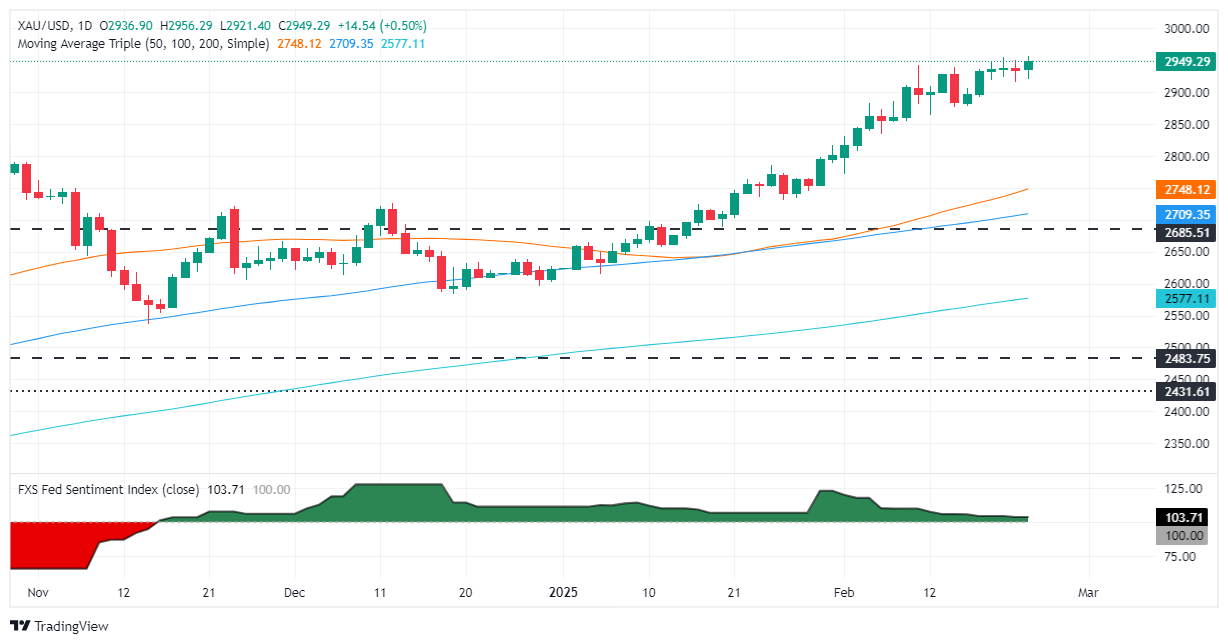
Gold prices surged during the North American session after hitting a record high of $2,956 as the Greenback weakened and US Treasury bond yields fell. At the time of writing, XAU/USD trades at $2,949, up 0.49%.
Uncertainty keeps Bullion prices underpinned as investors consider trade policies US President Donald Trump proposed. Geopolitics continued to be in the second stage as the Ukraine-Russia conflict seems closer to being resolved, while increasing tensions in the Middle East fueled demand for Gold.
Gold prices have risen for the past eight weeks, spurred by the most significant net inflows into Gold-backed ETFs since 2022, revealed Bloomberg.
Even though XAU/USD could be poised to remain near all-time highs, it seems that buyers have lost a step as price action shows signs of exhaustion.
This week, the US economic docket will feature Federal Reserve (Fed) speakers, the Conference Board Consumer Confidence, housing data, Durable Goods Orders, the second reading of Q4 GDP, and the release of the Fed’s preferred inflation gauge—the Core Personal Consumption Expenditures (PCE) Price Index.
Daily digest market movers: Gold price capitalizes on US yields drop
- The US 10-year Treasury note yield has tumbled one basis point to 4.443%, a tailwind for the precious metal. US real yields, as measured by the yield in the US 10-year Treasury Inflation-Protected Securities (TIPS), stay firm near 2.017%.
- The Conference Board Consumer Confidence is expected to drop from 104.1 to 103 in February.
- US business activity data in the United States (US) revealed last Friday was mixed with the S&P Global Manufacturing PMI expanding while the Services PMI shrank. Also, inflation expectations rose, and consumer sentiment deteriorated, revealed the University of Michigan (UoM).
- The Fed’s Meeting Minutes from Wednesday revealed that Trump’s trade and immigration policies fueled concerns over rising prices.
- The World Gold Council revealed that central bank purchases rose more than 54% YoY to 333 tonnes following Trump’s victory.
- Last week, Goldman Sachs upwardly revised Gold price projections to $3,100 by the end of 2025.
- Money market fed funds futures are pricing in 50 basis points of easing by the Fed in 2025.
XAU/USD technical outlook: Gold price hovers near all-time high
Gold price is tilted to the upside, though buyers seem to be losing some steam. Despite hitting an all-time high, XAU/USD paired some of those gains and retreated below $2,950 amid bulls’ lack of strength to drive the yellow metal to $3,000. In addition, the Relative Strength Index (RSI) is overbought. Once the RSI resumes its downward path toward neutrality, the precious metal will be under selling pressure.
In that outcome, Gold’s first support would be the $2,900 mark, followed by the February 14 swing low of $2,877, followed by the February 12 daily low of $2,864.
Gold FAQs
Gold has played a key role in human’s history as it has been widely used as a store of value and medium of exchange. Currently, apart from its shine and usage for jewelry, the precious metal is widely seen as a safe-haven asset, meaning that it is considered a good investment during turbulent times. Gold is also widely seen as a hedge against inflation and against depreciating currencies as it doesn’t rely on any specific issuer or government.
Central banks are the biggest Gold holders. In their aim to support their currencies in turbulent times, central banks tend to diversify their reserves and buy Gold to improve the perceived strength of the economy and the currency. High Gold reserves can be a source of trust for a country’s solvency. Central banks added 1,136 tonnes of Gold worth around $70 billion to their reserves in 2022, according to data from the World Gold Council. This is the highest yearly purchase since records began. Central banks from emerging economies such as China, India and Turkey are quickly increasing their Gold reserves.
Gold has an inverse correlation with the US Dollar and US Treasuries, which are both major reserve and safe-haven assets. When the Dollar depreciates, Gold tends to rise, enabling investors and central banks to diversify their assets in turbulent times. Gold is also inversely correlated with risk assets. A rally in the stock market tends to weaken Gold price, while sell-offs in riskier markets tend to favor the precious metal.
The price can move due to a wide range of factors. Geopolitical instability or fears of a deep recession can quickly make Gold price escalate due to its safe-haven status. As a yield-less asset, Gold tends to rise with lower interest rates, while higher cost of money usually weighs down on the yellow metal. Still, most moves depend on how the US Dollar (USD) behaves as the asset is priced in dollars (XAU/USD). A strong Dollar tends to keep the price of Gold controlled, whereas a weaker Dollar is likely to push Gold prices up.
Author

Christian Borjon Valencia
FXStreet
Markets analyst, news editor, and trading instructor with over 14 years of experience across FX, commodities, US equity indices, and global macro markets.