|

Gold Price News and Forecast: XAU/USD prices consolidate gains to sub-$1,650 area amid risk reset

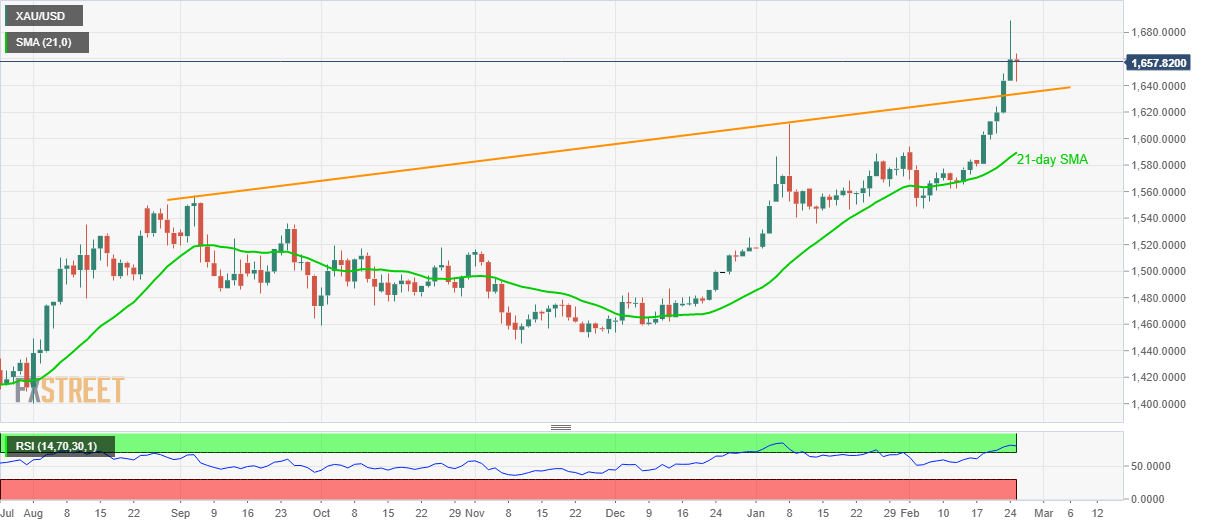
Gold Price Analysis: Resistance-turned-support trendline keeps $1,700 on the cards

Gold recovers most of the early-day losses while trading around $1,658, -0.10%, while heading into the European session on Tuesday. Even so, it needs to cross Monday’s high for the fresh rise. If the yellow metal manages to ignore overbought RSI conditions beyond $1,690, the high of 2013 near $1696 as well as $1,700 will be on the bulls’ radar.

It should, however, be noted that the commodity’s rise past-$1,700 can take aim at highs marked during November and October 2012, respectively near $1,751 and $1,794. 
Read more ...

Gold prices consolidate gains to sub-$1,650 area amid risk reset

Gold prices decline to $1,649.50, down 0.62%, amid the initial hours of the Asian session on Tuesday. While the risk of spreading coronavirus outside China propelled the bullion to a fresh seven-year high on Monday, the recently mixed headlines seem to trigger the pullback amid risk reset.

Among the key catalysts, China’s lowering of emergency alerts in various provinces and the recent recovery in coronavirus (COVID-19) numbers played the key role. Also challenging the risk-on was the World Health Organization’s (WHO) tweet mentioning the epidemic to have peaked between late-January and early-February. Further to support the sellers were the US President Donald Trump and the Federal Reserve Cleveland President Loretta Mester who downsized the risks emanating from the Chinese virus.

Read more ...


FXStreet Indonesian Site - new domain!
Access it at www.fxstreet-id.com

Author

FXStreet Team

Composed of a group of economic journalists and FX experts, the FXStreet content team produces and oversees all content published on FXStreet. It provides a purely journalistic approach to the Forex market.


More from FXStreet Team
Share:

Editor's Picks

AUD/USD extends the range play above 0.7200 as traders await US inflation data

AUD/USD is seen extending its consolidative price move above 0.7200 during the Asian session on Thursday amid mixed cues. Rising RBA rate-hike bets keep the Aussie close to its highest level since May 14. However, hawkish Fed expectations and escalating US-Iran tensions offer some support to the US Dollar, capping the currency pair as traders await US inflation figures.


USD/JPY consolidates around 153.50 as bears turn cautious ahead of US inflation

USD/JPY stabilizes above 153.50 during the Asian session on Thursday, but remains near a seven-month low set earlier this week as hawkish BoJ repricing continues to underpin the Japanese Yen. Meanwhile, rising September Fed rate-hike bets and escalating US-Iran tensions help ease US Dollar selling pressure, offering some support to the currency pair ahead of US inflation figures.

Gold resumes its decline below $4,400

Gold maintains an erratic trade so far this week, now slipping back below the key $4,400 mark per troy ounce following the stronger US Dollar and a strong rebound in US Treasury yields across the curve, particularly following US Producer Prices.

XRP slides amid a fragile crypto market structure
Ripple (XRP) falls for the second straight day, trading at $1.37 on Thursday. The broader cryptocurrency market remains fragile as investors weigh the impact of geopolitical tensions in the Middle East, which triggered persistent increases in Crude Oil prices while restricting shipping through the Straight of Hormuz and the Red Sea.
Jobs opened the door for the Fed — inflation decides whether it walks through
The latest US jobs report did not end the debate over the Federal Reserve’s (Fed) next move. It may have done something more subtle: it gave policymakers permission to keep their options open. After months of softer labour market signals, August delivered a stronger-than-expected rebound.
Venezuela’s 65-billion-barrel Oil deal could reshape America’s inflation fight
The United States (US) has secured unprecedented access to part of Venezuela’s vast Oil reserves. The timing is particularly significant as the war with Iran is disrupting Middle Eastern supplies, keeping energy prices elevated and reviving concerns about inflation.















