|

Gold Price News and Forecast: XAU/USD bears to retain control below 21-DMA, focus on Biden’s speech

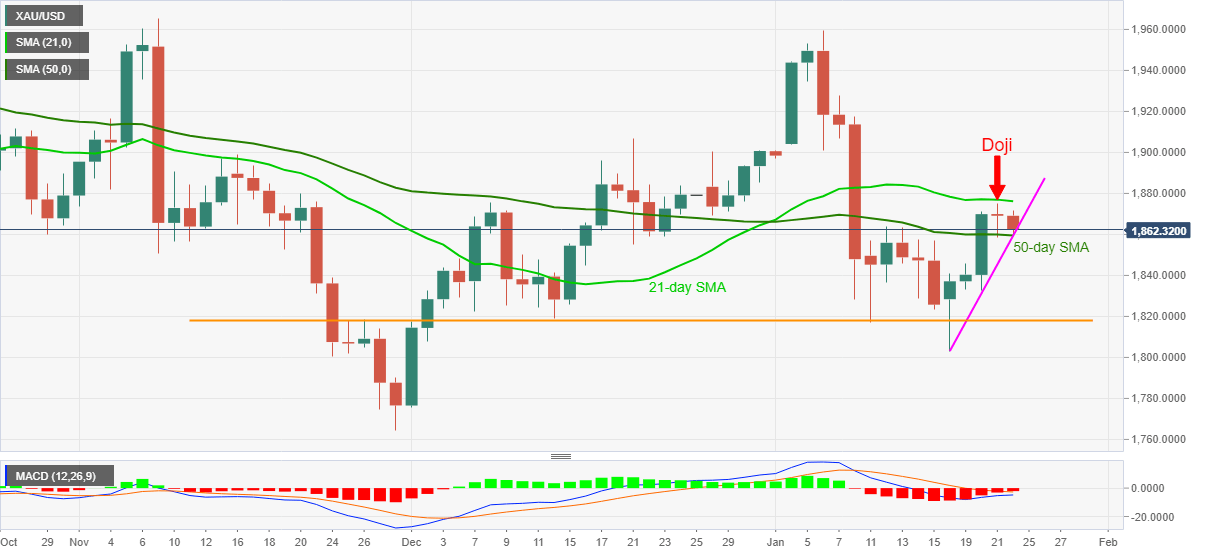
Gold Price Analysis: XAU/USD justifies Thursday’s doji below 21-DMA to drop towards $1,850

Gold bounces off intraday low of $1,859.00 to $1,862.10, down 0.37% on a day, during early Friday. The yellow metal refreshed two-week high the previous day but failed to cross a 21-day SMA. The resulted moves portrayed a Doji candlestick on the daily (D1) chart, which in turn gained support from the bearish MACD signals to portray today’s downtick.

However, gold sellers seem to struggle off-late as 50-day SMA and an upward sloping trend line from Monday limits immediate declines around $1,859.
Read more ...

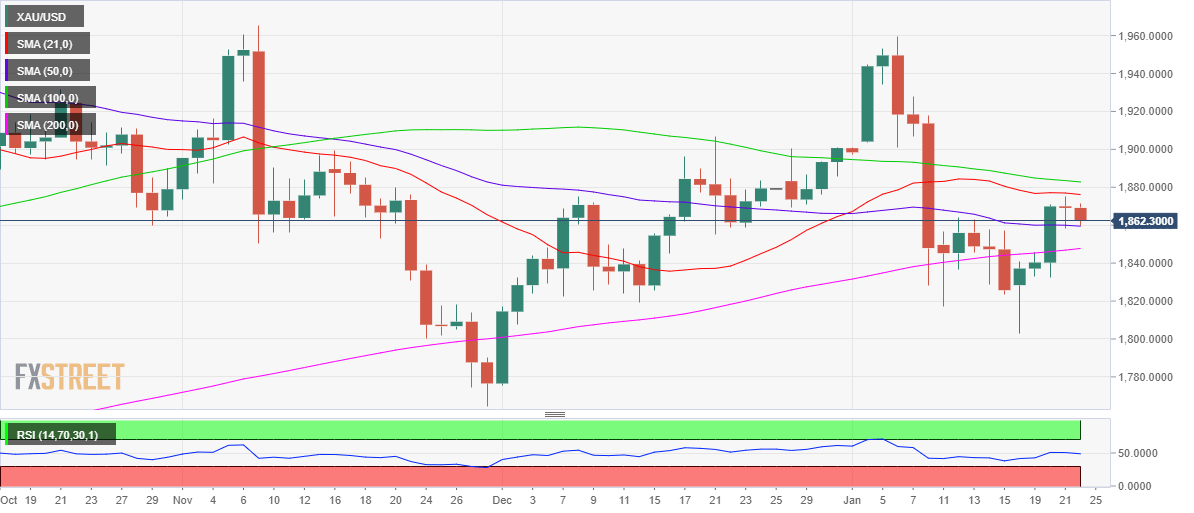
Gold Price Forecast: XAU/USD bears to retain control below 21-DMA, focus on Biden’s speech

Gold (XAU/USD) witnessed good two-way price movements and settled almost changed at $1869 on Thursday. The yellow metal eased from two-week highs of $1875, as markets resorted to profit-taking after the three-day recovery rally fuelled by the prospects of further stimulus. The uptick in the US Treasury yields on rising inflation expectations and ECB’s inaction also collaborated with the retreat in gold prices. Rejection at the 21-day simple moving average (DMA) further added credence to the pullback in the prices.
Read more ...

Author

FXStreet Team

Composed of a group of economic journalists and FX experts, the FXStreet content team produces and oversees all content published on FXStreet. It provides a purely journalistic approach to the Forex market.


More from FXStreet Team
Share:

Editor's Picks

AUD/USD struggles near 0.7150 as Fed hike bets and Middle East risks underpin USD

AUD/USD kicks off the new week on a weak note and hovers near Friday's low, around mid-0.7100s, as the US Dollar holds up on rising Fed rate-hike bets, bolstered by the US CPI. Furthermore, escalating Middle East tensions and clashes in the Strait of Hormuz underpin the safe-haven USD. However, hawkish RBA expectations could help limit deeper losses for the Aussie.

USD/JPY holds steady near mid-153.00s as traders await Fed/BoJ rate decisions

USD/JPY consolidates near a seven-month low touched last Tuesday as traders move to the sidelines ahead of the FOMC decision on Wednesday and the BoJ policy update on Friday. Meanwhile, a more hawkish repricing of the BoJ's normalization path supports the Japanese Yen, while rising Fed rate-hike bets and geopolitical risks underpin the US Dollar, leading to the pair's subdued price action at the start of the new week.

Gold consolidates above $4,300 as traders await Fed rate decision this week

Gold struggles to capitalize on Friday's modest bounce from sub-$4,300 levels and kicks off the new week on a subdued note as traders move to the sidelines ahead of a slew of central bank events. Meanwhile, the latest US inflation figures reaffirmed September Fed rate-hike bets and cap the non-yielding bullion. Moreover, escalating US-Iran tensions act as a tailwind for the safe-haven US Dollar, keeping XAU/USD bulls on the back foot.

Week ahead: Fed, BoJ and BoE decide amid inflation dilemma
A crucial central bank week looms for markets as both the Federal Reserve and Bank of Japan are under pressure from all sides, with their credibility at stake. The Bank of England looks set to have an easier ride, at least for now, while inflation releases will be watched too as war continues to rage in the Middle East.
CFTC Report: Japanese Yen reversal leads a broader positioning reset
The week in one sentence: Yen positioning swung back into net longs in the week to September 8, leading to a 103.0K-contract improvement. Canadian Dollar shorts also fell sharply, while Oil buying accompanied another price rise. Euro, Sterling and Swiss Franc positioning weakened despite firmer currencies, leaving those moves unconfirmed by speculative flows.
Venezuela’s 65-billion-barrel Oil deal could reshape America’s inflation fight
The United States (US) has secured unprecedented access to part of Venezuela’s vast Oil reserves. The timing is particularly significant as the war with Iran is disrupting Middle Eastern supplies, keeping energy prices elevated and reviving concerns about inflation.