Gold price creeps lower, holds narrow range before US GDP release
- Gold price edges up, trading near the 50-day SMA, as US Treasury yields decline and the US Dollar softens.
- Market focus on upcoming PCE and GDP reports could determine Gold's breakout from current tight trading range.
- Earlier economic indicators, including a sharp drop in Durable Goods Orders, set a cautious tone for Q1 2024 GDP expectations.

Gold price modestly gains but is stuck in a narrow range in Tuesday's mid-North American session, underpinned by the fall in US Treasury bond yields. Consequently, the Greenback (USD) weakens, as the US Dollar Index (DXY), which tracks the currency against six other currencies, drops 0.05%. At the time of writing, XAU/USD trades at $2,034.88, gaining 0.18%.
The yellow metal hovers around the 50-day Simple Moving Average (SMA) at $2,033.48 as investors brace for the release of the latest Personal Consumption Expenditures (PCE) report, the Federal Reserve’s (Fed) gauge to measure inflation. That and the latest Gross Domestic Product (GDP) data could be the catalysts that prompt Gold’s price to exit the trading range within the $2,020-$2,050 area.
Earlier, the US Department of Commerce revealed that Durable Goods Orders in January plummeted sharply even worse than expected, which could set the tone for Q1 2024 GDP data. Meanwhile, Home Prices data were mixed as buyer demand picked up.
Daily digest market movers: Gold advance prompted by soft US Dollar undermined by lower US yields
- US Durable Goods Orders dropped -6.1% MoM, more than the -4.5% contraction expected and the -0.3% dip observed in December.
- The S&P/Case Shiller Home Price Index for December rose 6.1% YoY, outpacing estimates of 6% and November’s 5.4% reading.
- Previous data releases in the week:
- US New Home Sales rose by 1.5% from 0.651M to 0.661M, less than the 0.68M expected.
- The Dallas Fed Manufacturing Index for February contracted -11.3 though it improved compared to January’s -27.4 shrinkage, suggesting that business activity is recovering.
- Federal Reserve Governor Michelle Bowman said she’s in no rush to cut rates, given upside risks to inflation that could stall progress or cause a resurgence in price pressure.
- Bowman said that inflation would decline “slowly,” adding that she will remain “cautious in my approach to considering future changes in the stance of policy.”
- Interest rate speculators have priced out a Fed rate cut in March and May. For June, the odds of a 25 basis point rate cut are at 49.7%.
- Investors are pricing in 85 basis points of easing throughout 2024.
Technical analysis: Gold stays firm near 50-day SMA
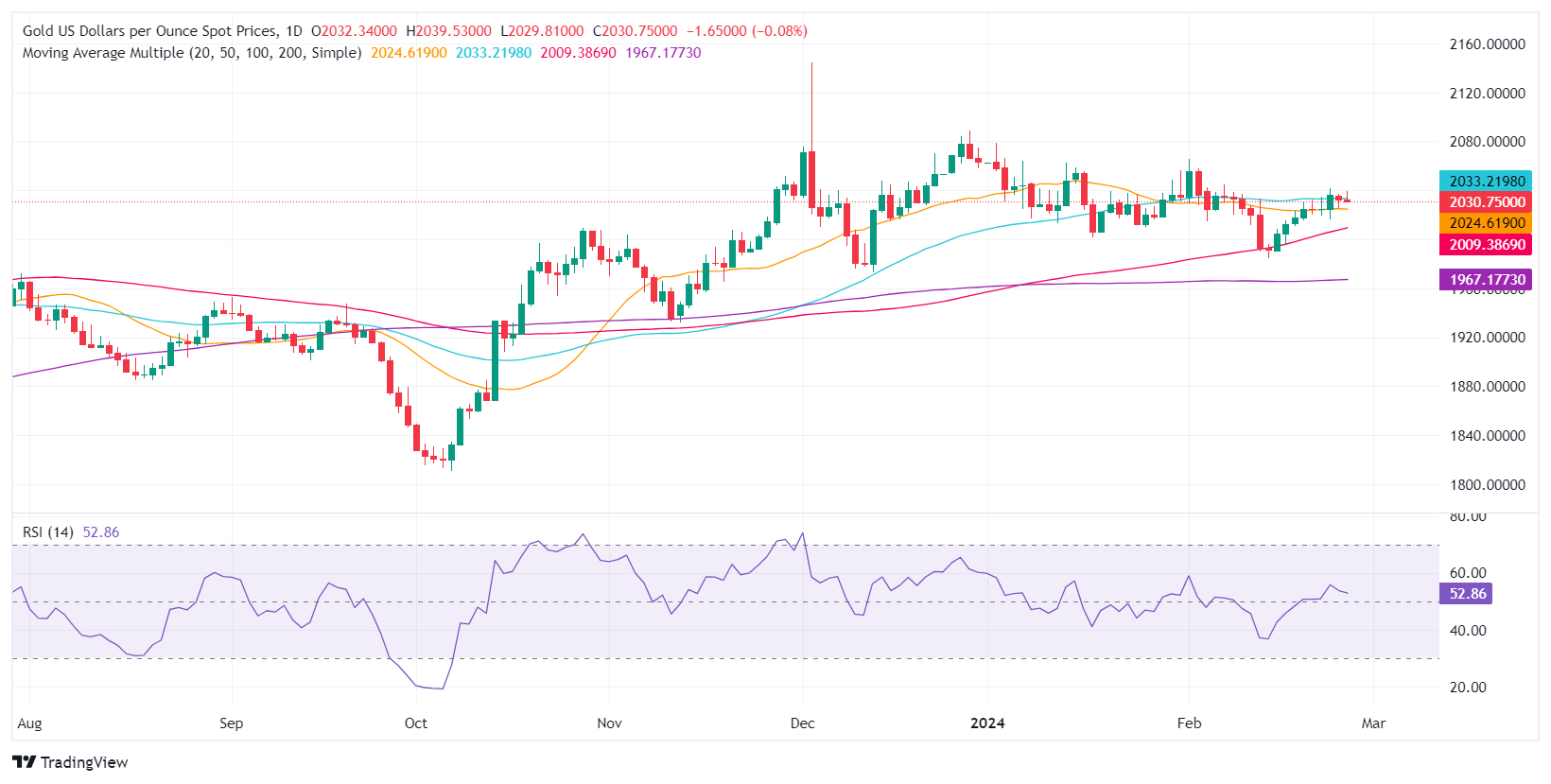
Gold is trading sideways as XAU/USD has failed to break above the $2,035 psychological resistance level for the last 12 days. Nevertheless, the upward bias remains intact, and if buyers reclaim the $2,035 level, that could open the door to challenge the psychological $2,050 figure. Key resistance levels up next would be the February 1 high at $2,065.60, ahead of the December 28 high at $2,088.48.
On the flipside, if Gold falls below the February 16 swing low of $2,016.15, XAU/USD would dive toward the October 27 daily high-turned-support at $2,009.42. Once cleared, that will expose key technical support levels like the 100-day SMA at $2,009.56, followed by the 200-day SMA at $1,967.09.
Gold FAQs
Why do people invest in Gold?
Gold has played a key role in human’s history as it has been widely used as a store of value and medium of exchange. Currently, apart from its shine and usage for jewelry, the precious metal is widely seen as a safe-haven asset, meaning that it is considered a good investment during turbulent times. Gold is also widely seen as a hedge against inflation and against depreciating currencies as it doesn’t rely on any specific issuer or government.
Who buys the most Gold?
Central banks are the biggest Gold holders. In their aim to support their currencies in turbulent times, central banks tend to diversify their reserves and buy Gold to improve the perceived strength of the economy and the currency. High Gold reserves can be a source of trust for a country’s solvency. Central banks added 1,136 tonnes of Gold worth around $70 billion to their reserves in 2022, according to data from the World Gold Council. This is the highest yearly purchase since records began. Central banks from emerging economies such as China, India and Turkey are quickly increasing their Gold reserves.
How is Gold correlated with other assets?
Gold has an inverse correlation with the US Dollar and US Treasuries, which are both major reserve and safe-haven assets. When the Dollar depreciates, Gold tends to rise, enabling investors and central banks to diversify their assets in turbulent times. Gold is also inversely correlated with risk assets. A rally in the stock market tends to weaken Gold price, while sell-offs in riskier markets tend to favor the precious metal.
What does the price of Gold depend on?
The price can move due to a wide range of factors. Geopolitical instability or fears of a deep recession can quickly make Gold price escalate due to its safe-haven status. As a yield-less asset, Gold tends to rise with lower interest rates, while higher cost of money usually weighs down on the yellow metal. Still, most moves depend on how the US Dollar (USD) behaves as the asset is priced in dollars (XAU/USD). A strong Dollar tends to keep the price of Gold controlled, whereas a weaker Dollar is likely to push Gold prices up.
Author

Christian Borjon Valencia
FXStreet
Markets analyst, news editor, and trading instructor with over 14 years of experience across FX, commodities, US equity indices, and global macro markets.