Gold price keeps the red below $3,100; looks to US NFP for fresh impetus
- Gold price meets with a fresh supply on Friday, though the downside potential seems limited.
- Trump’s tariffs-inspired risk-off mood might continue to act as a tailwind for the precious metal.
- Fed rate cut bets weigh on the USD and also contribute to limiting losses for the XAU/USD pair.

Gold price (XAU/USD) maintains its offered tone through the first half of the European session on Friday and currently trades below the $3,100 mark, down for the second successive day. The downtick lacks any obvious fundamental catalyst and could be attributed to some repositioning trade ahead of the crucial US monthly employment details, or the Nonfarm Payrolls (NFP) report.
In the meantime, worries about the potential economic fallout from US President Donald Trump's sweeping reciprocal tariffs might act as a tailwind for the safe-haven Gold price. Moreover, bets that the Federal Reserve (Fed) will resume its rate-cutting cycle soon amid a tariffs-driven US economic slowdown and a bearish US Dollar (USD) should limit losses for the non-yielding bullion.
Daily Digest Market Movers: Gold price drifts lower amid some repositioning ahead of the US jobs data
- Gold price attracts some sellers for the second successive day on Friday, though a combination of factors should continue to act as a tailwind and limit any meaningful corrective slide from the record high.
- US President Donald Trump rattled global financial markets late Wednesday and unveiled reciprocal tariffs of at least 10% on all imported goods, which could negatively impact the world economy.
- Traders ramped up expectations that the Federal Reserve will resume its rate-cutting cycle in June and lower borrowing costs four times by the year-end as Trump's trade policies reignite US recession fears.
- The yield in the benchmark 10-year US government bond slides below 4.0% for the first time in six months and fails to assist the US Dollar to build on the overnight bounce from a multi-month trough.
- Meanwhile, data released on Thursday showed that economic activity in the US services sector eased momentum in March, with the ISM Services PMI falling to 50.8 from 53.5 in February and missing estimates.
- Separately, the US Department of Labor (DOL) reported US citizens filing new applications for unemployment insurance ticked lower to 219K for the week ending March 29 from the 225K previous.
- The aforementioned fundamental backdrop favors the XAU/USD bulls. Hence, the modest downtick could be attributed to some repositioning trade ahead of the release of the monthly US employment details.
- The popularly known US Nonfarm Payrolls (NFP) report is expected to show that the US economy added 135K new jobs in March, though the Unemployment Rate is anticipated to hold steady at 4.1%.
Gold price bears retain intraday control below $3,100 mark; $3,056-3,054 support holds the key
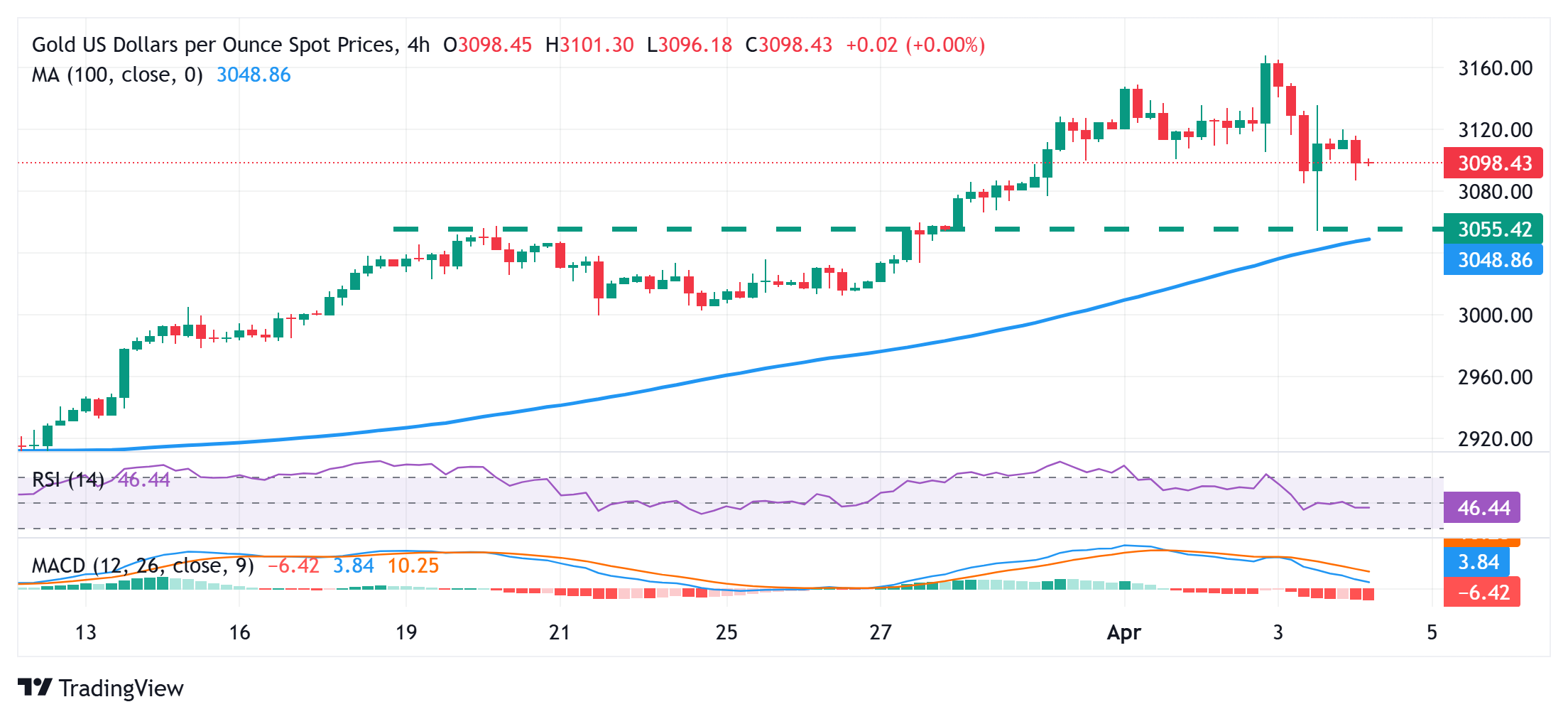
From a technical perspective, any subsequent fall might continue to find decent support near the $2,056-2,054 horizontal zone. The said area nears the 100-period Simple Moving Average (SMA) on the 4-hour chart and should now act as a key pivotal point for short-term traders. A convincing break below might prompt some technical selling and make the Gold price vulnerable to accelerate the corrective slide further towards the $3,036-3,035 intermediate support en route to the $3,000 psychological mark,
On the flip side, the $3,115-3,125 congestion zone now seems to act as an immediate hurdle. This is followed by resistance near the $3,143 area and the all-time peak, around the $3,157-3,158 region touched on Thursday, which if cleared could be seen as a fresh trigger for bullish traders. This, in turn, will set the stage for an extension of the Gold price's recent well-established uptrend witnessed over the past four months or so.
Economic Indicator
Nonfarm Payrolls
The Nonfarm Payrolls release presents the number of new jobs created in the US during the previous month in all non-agricultural businesses; it is released by the US Bureau of Labor Statistics (BLS). The monthly changes in payrolls can be extremely volatile. The number is also subject to strong reviews, which can also trigger volatility in the Forex board. Generally speaking, a high reading is seen as bullish for the US Dollar (USD), while a low reading is seen as bearish, although previous months' reviews and the Unemployment Rate are as relevant as the headline figure. The market's reaction, therefore, depends on how the market assesses all the data contained in the BLS report as a whole.
Read more.Next release: Fri Apr 04, 2025 12:30
Frequency: Monthly
Consensus: 135K
Previous: 151K
Source: US Bureau of Labor Statistics
America’s monthly jobs report is considered the most important economic indicator for forex traders. Released on the first Friday following the reported month, the change in the number of positions is closely correlated with the overall performance of the economy and is monitored by policymakers. Full employment is one of the Federal Reserve’s mandates and it considers developments in the labor market when setting its policies, thus impacting currencies. Despite several leading indicators shaping estimates, Nonfarm Payrolls tend to surprise markets and trigger substantial volatility. Actual figures beating the consensus tend to be USD bullish.
BRANDED CONTENT
Finding the right broker for trading Gold is crucial, as not all brokers offer the same advantages. Explore our list of top-performing brokers to discover the best options for seamless and cost-effective Gold trading.
Author

Haresh Menghani
FXStreet
Haresh Menghani is a detail-oriented professional with 10+ years of extensive experience in analysing the global financial markets.