Gold rises as US Treasury yields fall before key US inflation report
- Gold steadies at $2,030, buoyed by a dip in US Treasury yields and recent economic growth figures.
- Mixed US economic indicators and Fed statements on policy easing keep gold investors watchful.
- The 50-day SMA caps Gold's gains as Wall Street indices reflect cautious market sentiment.

Gold price remains steady near $2,030 on Wednesday, posting a gain of 0.17% after the US Bureau of Economic Analysis (BEA) revealed the country's economy expanded. A drop in US Treasury bond yields has kept the yellow metal near the current month and weekly highs, capped by the 50-day Simple Moving Average (SMA).
Wall Street treads water with most indices trading in the red. The Gross Domestic Product (GDP) for the last quarter in 2023 expanded a tick lower than the consensus and the preliminary reading, while Retail and Wholesale Inventories came in mixed.
Federal Reserve (Fed) Regional Presidents Susan Collins and John Williams crossed the newswires. They repeated previous remarks regarding easing policy later in the year and emphasized they haven’t reached the 2% goal for core inflation.
Daily digest market movers: Gold climbs on falling US yields
- Boston Fed President Susan Collins said, “I believe it will likely become appropriate to begin easing policy later this year.” She added, “When this happens, a methodical, forward-looking approach to reducing rates gradually should provide the necessary flexibility to manage risks while promoting stable prices and maximum employment.”
- New York Fed President John Williams stated, “While the economy has come a long way toward achieving better balance and reaching our 2% inflation goal, we are not there yet.” Williams added that he would need to assess “the data, the economic outlook and the risks, in evaluating the appropriate path for monetary policy that best achieves our goals.”
- On Tuesday, Federal Reserve Governor Michelle Bowman said she’s in no rush to cut rates, given upside risks to inflation that could stall progress or cause a resurgence in price pressure.
- Bowman said that inflation would decline “slowly,” adding that she will remain “cautious in my approach to considering future changes in the stance of policy.”
- The Gross Domestic Product (GDP) for the final quarter of 2023 was reported at 3.2% YoY, slightly below the preliminary estimate of 3.3%.
- US Retail Sales Inventories rose 0.3% MoM in January, below 0.4% in the previous month's data, while Wholesale Inventories declined -0.1% MoM, missing estimates of 0.1%.
- Previous data releases in the week:
- US Durable Goods Orders dropped -6.1% MoM, more than the -4.5% contraction expected and the -0.3% dip observed in December.
- The S&P/Case Shiller Home Price Index for December rose 6.1% YoY, outpacing estimates of 6% and November’s 5.4% reading.
- US New Home Sales rose by 1.5% from 0.651M to 0.661M, less than the 0.68M expected.
- The Dallas Fed Manufacturing Index for February contracted -11.3, though it improved compared to January’s -27.4 shrinkage, suggesting that business activity is recovering.
- The US Dollar Index (DXY), which gauges the Greenback’s value against six major currencies, edges up at 103.95 as uncertainty over US economic data has improved the appeal for safe-haven assets.
- The US 10-year Treasury note yield stands at 4.284%, down two basis points (bps).
- Interest rate speculators have priced out a Fed rate cut in March and May. For June, the odds of a 25 basis point rate cut are at 49.7%.
- Investors are pricing in 85 basis points of easing throughout 2024.
Technical analysis: Gold stays firm, fluctuating near the 50-day SMA
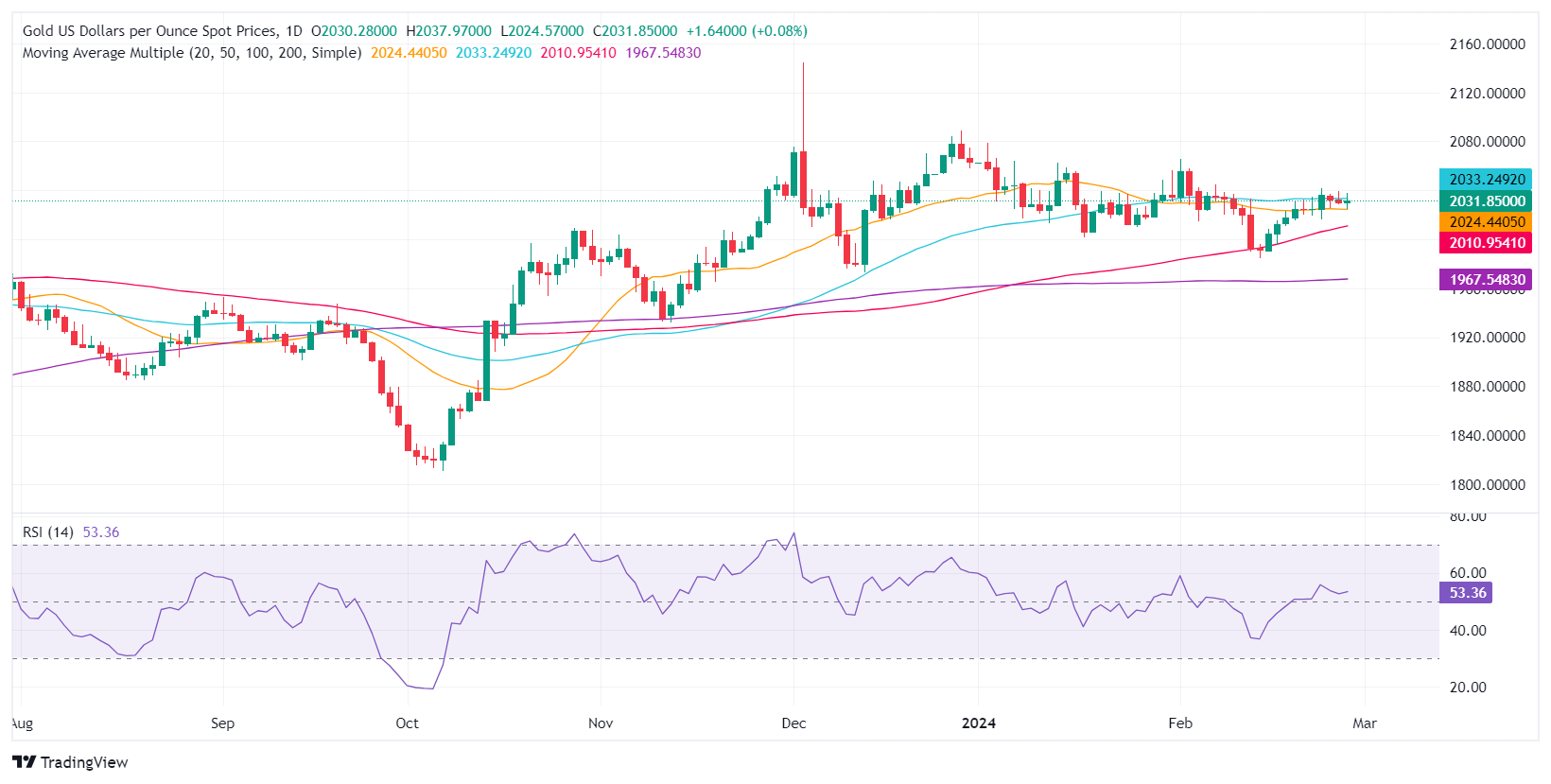
Gold is trading sideways as XAU/USD has failed to break above the $2,035 psychological resistance level for the last 12 days. Nevertheless, the upward bias remains intact, and if buyers reclaim the $2,035 level, that could open the door to challenge the psychological $2,050 figure. Key resistance levels up next would be the February 1 high at $2,065.60, ahead of the December 28 high at $2,088.48.
On the flipside, if Gold falls below the February 16 swing low of $2,016.15, XAU/USD would dive toward the October 27 daily high-turned-support at $2,009.42. Once cleared, that will expose key technical support levels like the 100-day SMA at $2,009.42, followed by the 200-day SMA at $1,967.45.
Gold FAQs
Why do people invest in Gold?
Gold has played a key role in human’s history as it has been widely used as a store of value and medium of exchange. Currently, apart from its shine and usage for jewelry, the precious metal is widely seen as a safe-haven asset, meaning that it is considered a good investment during turbulent times. Gold is also widely seen as a hedge against inflation and against depreciating currencies as it doesn’t rely on any specific issuer or government.
Who buys the most Gold?
Central banks are the biggest Gold holders. In their aim to support their currencies in turbulent times, central banks tend to diversify their reserves and buy Gold to improve the perceived strength of the economy and the currency. High Gold reserves can be a source of trust for a country’s solvency. Central banks added 1,136 tonnes of Gold worth around $70 billion to their reserves in 2022, according to data from the World Gold Council. This is the highest yearly purchase since records began. Central banks from emerging economies such as China, India and Turkey are quickly increasing their Gold reserves.
How is Gold correlated with other assets?
Gold has an inverse correlation with the US Dollar and US Treasuries, which are both major reserve and safe-haven assets. When the Dollar depreciates, Gold tends to rise, enabling investors and central banks to diversify their assets in turbulent times. Gold is also inversely correlated with risk assets. A rally in the stock market tends to weaken Gold price, while sell-offs in riskier markets tend to favor the precious metal.
What does the price of Gold depend on?
The price can move due to a wide range of factors. Geopolitical instability or fears of a deep recession can quickly make Gold price escalate due to its safe-haven status. As a yield-less asset, Gold tends to rise with lower interest rates, while higher cost of money usually weighs down on the yellow metal. Still, most moves depend on how the US Dollar (USD) behaves as the asset is priced in dollars (XAU/USD). A strong Dollar tends to keep the price of Gold controlled, whereas a weaker Dollar is likely to push Gold prices up.
Author

Christian Borjon Valencia
FXStreet
Markets analyst, news editor, and trading instructor with over 14 years of experience across FX, commodities, US equity indices, and global macro markets.