Gold price hit all-time high near $3,000 as trade tensions rock markets
- Gold soars 1.70% to a fresh record of $2,985, driven by uncertainty over US trade policies.
- Mixed signals from Trump administration officials on trade-induced recession fears fuel investor rush into Gold and Japanese Yen.
- Markets focus shifts to the Fed policy decision next week, with rates expected unchanged but crucial hints from new economic projections.

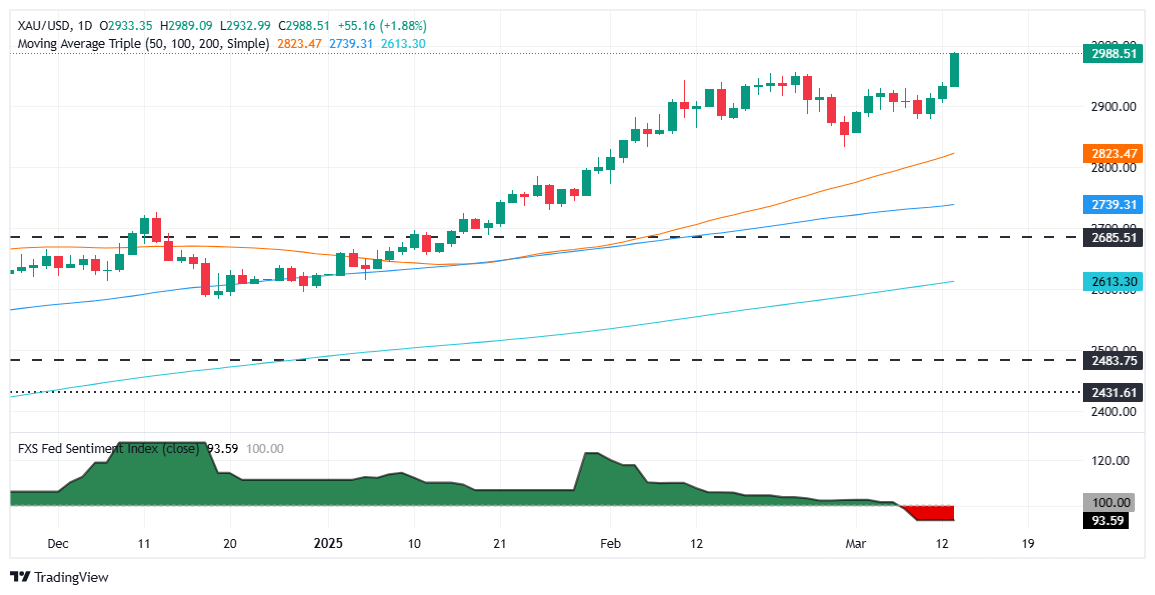
Gold prices skyrocketed on Thursday, with the yellow metal reaching a new record high of $2,989 yet poised to extend the trend towards the $3,000 figure. Uncertainty about the United States' (US) trade policies and increasing odds the Federal Reserve (Fed) would lower interest rates underpin the precious metal. XAU/USD trades at $2,988, up 1.86%.
The yellow metal’s advance is set to continue as US President Donald Trump embarks on a trade war with US allies and adversaries, as he tries to reduce the trade deficit. Fluctuations of imposing and removing duties on imports keep money flocking to Gold’s safe-haven appeal.
Recently, some US officials have not seemed worried about Wall Street’s reaction to Trump’s administration's trade policies. US Treasury Secretary Scott Bessent said that his comments last Friday about a “detox period” did not mean a recession was necessary. In contrast, US Commerce Secretary Howard Lutnick said a recession would be “worth it” to implement the current administration’s policies.
This was a green light for investors, who continued the sell-off in US equities and bought safe-haven assets like Gold and the Japanese Yen (JPY).
Meanwhile, data remains in the backseat, overshadowed by tariffs. Earlier, the US Bureau of Labor Statistics (BLS) revealed that inflation on the producer’s side was mainly unchanged, with a slight decline. At the same time, the number of Americans filing for unemployment benefits last week dipped, revealed the BLS.
Ahead this week, traders eye the University of Michigan (UoM) Consumer Sentiment for March. However, their radar is focused on the Federal Reserve (Fed) monetary policy decision next week. The Fed is expected to keep rates unchanged, update its economic projections, and dictate policy paths using the infamous “dot plot.”
Daily digest market movers: Gold price soars unfazed by a strong US Dollar
- The US 10-year Treasury bond yield erases yesterday’s gains, dropping four and a half basis points to 4.270%.
- US real yields, as measured by the US 10-year Treasury Inflation-Protected Securities (TIPS) yield that correlates inversely to Gold prices, climb one basis point to 1.99%.
- The US Dollar Index (DXY), which tracks the Greenback’s value against six currencies, recovers 0.27% to 103.85.
- The US Producer Price Index (PPI) for February came in softer than expected, rising 3.2% YoY, below the 3.3% forecast and down from 3.7% in January.
- Core PPI, which excludes volatile components, increased 3.4% YoY, falling short of the 3.5% estimate and easing from 3.6% in the prior month.
- Despite recent cooler-than-expected inflation data, economists caution that tariffs on US imports could lead to a renewed inflationary uptick in the coming months.
- Meanwhile, Initial Jobless Claims for the week ending March 8 edged down to 220K, beating forecasts of 225K and improving from the 222K reported previously.
- On Wednesday, 25% US tariffs on steel and aluminum took effect at midnight as US President Donald Trump is battling to reduce the trade deficit by applying duties on imports.
- Money market futures traders had been priced in 74 basis points of easing by the Federal Reserve (Fed) toward the end of the year.
- The Atlanta Fed GDPNow model predicts the first quarter of 2025 at -2.4 %, which would be the first negative print since the COVID-19 pandemic.
XAU/USD technical outlook: Gold price surges toward $3,000
Bullion prices are trading at all-time highs of $2,989 after clearing the previous year-to-date (YTD) high on February 20 at $2,954. Momentum remains exceptionally bullish, with the Relative Strength Index (RSI) slope aiming higher, but with room before turning overbought. With that said, Gold’s next resistance would be $3,000. A breach of the latter would expose $3,050 followed by the $3,100 mark.
Conversely, if XAU/USD drops below $2,950, the next support would be $2,900 ahead of $2,850. The following support will be a February 28 low of $2,832.
Gold FAQs
Gold has played a key role in human’s history as it has been widely used as a store of value and medium of exchange. Currently, apart from its shine and usage for jewelry, the precious metal is widely seen as a safe-haven asset, meaning that it is considered a good investment during turbulent times. Gold is also widely seen as a hedge against inflation and against depreciating currencies as it doesn’t rely on any specific issuer or government.
Central banks are the biggest Gold holders. In their aim to support their currencies in turbulent times, central banks tend to diversify their reserves and buy Gold to improve the perceived strength of the economy and the currency. High Gold reserves can be a source of trust for a country’s solvency. Central banks added 1,136 tonnes of Gold worth around $70 billion to their reserves in 2022, according to data from the World Gold Council. This is the highest yearly purchase since records began. Central banks from emerging economies such as China, India and Turkey are quickly increasing their Gold reserves.
Gold has an inverse correlation with the US Dollar and US Treasuries, which are both major reserve and safe-haven assets. When the Dollar depreciates, Gold tends to rise, enabling investors and central banks to diversify their assets in turbulent times. Gold is also inversely correlated with risk assets. A rally in the stock market tends to weaken Gold price, while sell-offs in riskier markets tend to favor the precious metal.
The price can move due to a wide range of factors. Geopolitical instability or fears of a deep recession can quickly make Gold price escalate due to its safe-haven status. As a yield-less asset, Gold tends to rise with lower interest rates, while higher cost of money usually weighs down on the yellow metal. Still, most moves depend on how the US Dollar (USD) behaves as the asset is priced in dollars (XAU/USD). A strong Dollar tends to keep the price of Gold controlled, whereas a weaker Dollar is likely to push Gold prices up.
Author

Christian Borjon Valencia
FXStreet
Markets analyst, news editor, and trading instructor with over 14 years of experience across FX, commodities, US equity indices, and global macro markets.