Gold Price Forecast: XAU/USD trades firmly near weekly high around $3,360 with US NFP in focus
- Gold price clings to gains around $3,365 ahead of the US NFP data for June.
- The US private sector saw a reduction in the labor force in June as businesses laid-off employees.
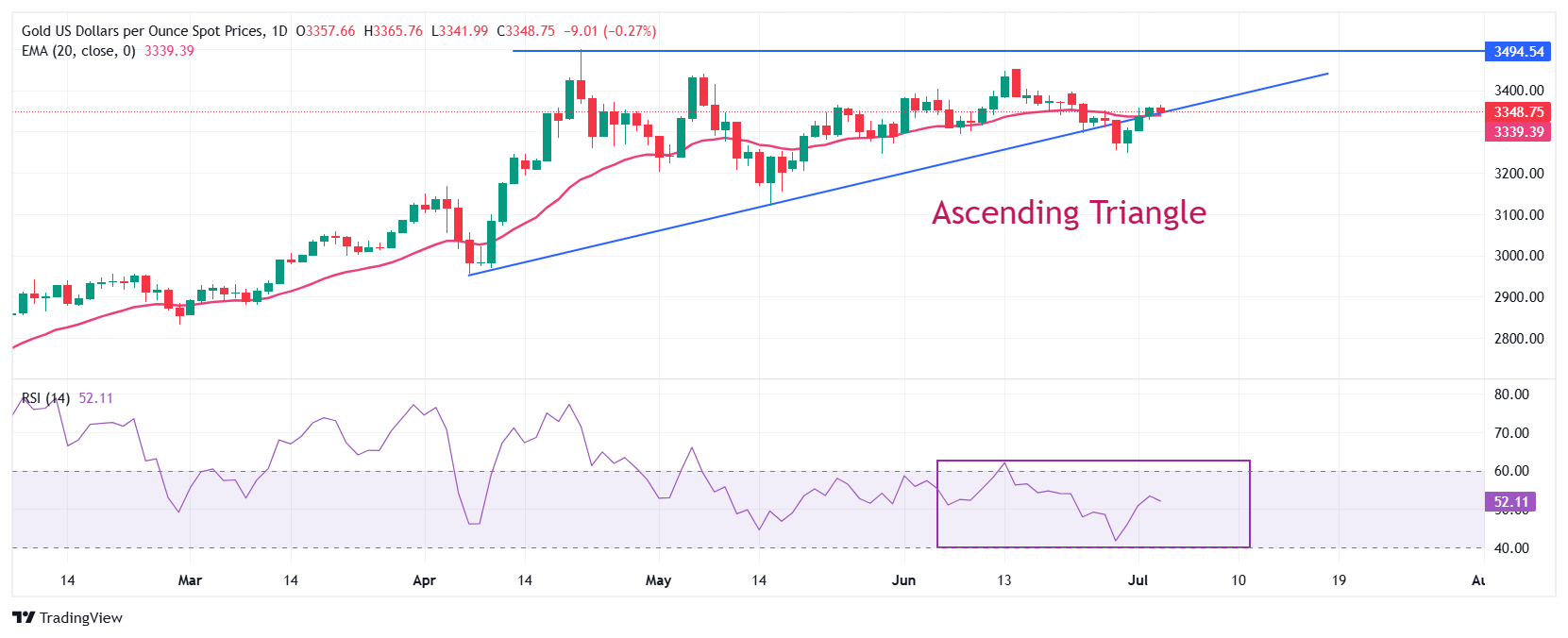
- Gold price strives to hold the Ascending Triangle formation on a daily timeframe.


Gold price (XAU/USD) holds onto gains near the weekly high around $3,365 during the European trading session on Thursday. The yellow metal trades firmly ahead of the United States (USD) Nonfarm Payrolls (NFP) data for June, which will be published at 12:30 GMT.
Investors will closely monitor the US NFP data as a few Federal Reserve (Fed) officials have expressed concerns regarding the labor market strength. Also, market experts believe that US business owners are reluctant for fresh hiring amid uncertainty surrounding the tariff policy imposed by President Donald Trump after his return to the White House.
The US NFP report is expected to show that the economy added 110K fresh workers, significantly lower than fewer than 139K in May. The Unemployment Rate is estimated to have accelerated to 4.3% from the prior reading of 4.2%.
Market participants are anticipating weak set of NFP numbers, following the ADP Employment Change data released on Wednesday, which showed that the private sector laid-off 33K employees in June, while they were expected to hire 95K fresh workers. Additionally, the May reading was also revised lower to 29K from 37K.
Soft US NFP data would prompt market expectations that the Fed will lower interest rates in the policy meeting later this month. Lower interest rates by the Fed bode well for non-yielding assets, such as Gold.
Meanwhile, investors are also awaiting clarity on trade negotiations between Washington and its trading partners as the tariff deadline is approaching, which is July 9.
Gold technical analysis
Gold price trades near the upward-sloping trendline of an Ascending Triangle formation on a daily timeframe, which is placed from the April 7 low of $2,957. The horizontal resistance of the above-mentioned chart pattern is plotted from the April 22 high around $3,500. Theoretically, a breakdown of the asset below the upward-sloping trendline results in a sharp downfall.
The precious metal trades wobbles near the 20-day Exponential Moving Average (EMA) around $3,342, suggesting that the near-term trend is uncertain.
The 14-day Relative Strength Index (RSI) oscillates inside the 40.00-60.00 range, indicating a sideways trend.
Looking up, the Gold price would enter in an unchartered territory after breaking above the psychological level of $3,500 decisively. Potential resistances would be $3,550 and $3,600.
Alternatively, a downside move by the Gold price below the May 29 low of $3,245 would drag it towards the round-level support of $3,200, followed by the May 15 low at $3,121.
Gold daily chart
(This story was corrected at 11:36 GMT to say in the fifth paragraph that Lower interest rates by the Fed bode well for non-yielding assets, such as Gold, not Silver.)
Gold FAQs
Gold has played a key role in human’s history as it has been widely used as a store of value and medium of exchange. Currently, apart from its shine and usage for jewelry, the precious metal is widely seen as a safe-haven asset, meaning that it is considered a good investment during turbulent times. Gold is also widely seen as a hedge against inflation and against depreciating currencies as it doesn’t rely on any specific issuer or government.
Central banks are the biggest Gold holders. In their aim to support their currencies in turbulent times, central banks tend to diversify their reserves and buy Gold to improve the perceived strength of the economy and the currency. High Gold reserves can be a source of trust for a country’s solvency. Central banks added 1,136 tonnes of Gold worth around $70 billion to their reserves in 2022, according to data from the World Gold Council. This is the highest yearly purchase since records began. Central banks from emerging economies such as China, India and Turkey are quickly increasing their Gold reserves.
Gold has an inverse correlation with the US Dollar and US Treasuries, which are both major reserve and safe-haven assets. When the Dollar depreciates, Gold tends to rise, enabling investors and central banks to diversify their assets in turbulent times. Gold is also inversely correlated with risk assets. A rally in the stock market tends to weaken Gold price, while sell-offs in riskier markets tend to favor the precious metal.
The price can move due to a wide range of factors. Geopolitical instability or fears of a deep recession can quickly make Gold price escalate due to its safe-haven status. As a yield-less asset, Gold tends to rise with lower interest rates, while higher cost of money usually weighs down on the yellow metal. Still, most moves depend on how the US Dollar (USD) behaves as the asset is priced in dollars (XAU/USD). A strong Dollar tends to keep the price of Gold controlled, whereas a weaker Dollar is likely to push Gold prices up.
Author
Sagar Dua
FXStreet
Sagar Dua is associated with the financial markets from his college days. Along with pursuing post-graduation in Commerce in 2014, he started his markets training with chart analysis.