Gold takes a breather ahead of the key Nonfarm Payroll (NFP) employment report on Thursday
- Gold price stalls ahead of Thursday's Nonfarm Payrolls (NFP) report for clues on the health of the US labour market.
- Fiscal concerns continue to rise as Trump's tax bill moves to the next stage. If passed, the budget deficit is expected to rise, which could boost demand for Gold.
- XAU/USD lingers below $3,350 as momentum indicators remain steady above neutral territory.

Gold (XAU/USD) price is trading in a tight range as traders digest Wednesday’s Automatic Data Processing (ADP) employment data and look ahead to Thursday's Nonfarm Payroll (NFP) report.
With XAU/USD hovering near $3,340 at the time of writing, US President Trump's tax bill and interest rate expectations continue to drive demand for bullion.
The ADP Employment Change report for June indicated that the private sector experienced a contraction in June.
Analysts had expected the June report to show that 95,000 jobs were added to the US private sector in May. Instead, a negative reading of 33K reflects potential weakness in the US labour market.
As a closely watched precursor to the Nonfarm Payrolls (NFP) report, the soft print has provided some support for Gold.
Nonfarm Payrolls on Thursday are expected to decrease to 110,000 in June from 139,000 in May. The Unemployment Rate is expected to rise to 4.3% from 4.2%. Increases in unemployment may raise expectations of interest rate cuts, which are supportive of non-yielding assets, such as Gold.
As the Fed remains committed to monitoring the incoming employment and inflation data before reducing interest rates, this job report may influence the potential trajectory for interest rates.
On Tuesday, Fed Chair Jerome Powell stated at the European Central Bank (ECB) Forum on Central Banking in Sintra that "It's going to depend on the data, and we are going meeting by meeting." "I wouldn't take any meeting off the table or put it directly on the table. It's going to depend on how the data evolves,” Powell added.
These comments suggest that the Fed is not rushing to cut rates, increasing the potential for a September interest rate cut.
Gold daily digest market movers: XAU/USD trades steady as the House of Representatives votes on Trump’s tax bill
- At the same time, the US President Donald Trump administration’s proposed “Big Beautiful Bill,” with its estimated $3.3 trillion impact on the deficit, passed the Senate.
- The House of Representatives is expected to vote on the bill on Wednesday. The Republican apathy is pushing to pass the bill by Friday, July 4.
- The bill has drawn fire from across the political spectrum, including from Elon Musk and several Democratic leaders, who warn it could lead to inflation and a weaker US Dollar (USD). Such a backdrop often prompts investors to turn to Gold as a hedge against instability and currency depreciation.
- The ISM Manufacturing Purchasing Manufacturing Index (PMI), released on Tuesday, rose to 49 in June, higher than the estimated 48.8.
- Additionally, the Job Opening Labour Survey (JOLTS) report released on Tuesday showed that 7.769 million vacancies in the US were available in the last day of May. This beat the estimate of 7.3 million.
- The ECB Forum on Central Banking continues in Sintra, Portugal. ECB President Christine Lagarde, Bank of Japan (BoJ) Governor Kazuo Ueda, Bank of England Governor Andrew Bailey, and Federal Reserve Chair Jerome Powell are discussing Central Banking policy.
- Inflation and interest rates have remained top priorities in discussions. Comments from the meeting may continue to drive interest rate expectations. Prospects of rate cuts could boost demand for non-yielding assets such as Gold.
- With a July 9 tariff deadline fast approaching, the US is focusing on smaller, step-by-step trade deals rather than sweeping agreements, aiming to avoid triggering new tariffs. While partial progress has been made with countries such as the UK and China, talks with Japan and the European Union remain unsettled. The EU has shown openness to a blanket 10% tariff but is pushing for exceptions in sensitive sectors such as semiconductors and pharmaceuticals.
Gold technical analysis: XAU/USD struggles to clear resistance at the 20-day SMA
Gold is trading near $3,340 at the time of writing, with the 20-day Simple Moving Average (SMA) providing resistance near $3,350.
The 23.6% Fibonacci retracement level of the April low to the April high move provides resistance at $3,371. A move higher and a break of wedge resistance could push XAU/USD to the $3,400 psychological level, opening the door for the June high of $3,452.
Gold (XAU/USD) daily chart
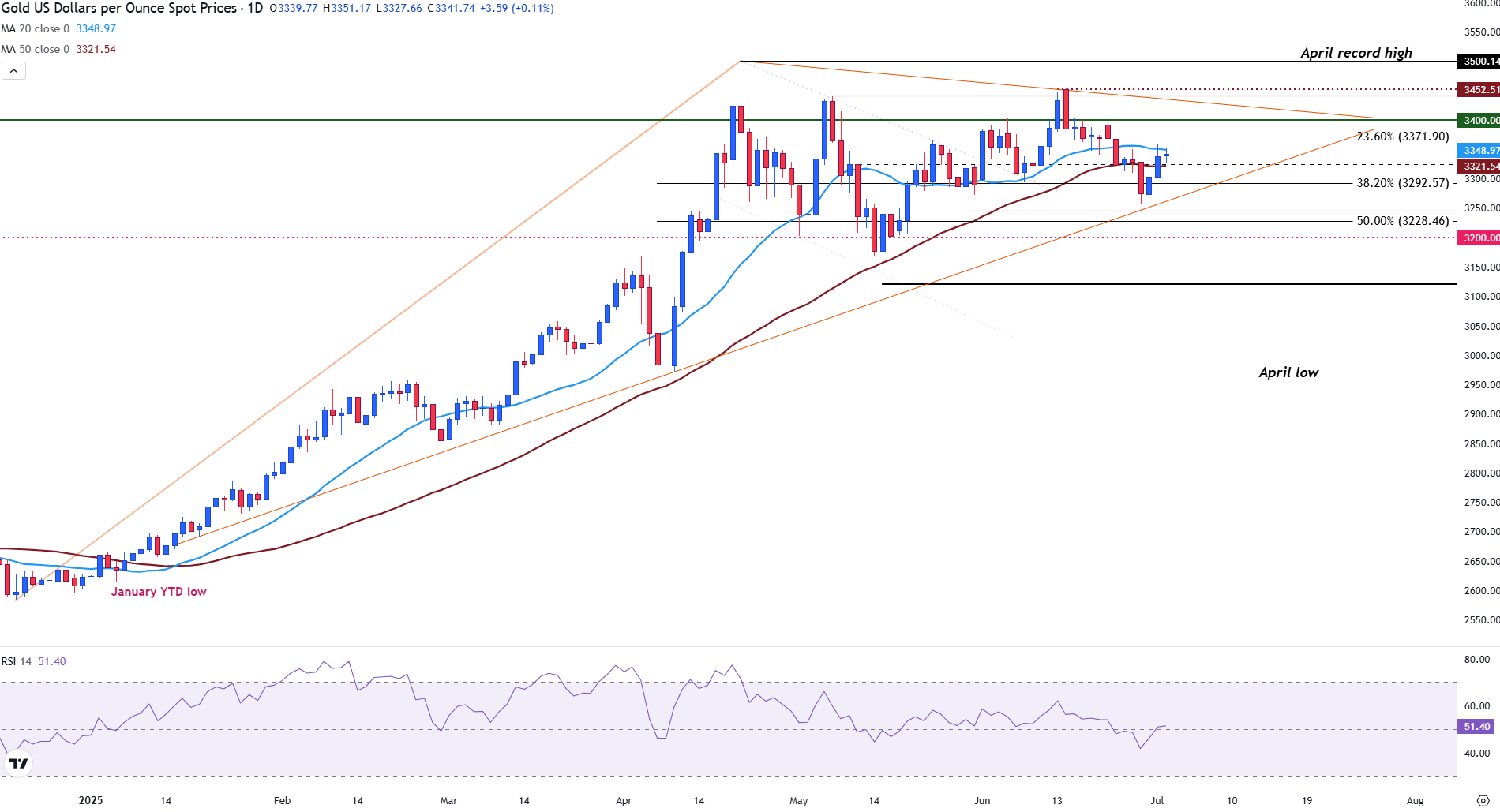
The Relative Strength Index (RSI) is nearing 52 at the time of writing, suggesting that momentum remains close to neutral levels.
On the downside, the 50-day SMA provides near-term support at $3,321. Below that is the round number of $3,300 and the 50% Fibonacci retracement of the April move at $3,229.
A move below could bring the May low of $3,120 mark into play.
Risk sentiment FAQs
In the world of financial jargon the two widely used terms “risk-on” and “risk off'' refer to the level of risk that investors are willing to stomach during the period referenced. In a “risk-on” market, investors are optimistic about the future and more willing to buy risky assets. In a “risk-off” market investors start to ‘play it safe’ because they are worried about the future, and therefore buy less risky assets that are more certain of bringing a return, even if it is relatively modest.
Typically, during periods of “risk-on”, stock markets will rise, most commodities – except Gold – will also gain in value, since they benefit from a positive growth outlook. The currencies of nations that are heavy commodity exporters strengthen because of increased demand, and Cryptocurrencies rise. In a “risk-off” market, Bonds go up – especially major government Bonds – Gold shines, and safe-haven currencies such as the Japanese Yen, Swiss Franc and US Dollar all benefit.
The Australian Dollar (AUD), the Canadian Dollar (CAD), the New Zealand Dollar (NZD) and minor FX like the Ruble (RUB) and the South African Rand (ZAR), all tend to rise in markets that are “risk-on”. This is because the economies of these currencies are heavily reliant on commodity exports for growth, and commodities tend to rise in price during risk-on periods. This is because investors foresee greater demand for raw materials in the future due to heightened economic activity.
The major currencies that tend to rise during periods of “risk-off” are the US Dollar (USD), the Japanese Yen (JPY) and the Swiss Franc (CHF). The US Dollar, because it is the world’s reserve currency, and because in times of crisis investors buy US government debt, which is seen as safe because the largest economy in the world is unlikely to default. The Yen, from increased demand for Japanese government bonds, because a high proportion are held by domestic investors who are unlikely to dump them – even in a crisis. The Swiss Franc, because strict Swiss banking laws offer investors enhanced capital protection.
Author

Tammy Da Costa, CFTe®
FXStreet
Tammy is an economist and market analyst with a deep passion for financial markets, particularly commodities and geopolitics.
















